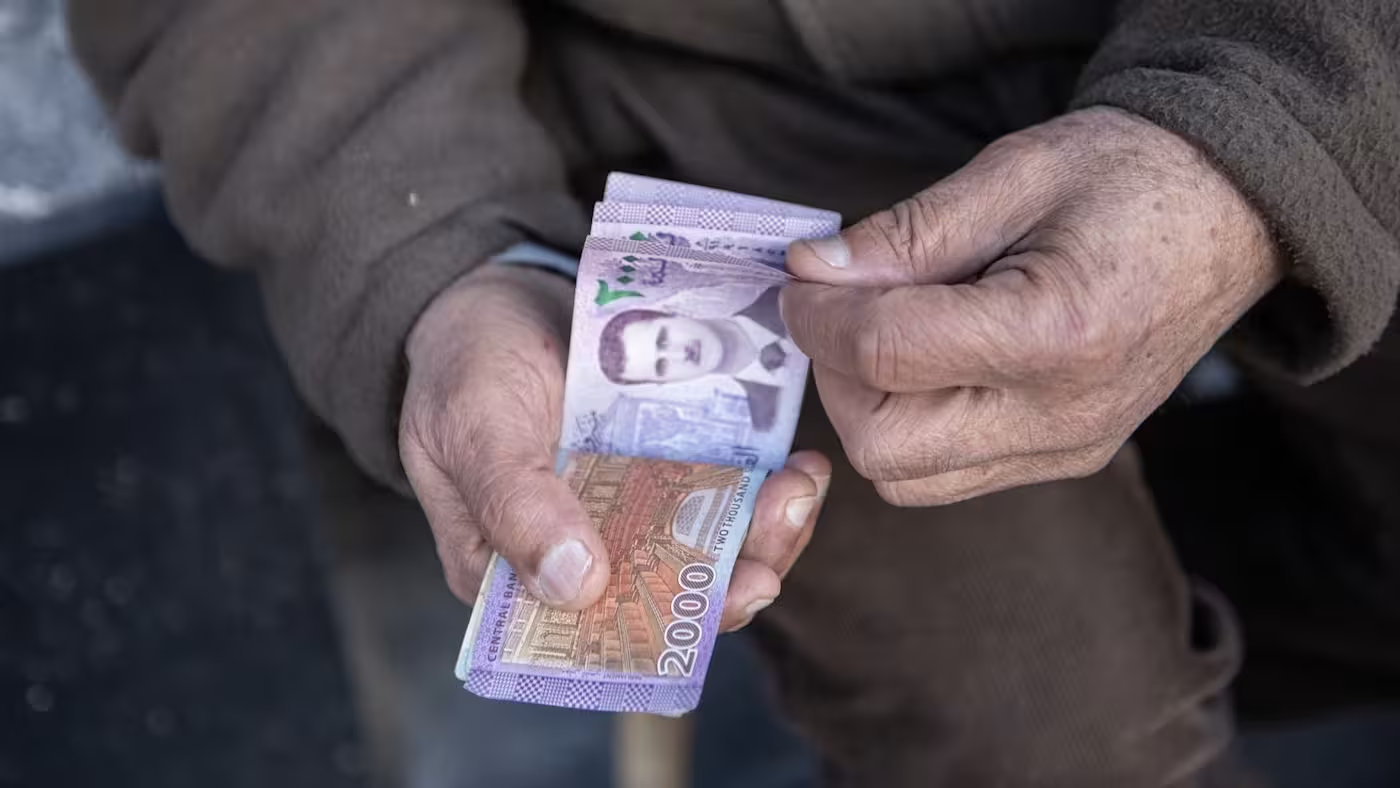
Syrian authorities have announced the replacement of banknotes bearing the image of ousted president Bashar al-Assad alongside a redenomination of the national currency—two zeros will be removed from the Syrian pound. The move is intended to restore confidence in a currency battered by war, sanctions, and corruption.
From January 1, Syria’s central bank will begin the redenomination, issuing new notes featuring Syrian flora—olives, roses, and mulberry trees. The old currency, which Syrians continued to use for more than a year after the fall of Assad’s regime, including a 2,000-pound note with the portrait of the long-serving dictator, will be gradually withdrawn from circulation. One new pound will be equivalent to 100 units of the old currency.
The Syrian pound has lost more than 99 percent of its value since 2011. As a result, the largest note in circulation—5,000 pounds—is worth just over 40 US cents, while large purchases in a cash-based economy require carrying bags and suitcases stuffed with banknotes. The authorities say the redenomination will simplify day-to-day transactions, ease accounting for banks and businesses, and make the currency more comprehensible and trustworthy to a population that has endured its precipitous collapse.
Central bank governor Abdulkader Husriyeh said at a press conference that the currency change would “raise confidence domestically and abroad,” stressing that it forms part of a broader strategy to shore up economic stability. President Ahmed al-Sharaa, speaking at the launch ceremony for the new currency, acknowledged that the measure would not halt inflation: “This decision…does not mean an improvement in the economy or the exchange rate in the country; it is solely about making transactions more convenient for society.”
Similar steps have previously been taken by Turkey, Venezuela, and Zimbabwe after bouts of hyperinflation; Iran has also discussed the possibility of redenomination in recent months. Ibrahim Kawshadji, an economist from Hama who attended the ceremony, pointed to a potential psychological effect: “The nominal value of money, goods, services, and wages changes. These enormous figures were exhausting people.”
The transition period will last three months, with the option of an extension. During this time, both currencies will circulate simultaneously, and sellers will be required to display prices in both formats. Banknotes from the Assad era will be gradually replaced with new ones. The decision also carries symbolic weight: notes associated with the former regime will be withdrawn from circulation, including the 1,000-pound bill bearing the portrait of Hafez al-Assad.
According to al-Sharaa, the choice of natural motifs reflects everyday life and the country’s geographic diversity: “It is an expression of a new national identity…and a departure from the practice of venerating individual personalities.” The authorities also hope to steer the population back toward using the national currency. Since the ban on foreign currencies was lifted, people have increasingly relied on dollars to avoid carrying sacks of cash.
Al-Sharaa’s government, which came to power in December 2024, is seeking backing from Western countries by pledging democratic procedures and economic reforms, but progress has remained limited. The authorities’ failure to curb sectarian violence and unify the country has eroded confidence in the administration.
Economist Samir Aita dismissed the initiative as “window dressing,” asking: “Why issue new banknotes today if there are no real economic reforms?” He argued that the current exchange rate is artificial and sustained solely through tight liquidity controls. At the same time, analysts note that if the redenomination is implemented successfully on a technical level, it could give the central bank greater control over the money supply and provide a baseline for assessing the true volume of cash in circulation.
Husriyeh himself also underscored the political subtext of the decision, declaring at the launch ceremony: “We need to break with the past.”