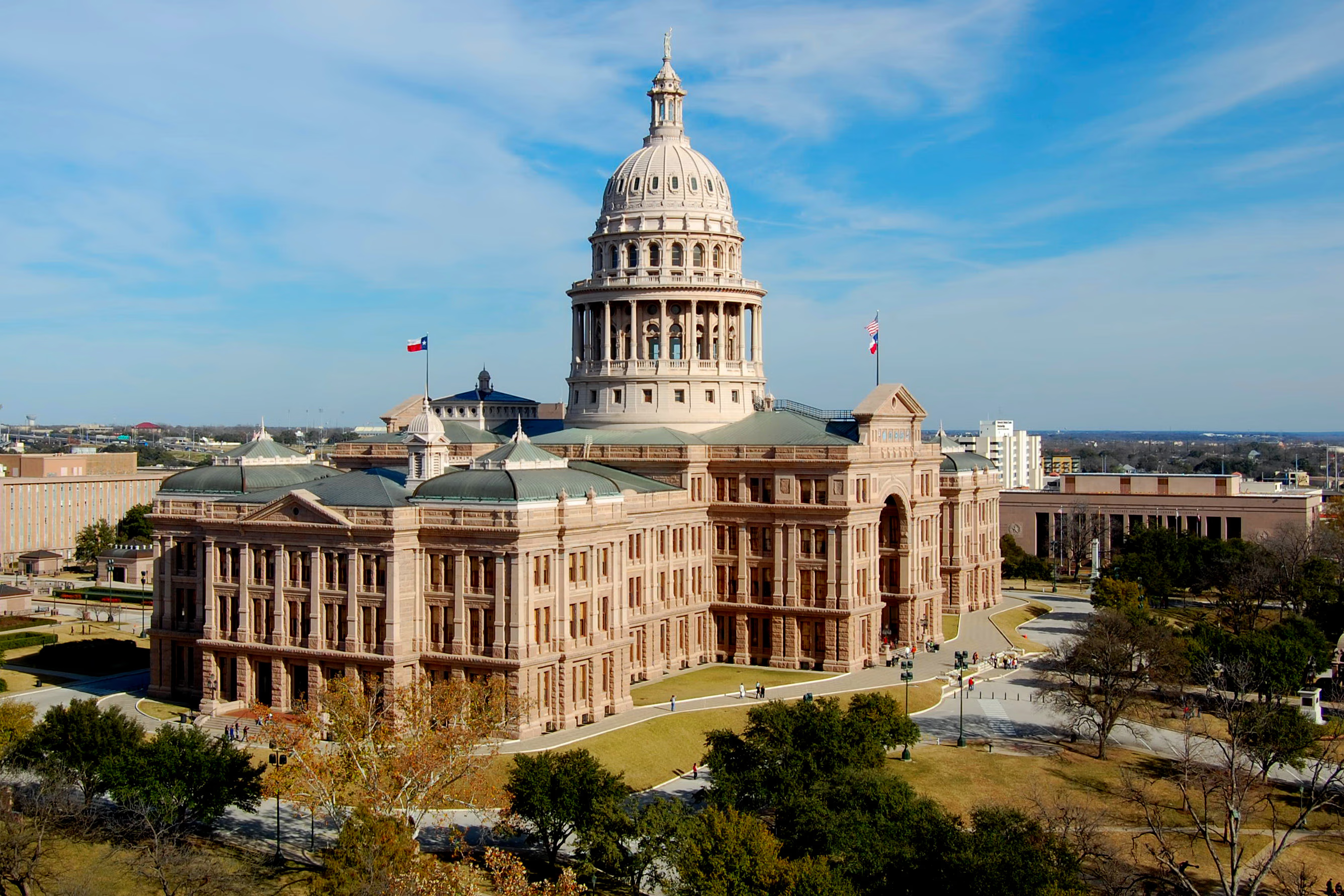
On December 4, the US Supreme Court suspended a federal court’s ruling and allowed Texas to use a new congressional map in the 2026 elections. A lower court had blocked the map in November after detecting signs of racial gerrymandering, but most justices concluded that intervening so close to the start of the electoral cycle would be inappropriate. The map—which could give Republicans as many as five additional seats in the House of Representatives—now takes effect, sharpening the political consequences for other states, where Democrats are debating whether to answer with redistricting of their own.
After the Supreme Court’s decision cleared the way for Republicans to use Texas’s new congressional map next year, Democrats have fewer avenues to advance redistricting efforts of their own. Democrats in Virginia signal they intend to redraw their district boundaries, but party members elsewhere oppose such moves, complicating the ambitions of those hoping to maximise additional seats ahead of the congressional elections.
The disagreements highlight the difficulty the party faces in crafting a response to Republicans, who are seeking to cement new maps in several states, including Indiana and Florida.
«Two wrongs do not make a right. They never have and never will», said Illinois state senator Willie Preston, who leads the Senate wing of the Illinois Legislative Black Caucus and has long opposed revisiting the state’s district boundaries.
Preston said he is prepared to review a new map provided it does not dilute the influence of Black voters. But overall, he argued, there is «no broad demand» in the state for redrawing the lines. «I do not think it makes sense to shift responsibility onto those who, like me, consider it vital to protect Black representation and see a mid-decade redistricting as a threat to it», added Preston, who is running for the state’s 2nd District.
On Thursday, December 5, the Supreme Court handed Republicans a significant advantage by allowing Texas to retain a newly approved congressional map for the House elections—one that could give the party as many as five additional seats in the upcoming contest.
Last month, a panel of federal judges had blocked the map from taking effect next year. After Texas Republicans appealed, Justice Samuel Alito suspended that ruling, temporarily reinstating the map while the Supreme Court considered the case.
Even before Thursday’s Supreme Court decision was announced, Democrats in Virginia had begun hinting at their own redistricting plans. «A 10–1 map is within the realm of possibility if it is done carefully and with respect for communities of interest, but we are going to study everything closely», Virginia House Speaker Don Scott said Wednesday in a conversation with Larry Sabato, director of the University of Virginia’s Center for Politics.
Another Virginia Democrat wrote on X that the party intends to respond in kind once the Supreme Court’s ruling is final.
«I’ve got something saved up for Texas…» Virginia Senate president L. Louise Lucas wrote on X. In another post, she joked: «Tonight I’ll follow back anyone who posts 10–1».
Yet even after the Supreme Court’s ruling, many Democrats remain unmoved. Preston, the Illinois state senator, continues to argue that Democrats in his state are unlikely to gain additional seats. He noted that the party might instead focus its efforts on New York, Maryland and Virginia.
Illinois also faces a purely procedural hurdle: the filing deadline for candidates passed on November 3. Even so, some Democrats stress that the question of redistricting is not definitively closed. John Maxson, spokesperson for Illinois House Speaker Emanuel Chris Welch, told The Hill by email that «all options remain on the table in Illinois».
In Maryland, Governor Wes Moore has signalled support for revising the map, but he faces firm resistance from Senate President Bill Ferguson. Following the 2020 census, the state attempted to adopt an aggressive 8–0 Democratic map, but in 2022 a court ruled it excessively partisan.
In a letter to Senate colleagues in October, Ferguson warned that the legal risks of mid-cycle redistricting were «too great» and that the «potential harm to Democrats is catastrophic», according to a copy of the document published by Maryland Matters.
Despite internal divisions, Democrats can point to several recent gains. California voters approved Proposition 50, championed by Governor Gavin Newsom, clearing the way for a new map that could give the party another five seats. In Utah, a judge rejected a GOP-leaning map and backed an alternative that creates a Democratic-favoured district—an unusual outcome in one of the most conservative states in the country.
Moreover, some analysts believe that even with the Texas ruling, Republicans may not secure major net gains. «Remember that even under the Supreme Court-approved Texas map, Republicans overall may see only a modest advantage from redistricting. Key uncertainties remain in Florida, Indiana, Louisiana and Virginia», Dave Wasserman of the nonpartisan Cook Political Report wrote on X.
Republicans themselves are also split. On Friday, the Indiana House approved a new map that turns all nine districts into Republican-leaning seats. But the map’s fate in the Senate remains unclear—some Republicans have already questioned its prospects.
Meanwhile, anxiety is rising among Democrats over the broader consequences of the current redistricting battles—for their party and for the country. Next year, the Supreme Court will hear a case on the Voting Rights Act and Louisiana’s congressional map, and the ruling could significantly narrow the scope for considering race when drawing district lines.
When the ruling will be issued remains unclear. If the court announces it early enough, several Republican-led Southern states could still redraw their district boundaries before the 2026 elections—a development that would deal a significant blow to Democrats.
Responding to Preston’s stance against remapping districts in Illinois, John Bisognano, president of the National Democratic Redistricting Committee, stressed that lawmakers must fully grasp the scale of the threat posed, in his view, by the Republican strategy. «Everyone needs to understand that we are in an existential moment and soberly assess the need to preserve the representative character of our democracy», Bisognano said, «and not allow the model Donald Trump is attempting to impose—one that would create a US House of Representatives answerable to a single party—to take hold».