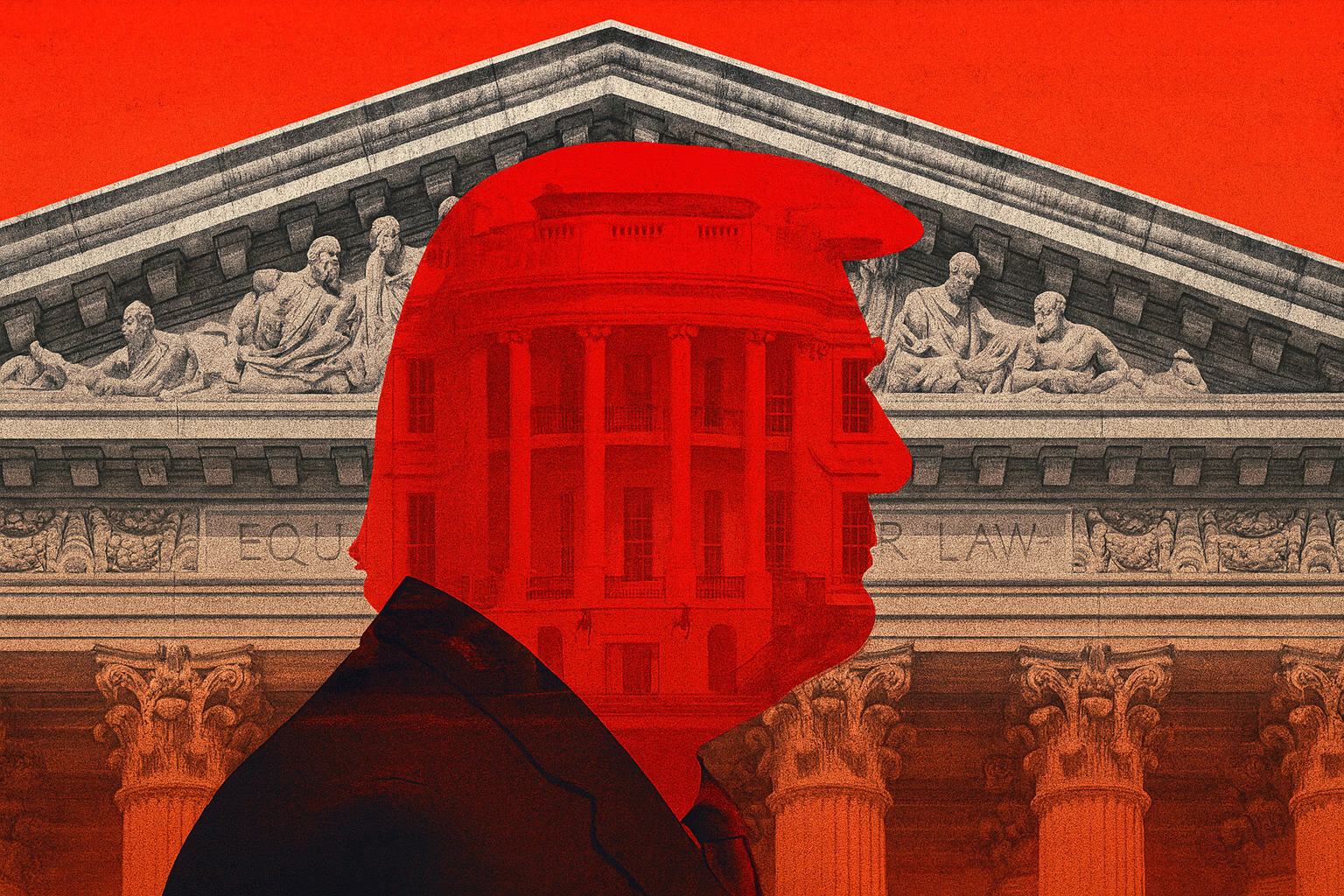
The Federal Trade Commission is one of the United States’ key independent regulators, overseeing antitrust enforcement and consumer protection. Its members have traditionally enjoyed safeguards against politically motivated dismissal, a measure designed to insulate the agency from the White House. Should the Supreme Court affirm the president’s authority to remove commissioners at will, Trump would gain the ability to swiftly reshape the leadership of the FTC and other independent bodies, effectively bringing them under executive control.
Based on Monday’s oral arguments, the Supreme Court appears inclined to endorse President Trump’s authority to dismiss members of the Federal Trade Commission.
Such a ruling could destabilize nearly a century of legal doctrine: if Trump prevails in Trump v. Slaughter, a 90-year-old framework shielding commissioners of independent agencies from politically driven removal would be placed at risk.
The case stems from Trump’s move earlier this year to remove Rebecca Slaughter and Alvaro Bedoya, Democrats serving on the FTC’s leadership team. The dispute turns on Humphrey’s Executor—a 1935 precedent holding that commissioners of independent regulators cannot be dismissed without specific cause.
The Court’s conservative majority appears unwilling to restrict a president’s power to replace agency heads. Justice Brett Kavanaugh observed: “Once presidential authority is taken away, it is exceedingly difficult to restore it through the legislative process.” Justice Amy Coney Barrett questioned the notion that such protections have existed since the nation’s founding. Chief Justice John Roberts noted that today’s FTC wields far broader powers than it did in 1935, weakening the force of the earlier precedent.
U.S. Solicitor General D. John Sauer argued that Humphrey’s Executor—partially eroded but never formally overturned—unconstitutionally constrains presidential authority. He described certain agencies as “headless” and as “second-rate legislative assemblies.”
The liberal justices, meanwhile, questioned the need to dismantle a long-standing framework and asked why the Court should assume that a president distrusts Congress in structuring the division of power among federal agencies. They contended that independent bodies have existed since the early years of the republic and are constituted under the same principles as the FTC. “You are asking us to dismantle the architecture of government,” Justice Sonia Sotomayor told Sauer. “Independent agencies have existed since the founding… This is not some modern invention.” Justice Elena Kagan added: “If you go down this road, it is hard to see where it stops,” warning that the “real-world consequences” of a Trump victory could lead to an excessive expansion of presidential power.
In the coming months, the Court is also set to consider arguments in a case involving Trump’s attempt to remove Lisa Cook from her post as a governor of the Federal Reserve—a dispute that may force the justices to decide whether the central bank’s unique status warrants a different approach to assessing presidential authority.
A ruling is expected by the end of June.