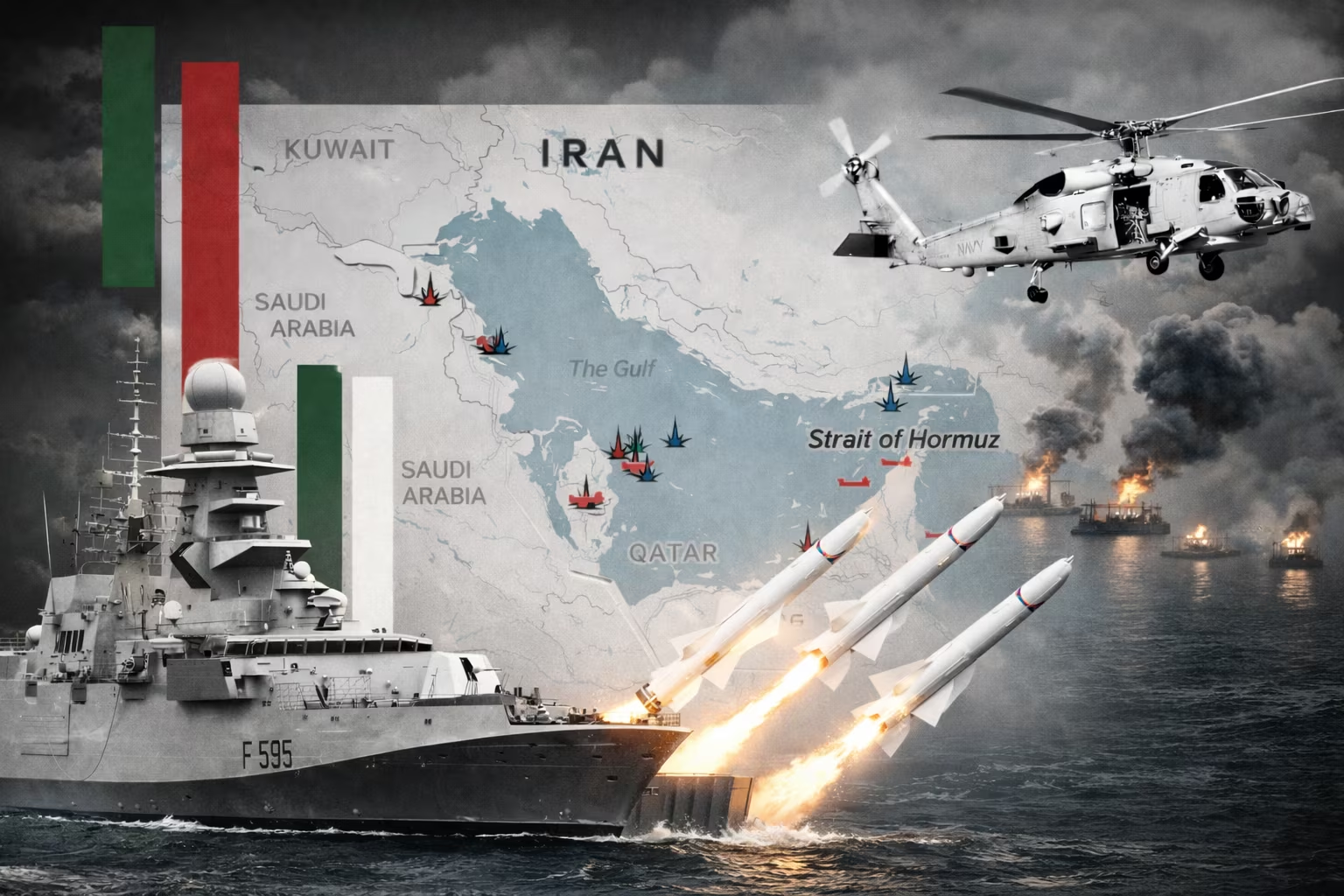
The term “tanker war” became associated with one of the episodes of the Iran–Iraq conflict of the 1980s. During that period, the two sides systematically struck commercial vessels in the Persian Gulf in an effort to undermine the foreign trade of their opponent and its allies. As a result of the attacks, more than 500 ships were damaged and over 400 civilian sailors were killed. The campaign threatened global oil supplies and ultimately compelled NATO countries to organize military convoys to escort commercial shipping through the waters of the Persian Gulf.
After the United States and Israel launched strikes on Iranian territory on February 28—and Tehran responded by attacking commercial vessels off its own coast—analysts and political figures began once again to warn of the risk of a new “tanker war.” By several indications, such a confrontation may already be taking shape, although its potential duration remains uncertain. Last time, the most intense phase of the Iran–Iraq “tanker war” lasted about four years. The likelihood of a similar scenario recurring is discussed by the Financial Times.
Against the backdrop of escalating tensions between the United States and Iran, analysts have long warned that in the event of a direct confrontation Tehran could attempt to block the Strait of Hormuz—a critical maritime corridor linking the Persian Gulf with the Gulf of Oman and, beyond it, the open ocean. This passage is widely regarded as vital to the global energy system: nearly 35% of the world’s seaborne crude oil trade and about 20% of global shipments of liquefied natural gas pass through it.
When the United States and Israel began striking Iran on February 28, the Islamic Revolutionary Guard Corps—the principal coercive arm of the Iranian state—warned that it would target vessels transiting the Strait of Hormuz. In the days that followed, at least eight tankers were hit, and at least two people were killed. Shipping through the strait nearly came to a halt, while global oil and gas prices moved higher. In Washington, officials acknowledged that the United States might again resort to military convoys to protect commercial shipping—much as it did in the 1980s.
However, military experts told the Financial Times that the destroyers and fighter aircraft needed to escort commercial vessels may not be available in the near term, as they are currently engaged in operations against Iran. Joshua Tallis, an American analyst specializing in maritime security and naval strategy, considers it unlikely that the U.S. Navy will be able to provide protection for commercial shipping “over the next seven to ten days.” According to him, such capabilities will only emerge after more of Iran’s anti-ship defense systems have been destroyed.
Mark Montgomery, a former commander of a U.S. Navy carrier strike group, believes that an operation to escort tankers would be “difficult, but feasible.” Organizing it will take time—“up to two weeks before conditions become favorable”—and it would inevitably reduce the role of the American fleet in strikes against Iran. U.S. forces are currently actively targeting, among other things, Iran’s navy. According to the U.S. Central Command, at least 17 vessels have been sunk since February 28.
John Miller, the former commander of the U.S. Fifth Fleet responsible for operations in the Middle East, notes that the United States has enough ships in the region to organize military convoys. However, these forces would have to confront a wide range of threats—Iranian anti-ship missiles, submarines, fast attack boats, naval mines and drones. Particularly dangerous could be the use of unmanned surface vessels. They strike a ship’s hull at the waterline, flooding the engine room, explained Martin Kelly, a maritime analytics specialist at the EOS Risk Group.
According to Jim Lamson, a former CIA analyst, Iran possesses thousands of anti-ship missiles and hundreds of launchers. The country also operates a small fleet of Russian submarines and an unspecified number of North Korean mini-submarines. Iran additionally holds one of the world’s largest stockpiles of naval mines. So far, they have not been used in the current conflict. Yet even credible reports of possible mining in the Strait of Hormuz could sharply drive up the cost of maritime insurance and tanker freight rates—fees that have already increased four to twelvefold since February 28.
On the one hand, destabilization of global shipping and energy markets works to Iran’s advantage. It is widely assumed that Tehran hopes economic and diplomatic pressure will eventually force the United States and Israel to halt their military campaign. Under this logic, the countries of the Persian Gulf—many of which depend heavily, and in some cases decisively, on the Strait of Hormuz for exporting their energy resources—would push Washington to bring the war to an end.
On the other hand, a prolonged blockade of the strait would also deal a serious blow to Iran itself. Nearly all Iranian oil is exported to China and almost entirely passes through the same Strait of Hormuz. “The Iranians say, ‘If we cannot sell our oil, then no one can.’ But the reverse is also true—if no one can sell oil, then neither can Iran. They cannot sustain such a loss of economic benefit indefinitely,” John Miller noted.
Thus, a prolonged blockade of the Strait of Hormuz serves neither Iran’s interests nor those of its adversaries. Yet this paradox hardly means the strait will reopen quickly. As the conflict drags on, the likelihood grows that the United States and Iran “will deploy more powerful energy levers to force an outcome in their favor,” Clayton Seigle, an energy security analyst at the Washington-based Center for Strategic and International Studies, told the Financial Times.