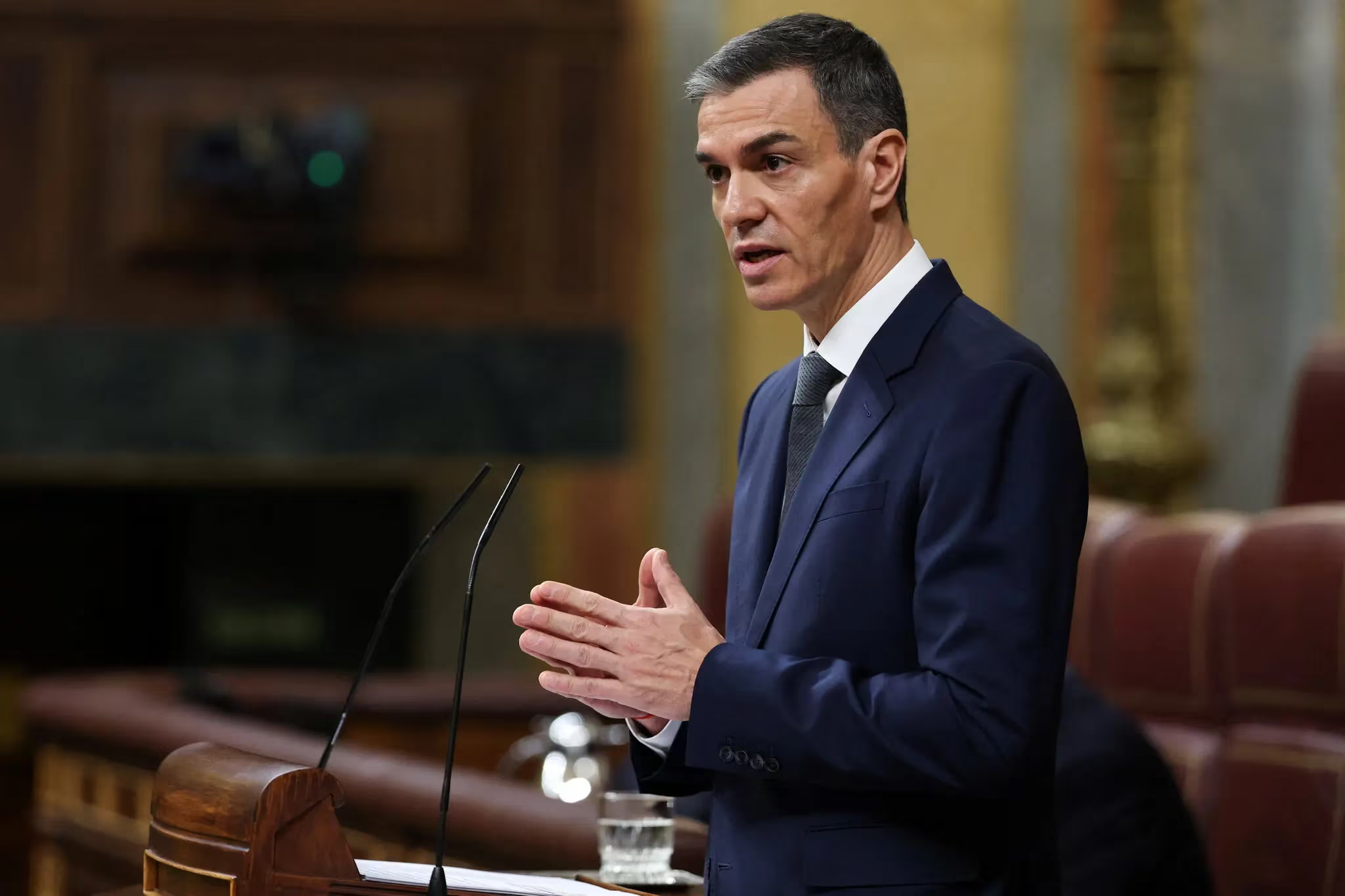
For more than a year, Spanish Prime Minister Pedro Sánchez has sought to establish himself as Europe’s leading voice of left-wing resistance to President Trump.
When Trump intensified deportations, Sánchez offered undocumented migrants a pathway to legal status. When the American president defended U.S. technology giants, the Spanish prime minister pushed instead for new restrictions against them. And last weekend, Sánchez refused to allow Spain to serve as a staging ground for American military aircraft heading to strike Iran—prompting Trump to threaten to halt trade with Spain.
On Wednesday, March 4, the standoff moved into the open. Sánchez delivered a special address to the nation, condemning the campaign against Iran and reaffirming Spain’s refusal to take part, despite threats of economic measures from Trump.
“We are not going to become accomplices to something that harms peace simply out of fear of someone else’s reprisals,” Sánchez said in a televised address. “It is not even clear what the objectives are of those who launched the first strike,” he added, referring to the United States and Israel.
Sánchez’s address from the Moncloa Palace in Madrid intensified the clash between Trump and his most outspoken European critic. The Spanish prime minister has consistently pursued a course distinct from that of the leaders of the United Kingdom, France, and Germany, who in a joint statement pledged to support defensive actions against Iran.
The speech came less than a day after an impromptu briefing by Trump in the Oval Office, where he threatened to inflict economic damage on Spain and dismissed Spanish restrictions on the use of local bases by American aircraft.
“We can use that base if we want,” Trump said. “We can just fly in and use it.”
This clash has become another example of how Sánchez, facing political difficulties at home, seeks to underscore the distance between his policies and Trump’s course.
Sánchez has described Trump’s trade tariffs as “unfounded and unfair.” He characterized the American president’s plans to relocate Palestinians from the Gaza Strip as “immoral,” and described Israel’s actions in Gaza as “genocide.”
Spain alone among NATO members rejected Trump’s demand to raise defense spending to 5 percent of the budget. Sánchez called the idea “incompatible with our worldview.” In July he also aligned himself with some of Trump’s most prominent critics, including Brazil’s president Luiz Inácio Lula da Silva, and pledged to confront “oligarchs and the far right.”

Damage in Tehran.
Sánchez has also implicitly criticized Trump’s hard-line migration policy. In a February essay for The New York Times, he wrote: “Some leaders have chosen to hunt down migrants and deport them through operations that are both unlawful and cruel.” He described the seizure of Venezuelan president Nicolás Maduro by American forces as a “terrible precedent” that encourages the “law of the jungle.”
For Sánchez, Trump has become not only an ideological adversary but also a convenient political target as domestic pressures mount.
Opinion polls show that more than half of Spaniards view Sánchez unfavorably. His government controls less than half the seats in parliament, has been unable to pass a budget for several years, is suffering defeats in regional elections, and is grappling with corruption scandals. In such circumstances, said the Spanish political analyst Pablo Simón, the prime minister has increasingly turned to foreign policy “to gain political leverage within Spain.”
Trump’s sharp reaction to the restrictions on American military aviation, and the international attention surrounding the episode, was “exactly what Sánchez wanted,” said Ramón González Férriz, a writer and columnist for the Spanish outlet El Confidencial. “He has long sought an open confrontation with Donald Trump,” he noted, adding that the American president is deeply unpopular in Spain.
At the same time, this stance has made Sánchez a prominent figure for the global left. The Italian left-wing magazine L’Espresso named him its person of the year for 2025, while the British publication New Statesman described the Spanish prime minister as a “left-wing icon.”
Spain’s left has traditionally maintained a complicated relationship with the United States. In 1986, a significant share of it opposed the country’s entry into NATO. In 2004, Prime Minister José Luis Rodríguez Zapatero became a hero to the left when he withdrew Spanish troops from Iraq. According to González Férriz, Spain’s left has a long-standing tradition of demonstrating that it “will not be vassals of America.”
For Sánchez, who has been in power since 2018, this display of independence also carries pragmatic value. An anti-Trump stance allows his Socialist Party to reinforce its electoral base while at the same time containing pressure from more radical left-wing forces.
Yet such a strategy also carries political risks. Some analysts are asking whether a hard confrontation with Trump—especially amid new threats directed at Spain—could ultimately produce tangible economic consequences.
This stance has also left Sánchez vulnerable to criticism from the right-wing opposition. This week its representatives said the prime minister was sacrificing Spain’s international reputation for domestic political gain. “In trying to win a few votes at home,” said the leader of the Popular Party, Alberto Núñez Feijóo, “we cannot put our security at risk.”
A similar assessment came from Israel’s foreign minister, Gideon Saar, who questioned whether Sánchez was “on the right side of history.”