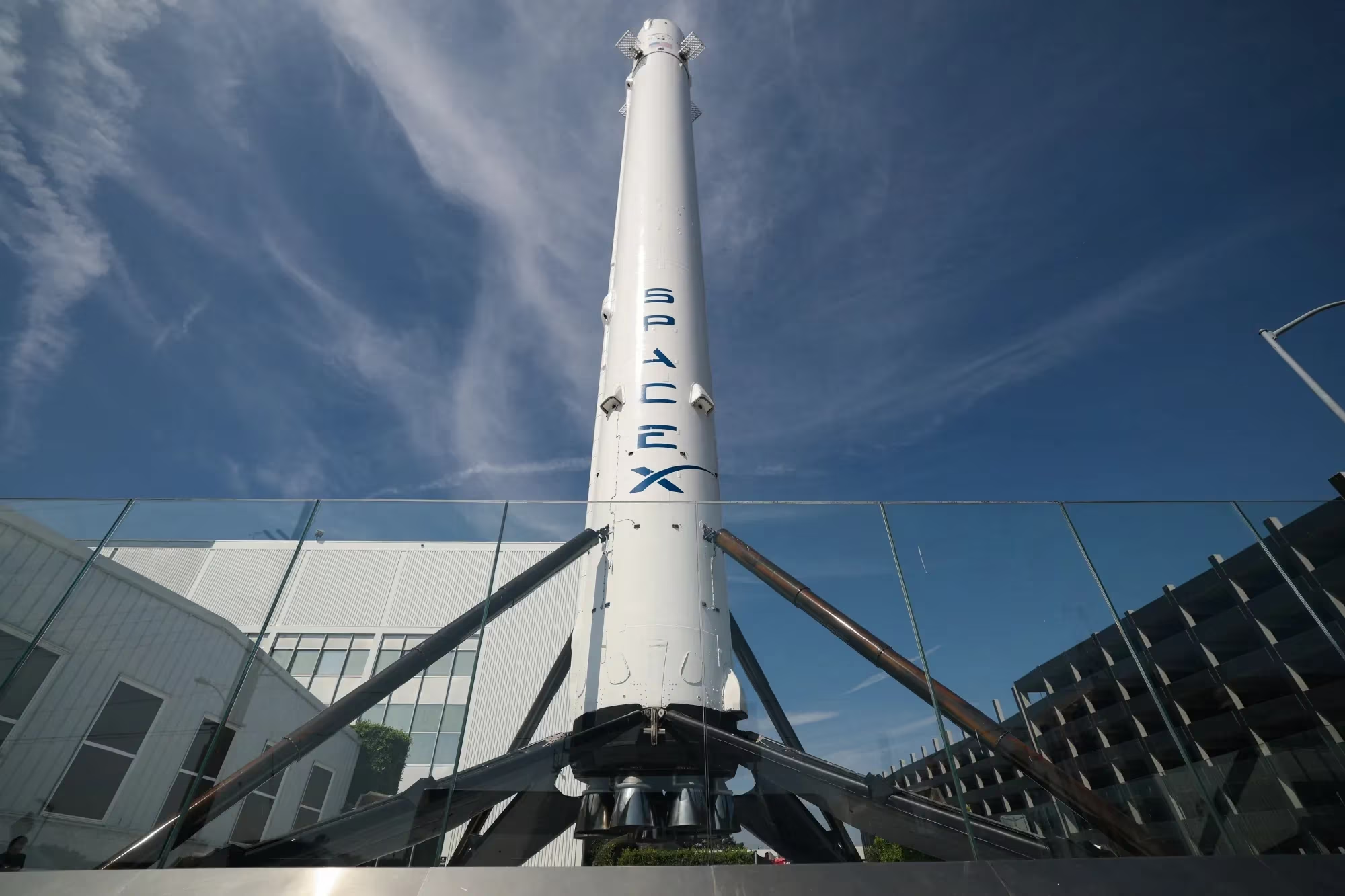
SpaceX has carried out the largest initial public offering in history. The company, formally registered as Space Exploration Technologies Corp., sold 555.6 million shares at $135 apiece, according to a statement on its website. The offering raised about $75 billion—more than twice the $29.4 billion raised by Saudi Aramco in 2019.
At the offering price, SpaceX’s market value reaches $1.77 trillion, while its fully diluted valuation, including employee options and restricted stock, is about $1.8 trillion. That puts the company among the world’s 10 largest publicly traded firms—making it worth more even than Tesla, Elon Musk’s other company. Musk himself moved within reach of becoming the world’s first trillionaire after the listing.
Retail investors—Musk’s fans—played a central role in the deal. According to people familiar with the situation, they placed orders worth more than $100 billion, even though only one-fifth of the shares had been reserved for them. Demand from passive funds may also rise: rule changes could speed the stock’s inclusion in indexes such as the Nasdaq-100.
SpaceX’s valuation has risen rapidly. Its acquisition of xAI, also owned by Musk, in February lifted the private valuation of the combined entity to $1.25 trillion and SpaceX itself to $1 trillion. In December, during an insider share sale, the company was valued at about $800 billion—twice as much as in July 2025.
Behind that growth is SpaceX’s transformation in six months from a company focused on rocket launches and satellite internet into a contender for leadership in artificial intelligence. Contracts to provide computing infrastructure to Anthropic and Google worth up to $2.17 billion a month are expected to become its main source of revenue.
The IPO took place amid feverish demand for AI-linked stocks. Despite a sharp sell-off in recent sessions, the Nasdaq-100 is up 15.45% since the start of the year, while the Philadelphia semiconductor index has gained 81.84% amid the scramble for physical infrastructure. Even accelerating inflation and the economic fallout from the war in Iran have not stopped U.S. indexes from rising to record highs.
SpaceX is the first of three major listings expected to take advantage of this demand. Anthropic and OpenAI, its rivals in AI, could go public as soon as this year at valuations above $1 trillion each. Together with Alphabet’s $85 billion follow-on offering, this wave of new public capital has prompted debate over whether there will be enough investor demand in the market. “This is an important event as a kind of bellwether for Anthropic and OpenAI,” said Anthony Saglimbene, chief market strategist at Ameriprise. “When I look at all three companies and the amount of capital they are raising, it tells me demand for AI remains very strong despite increased volatility.”
Skeptics point out that the company has yet to show a profit, and that a significant part of its plan to capture the AI market, which SpaceX itself values at $26.5 trillion, rests on technologies that either do not exist or have not been proven at scale. Grok, the chatbot it acquired along with xAI, lags behind Anthropic’s and OpenAI’s products in adoption among consumers and corporate clients. Prominent short-seller James Chanos called the listing an “IPO of hopes and dreams,” driven by enthusiasm around Musk and artificial intelligence rather than fundamentals. “The total addressable market for space is infinite,” the founder of Chanos & Co. said at the iConnections Global Alts conference in New York. “You can invent any stories—colonies on Mars, factories on the Moon, data centers in space—to justify the valuation.”
Even skeptics acknowledge, however, that Musk has built Tesla and SpaceX into giants and made money for investors—including through a loyal base of retail shareholders. “This is probably the most optimistic IPO,” said Kim Forrest, chief investment officer at Bokeh Capital Partners, who does not herself buy shares in listings. “SpaceX buyers want to be part of the future. And I think that is strangely reassuring at a moment when we are lurching between the poles of greed and fear.”