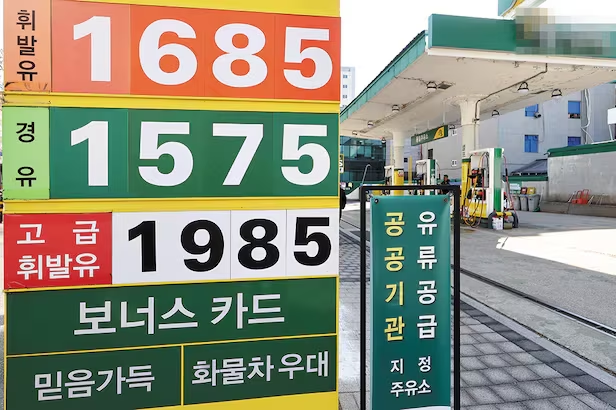
South Korean President Lee Jae-myung urged citizens to “save every drop of fuel,” sharpening the government’s official push for energy conservation as the deepening conflict over Iran takes a painful toll on the country’s import-dependent economy and adds to the pressure on households and businesses.
Speaking in parliament on Thursday, Lee hardened earlier calls for restraint in fuel consumption, underscoring rising concern within the government as it tries to contain the economic fallout from surging energy prices and prolonged supply disruptions. He said the Middle East crisis had become one of the gravest threats to energy security in decades.
“I sincerely urge all citizens to take an active part in everyday energy-saving practices—to use public transport and conserve electricity,” Lee said. “The current crisis is not a brief shower that passes quickly, but a major storm of uncertain duration, which makes it all the more severe.”
The remarks came as the government proposed a supplementary budget of 26.2 trillion won ($17 billion), aimed at softening the blow from rising fuel prices, supporting vulnerable households and stabilizing supply chains. The package was a response to a sharp jump in oil prices—Brent rose by more than 40% in March.
The authorities have already resorted to unprecedented measures—for the first time in nearly three decades, a cap on fuel prices has been introduced, while tax relief has been expanded to ease the burden on households and companies. At the same time, efforts have intensified to secure alternative energy sources and manage key resources, including naphtha and urea, both critical to industry.
More than 10 trillion won from the supplementary budget will be allocated to offset high energy costs, including subsidies and direct support for households. The remaining funds will go toward helping small businesses, young workers and industries under pressure from rising logistics and production costs. A vote on the package is expected by April 10.
Lee presented the budget measures not only as a crisis-response tool, but also as part of a broader policy shift—the government intends to accelerate investment in renewable energy and strengthen supply-chain resilience to reduce dependence on external shocks.
Economists say the stimulus could support growth in the short term, but warn of inflation risks as higher energy prices filter through the broader economy. The authorities are trying to limit pressure on markets by financing the package mainly through above-target tax revenues rather than through new bond issuance.
At a meeting of financial authorities on Thursday—with the finance minister and the governor of the Bank of Korea in attendance—it was said that the additional spending could lift growth by about 0.2 percentage points and have only a limited effect on inflation, given the negative GDP gap and the focus of the measures on supporting vulnerable sectors.
“If we save every drop of fuel, avoid wasting even a single plastic bag, and show mutual respect and collective resolve, we will be able to emerge from this crisis tunnel safely and quickly,” Lee said