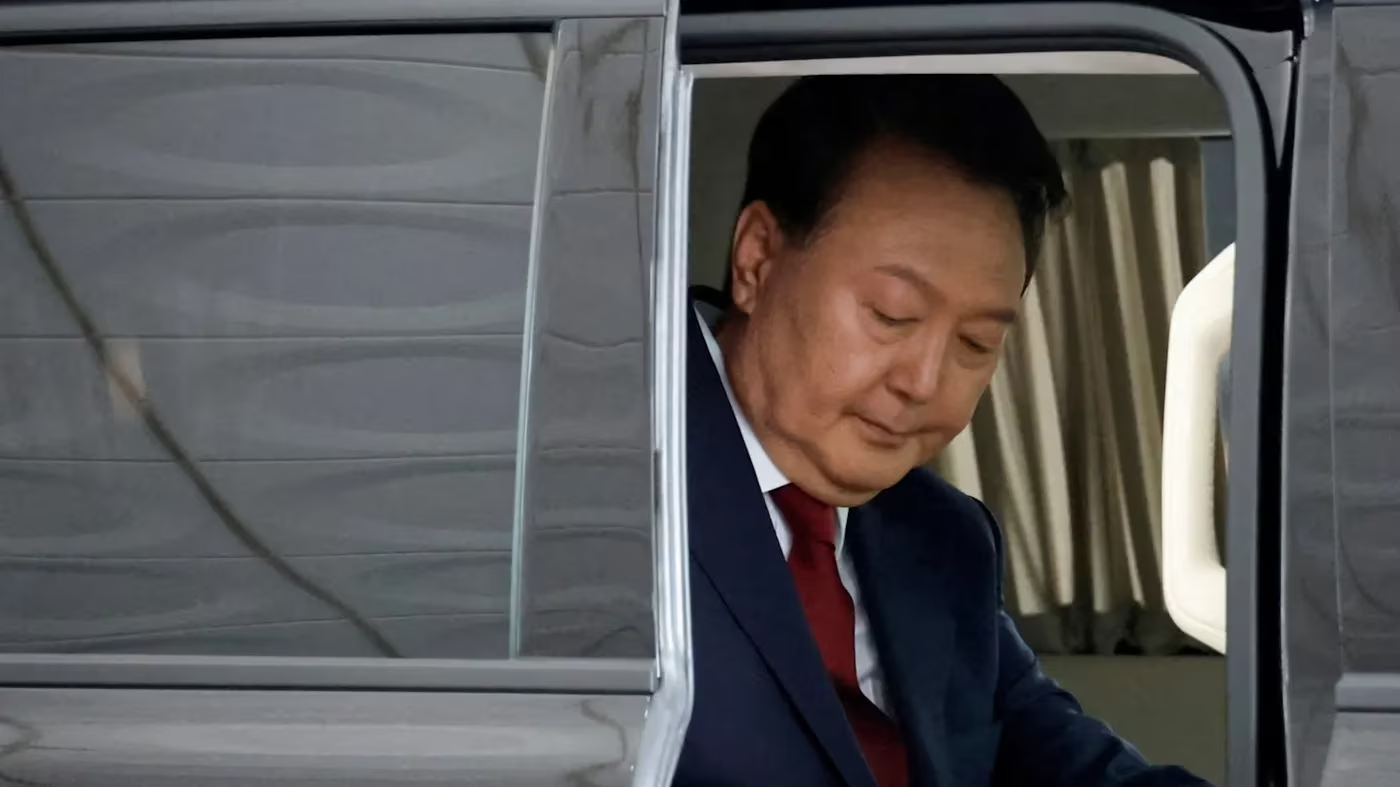
Former South Korean president Yoon Suk Yeol has been sentenced to life imprisonment over an insurrection case linked to his failed attempt to impose martial law, a move that plunged the country into a political crisis.
A panel of three judges at the Seoul Central District Court on Thursday found Yoon guilty of leading an insurrection in late 2024 aimed at undermining the constitutional order. Judge Ji Gwi Yeong said that “Yoon’s actions, which were inciteful in nature, fundamentally eroded the core values of democracy.” Yoon, who is now 65, had also faced the possibility of the death penalty.
The insurrection ruling marked the second—and most consequential—in a series of court decisions against the former president following his sudden declaration of martial law. Last month, he was sentenced to five years in prison in a related case involving obstruction of justice, abuse of power, and the falsification of official documents.
The verdict drew a line under a dramatic chain of events that became South Korea’s most severe political crisis in decades and a major test for its 39-year-old democracy. At 11:00 p.m. on December 3, 2024, Yoon addressed the nation on television, claiming that “anti-state” forces aligned with North Korea were attempting to seize control of the country, and announced emergency rule to “protect the free and constitutional order.”
The ruling triggered mass protests. Lawmakers, climbing over barricades, broke into the National Assembly building and held an emergency vote to overturn the decree imposing martial law. Under mounting pressure, Yoon rescinded the order roughly six hours after it was issued. Ten days later, parliament impeached him, and last year the Constitutional Court formally removed him from office.
The court ruling said that Yoon had deployed troops to the National Assembly to obstruct lawmakers’ work and detain political opponents. The judges noted that “the declaration of emergency martial law and the subsequent actions of the military and police severely undermined the political neutrality of the security forces, damaged South Korea’s international reputation, and led to extreme political polarization.”
The judges said Yoon had been driven by a sense of crisis stemming from an opposition-controlled parliament that systematically blocked his legislative initiatives. They rejected, however, the prosecution’s claim that the emergency measures were part of a year-long plan to establish a dictatorship. The court also noted Yoon’s lack of remorse.
Yoon has the right to appeal the verdict, and his lawyers have already criticized the ruling. South Korea’s judicial system allows for up to three levels of review in criminal cases, including a final hearing by the Supreme Court on matters of legal interpretation.
As part of the investigation into the crisis, other senior officials also received prison sentences. Former defense minister Kim Yong Hyun on Thursday was sentenced to 30 years in prison for his role in the insurrection. Ex-prime minister Han Duck Soo, who served as acting president after Yoon’s impeachment, had earlier been handed a 23-year sentence for facilitating the introduction of emergency measures.
In December, an independent prosecutor cleared Yoon’s wife, Kim Keon Hee, of charges related to the martial law episode, but last month she was sentenced to 20 months in prison in a separate corruption case.
According to a January poll, about 58 percent of South Koreans supported a death sentence for Yoon. The country, however, has not carried out an execution since 1997.
Chang Young Soo, a professor of constitutional law at Korea University, said that “it is difficult to regard Yoon’s unconstitutional declaration of martial law as a more serious crime than the military coup carried out by former president Chun Doo Hwan,” referring to the general who seized power in December 1979 and later ordered the mass killing of civilians in the southwestern city of Gwangju. Chun was sentenced to death in 1996, but the punishment was commuted to life imprisonment, and the following year he was released under a presidential pardon.
Yoon’s conviction fits a longstanding pattern in South Korean politics, in which few former presidents have avoided criminal prosecution after leaving office. Lee Myung-bak, who led the country from 2008–2013, was convicted of bribery, embezzlement, and abuse of power. His successor, Park Geun-hye, who governed from 2013–2017, was also sentenced for abuse of authority and coercion. Roh Moo-hyun, who came under investigative pressure over bribery allegations involving members of his family, took his own life in 2009.
Both Park and Lee were later granted presidential pardons, with the latter pardoned by Yoon himself. According to Chang, this pattern of “extreme factional conflict” is compounded by a “winner-takes-all” system in which the president wields sweeping powers but is limited to a single term.
The ruling Democratic Party of President Lee Jae-myung is advancing an amendment that would ban pardons and sentence reductions for those convicted of insurrection. During his attempt to impose martial law, Yoon ordered the arrest of Lee himself, as well as senior figures from the Democratic Party and his own People Power Party.