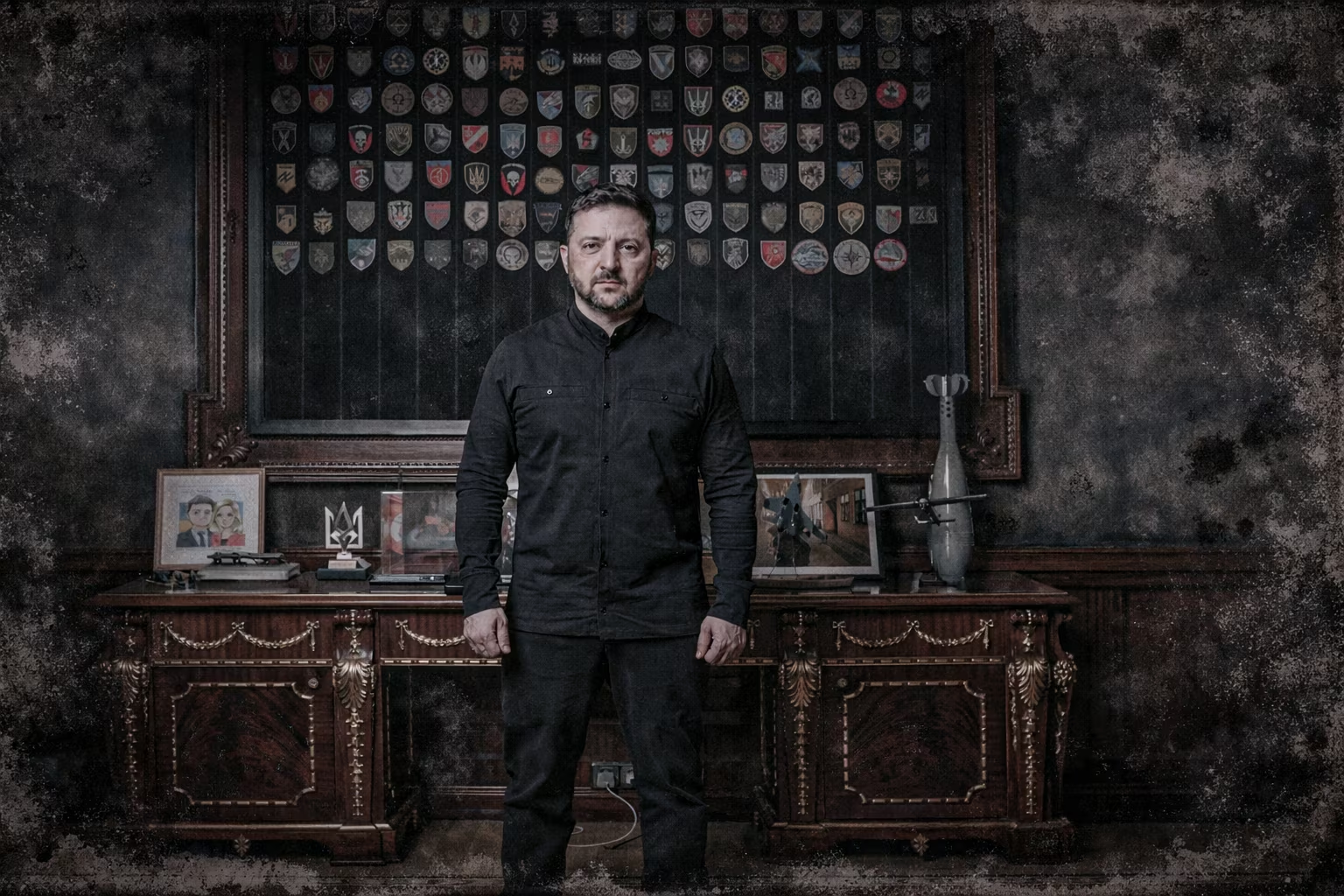
The Atlantic has published an article by journalist Simon Shuster examining the current state of the war and the political calculations surrounding potential negotiations. The piece подробно lays out Ukraine’s mounting exhaustion, the logic of a war of attrition, and the constraints confronting Kyiv as the conflict drags on. Against this backdrop, the author identifies a growing gap between President Volodymyr Zelensky’s public rhetoric and how the situation is assessed by his inner circle, Western allies, and participants in the negotiating process.
The article clearly traces the tension between Volodymyr Zelensky’s public messaging and the assessments of the author—journalist Simon Shuster, who has long been closely familiar with the Ukrainian president and his entourage.
This is most evident in the military sphere. Zelensky insists that “Ukraine is not losing,” yet Shuster writes bluntly that “the arithmetic of attrition is not on Ukraine’s side”—a reality well understood in the West. To underscore the point, he cites a NATO general: “If anyone is waiting for Russia to simply give up and go home, they will be waiting a long time.”
Expanding on the theme of exhaustion, the author describes Kyiv’s plans to drive Russian military losses to 50,000 troops per month in order to exceed Moscow’s capacity to replenish its forces. But the very articulation of such a goal, Shuster emphasizes, indirectly suggests that Russia has so far been managing to replace its losses. He notes that with a population more than three times that of Ukraine’s and a nominal GDP roughly ten times larger, Russia is objectively better positioned to absorb losses—both human and economic.
The second line of divergence concerns negotiations. Zelensky is counting on Donald Trump’s interest in striking a peace deal, but the magazine points to the risk that as the U.S. presidential election approaches Trump “may decide that negotiations have become politically disadvantageous for him” and “step aside, placing the blame for diplomatic failure on the intransigence of one or both sides.”
The third pressure point involves security guarantees. Shuster recalls that Zelensky had previously said an agreement with the United States was “100 percent” ready. Yet in interviews the president acknowledges unresolved issues and notes that American language remains too vague. In particular, it is still unclear whether the United States would be willing, for example, to intercept missiles over Ukraine in the event of a ceasefire violation. “We need all of this to be spelled out,” Zelensky emphasizes.
The fourth divergence concerns the territorial question. Publicly, the president insists that “no one should expect us to give up land.” Yet the article reports that two of his advisers are prepared to contemplate “the most painful concession—the loss of control over part of Donetsk Oblast.” It also notes that the new head of the negotiating team, Kyrylo Budanov, is, according to Shuster, more inclined toward territorial compromise than the previous team.
Taken together, the piece documents the presence of internal disagreements within Ukraine’s leadership over a possible troop withdrawal and the form territorial concessions might take. This is reinforced by another episode describing anxiety among parts of Zelensky’s circle: if the war cannot be brought to an end this spring, Ukraine will have to brace for several more years of fighting. This is followed by the president’s opposing stance—he allows for the continuation of the war if a peace deal is, in his view, “bad,” meaning that it would lack the desired guarantees and require the withdrawal of forces from Donbas.
The article’s concluding judgment is straightforward: if Zelensky is unwilling to compromise in the name of a faster peace, a different logic is taking hold among those around him. His allies argue that Ukraine needs peace, and that prolonging the war carries ever higher risks for the country.