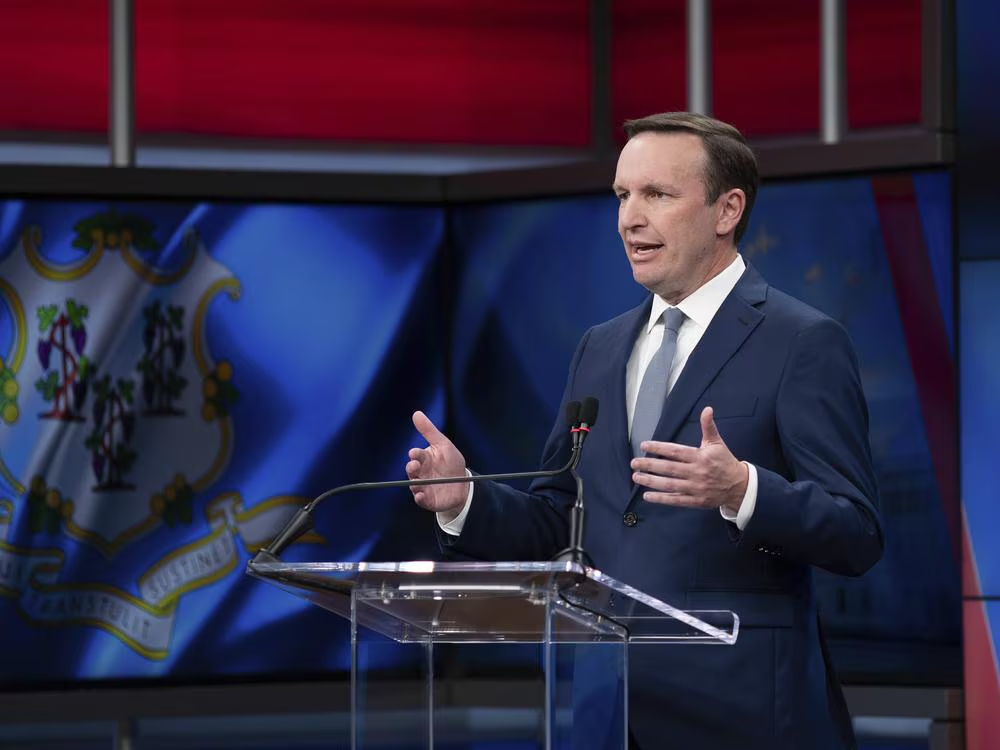
On March 1, Connecticut Senator Chris Murphy said that a conflict with Iran would not produce democracy but would instead bring to power “an even more hardline and dangerous leadership.” Speaking on CBS News, he said the president had explicitly framed the objective as regime change and the elimination of Iran’s missile and nuclear programs, but that these goals could not be achieved. According to Murphy, U.S. intelligence agencies have already warned the president that the most likely outcome would be the replacement of the current leadership by radical elements of the Islamic Revolutionary Guard Corps.
Murphy stressed that the result would not be a democratic Iran but an even more repressive system of power. He noted that it is impossible to destroy a nuclear program through airstrikes alone. Last year, the president claimed the program had been completely eliminated; subsequent assessments, however, showed that within just a year Iran had once again moved close to being able to restore it—potentially within about one week.
On Saturday morning, February 28, Israel and the United States carried out strikes on Iranian targets after tensions between Washington and Tehran escalated. Iran soon responded with attacks on Israel and several Persian Gulf states, including Qatar and Saudi Arabia.
As a result of the joint U.S.–Israeli strikes carried out on Saturday, Iran’s supreme leader, Ayatollah Ali Khamenei, was killed. The U.S. president announced his death later in the afternoon. “Khamenei, one of the most evil people in history, is dead,” he wrote on Truth Social. According to him, this was “not only justice for the people of Iran, but also for all great Americans and people from many countries around the world who were killed or maimed by Khamenei and his band of bloodthirsty thugs.”
Following the death of the supreme leader, Iran announced the formation of an interim leadership. State television reported that the temporary council includes President Masoud Pezeshkian, Guardian Council member Ayatollah Alireza Arafi, and judiciary chief Gholam-Hossein Mohseni-Ejei.