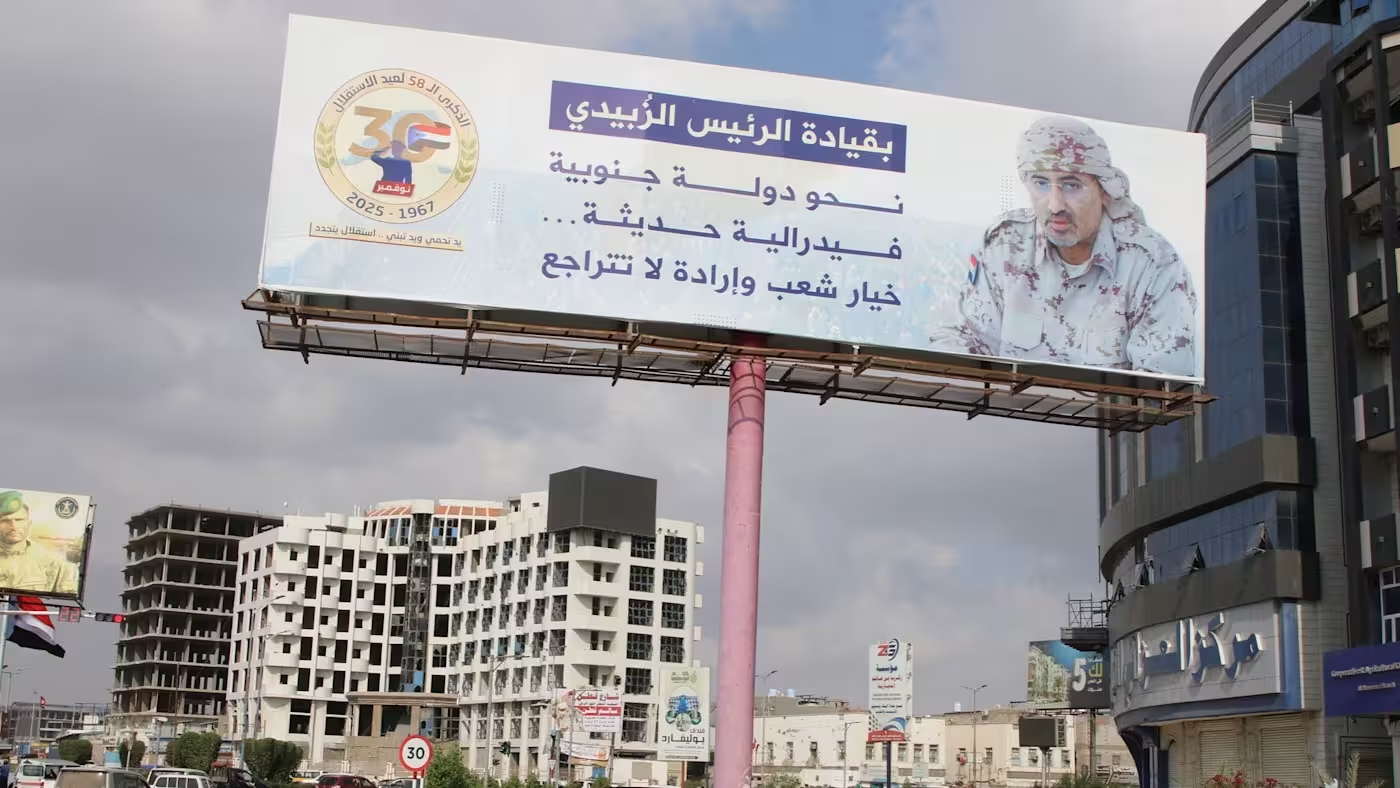
Saudi Arabia carried out air strikes in southern Yemen, targeting an area linked to the leader of the Southern Transitional Council. Riyadh accused Aidarous al-Zubaidi of preparing a military escalation and said relations with the United Arab Emirates had sharply deteriorated.
Saudi Arabia has launched new air strikes on southern Yemen, hitting the area where the leader of a faction backed by the United Arab Emirates resides, after accusing him of mobilising armed forces and equipment in an effort to “create instability”.
The actions of the Riyadh-led coalition followed the failure of Aidarous al-Zubaidi, who heads the separatist Southern Transitional Council, to travel to Saudi Arabia for talks intended to resolve a month-long crisis in the country. That crisis has exposed a deepening rift between Saudi Arabia and Abu Dhabi.
“The legitimate government and the coalition received intelligence indicating that al-Zubaidi had concentrated significant forces—including armoured vehicles, combat units, heavy and light weapons, as well as ammunition,” said Major General Turki al-Maliki, spokesman for the Saudi-led coalition, in an official statement.
He described the air strikes on the southern province of al-Dhalea—al-Zubaidi’s home region—as “limited” and “pre-emptive”, saying their purpose was to disrupt the movement of anti-government formations.
The latest escalation followed accusations of treason levelled against al-Zubaidi by representatives of Yemen’s Saudi-backed government, who subsequently removed him from the Presidential Leadership Council.
A series of explosions struck southern Yemen following Saudi air strikes on weapons depots belonging to separatist formations.
The crisis began in December, when the Southern Transitional Council launched an offensive to seize control of the Hadramout and al-Mahra provinces, which border Saudi Arabia.
Riyadh said the STC’s advance posed a threat to the kingdom’s national security and accused the United Arab Emirates of having sanctioned the operation.
In response, Saudi Arabia carried out a series of air strikes and backed forces loyal to Yemen’s government, forcing the STC to withdraw from Hadramout—the country’s largest and most economically significant province—as well as from al-Mahra.
The Saudi-led coalition demanded that the STC leadership travel to the kingdom for talks. While dozens of representatives of the movement made the trip, Aidarous al-Zubaidi was not among them.
The STC rejected claims that he had fled and, in a statement published on Wednesday, stressed that al-Zubaidi continues to perform his duties from Aden—the city that became the seat of Yemen’s internationally recognised government after the Houthi takeover of the capital, Sanaa, ten years ago.
The statement also said that al-Zubaidi “directly oversees the work of military, security and civilian institutions”. The movement condemned the coalition’s latest air strikes as “unjustified” and demanded that the Saudi authorities immediately halt the attacks.
The coalition’s spokesman, Turki al-Maliki, in turn accused al-Zubaidi of distributing weapons in Aden “with the aim of creating instability in the coming hours”.
Saudi Arabia’s state news television channel reported that forces backed by Riyadh had begun advancing towards Aden, which is under STC control.
According to Farea al-Muslimi, a research fellow at Chatham House, the current escalation marks “a new and significant phase unfolding against the backdrop of Yemen’s protracted and bloody war and rapidly deteriorating relations between Saudi Arabia and the UAE”.
“On the ground, the city of Aden is entering what could become its third war in a decade,” he said. “Since early morning, reports have been emerging of widespread looting of weapons, the seizure of private and public property, and the rapid deployment of armed groups across the city.”
Saudi Arabia and the UAE intervened in Yemen’s civil war in 2015, opposing the Iran-backed Houthis, who control much of the country’s densely populated north. The two countries, however, relied on different local forces, which often ended up competing with one another.
After 2019, the UAE withdrew most of its troops, but continued to back the STC and left behind what it described as a counter-terrorism unit in the south.
Those forces were fully withdrawn after Saudi Arabia last week struck what it said was an Emirati arms shipment at Yemen’s port of Mukalla and accused Abu Dhabi of supporting the STC’s offensive.
The Southern Transitional Council remains the most powerful force in southern Yemen and advocates the creation of a separate state there—echoing the period before the country’s unification in 1990.
Despite their status as long-standing allies, Saudi Arabia and the UAE are increasingly diverging in their approaches to resolving regional crises, including the conflicts in Yemen and Sudan. Analysts say the current confrontation is the most serious in recent years.
“Another humanitarian catastrophe is looming—this time driven by the collapse of former alliances,” al-Muslimi warned.