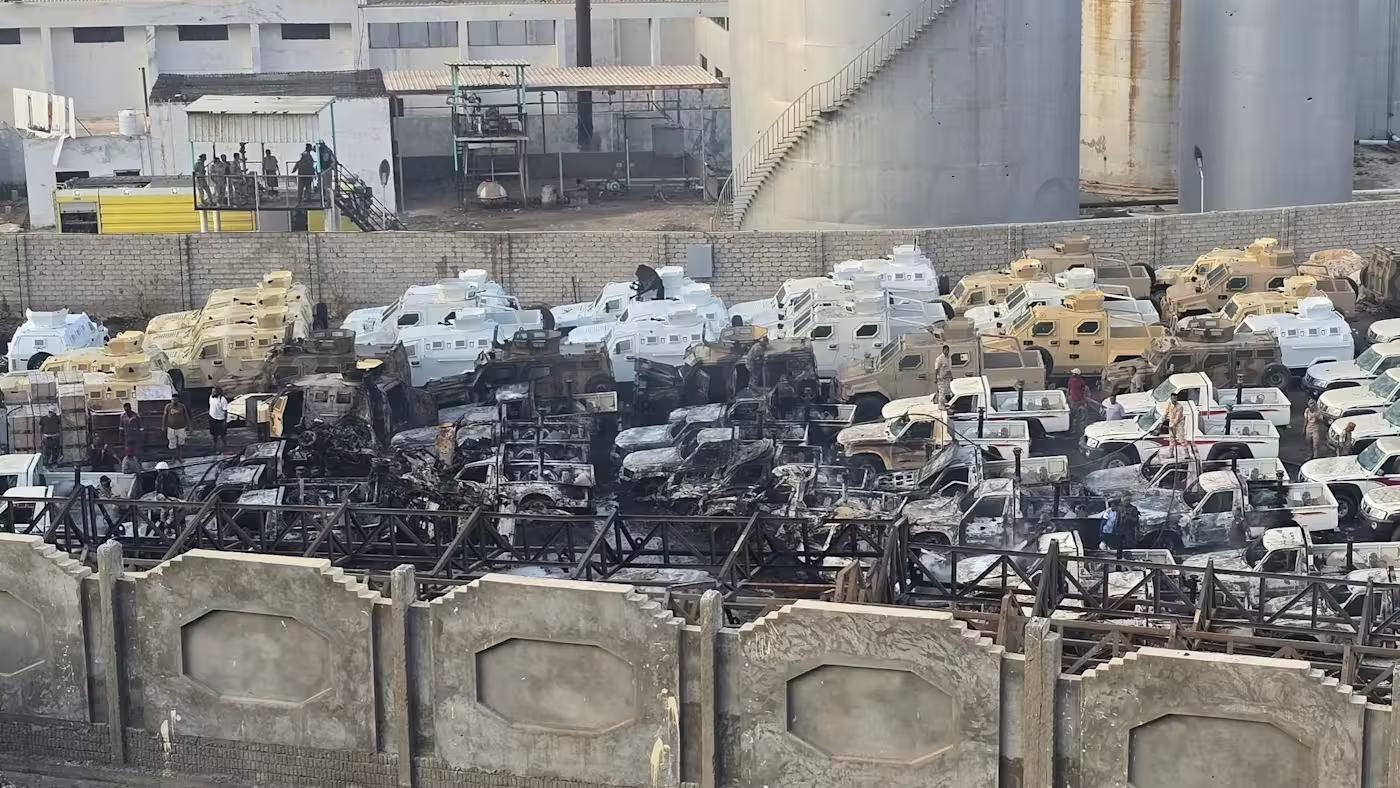
Saudi Arabia has carried out an air strike on a Yemeni port, saying the target was shipments of weapons and armoured vehicles from the United Arab Emirates intended for southern separatist forces. The strike—the second by Riyadh on Yemen in the past five days—hit sites in the port city of Mukalla and marked a sharp escalation of tensions between Saudi Arabia and the UAE against the backdrop of the country’s war.
The kingdom for the first time placed direct responsibility on Abu Dhabi, accusing it of backing an offensive by the Southern Transitional Council—a southern separatist group that this month triggered a crisis by taking control of two strategically important provinces, Hadhramaut and al-Mahra. Saudi Arabia’s foreign ministry said the UAE had “applied pressure” on the Southern Transitional Council, encouraging it “to carry out military operations on the kingdom’s southern borders”. The ministry described these actions as a “threat” to Saudi Arabia’s national security and to Yemen’s stability.
The statement stressed that “the steps taken by the UAE are considered extremely dangerous, contradict the principles on which the coalition to restore legitimacy in Yemen was established, and do not serve the objectives of the [Saudi-led] coalition to ensure Yemen’s security and stability”. It added that any threat to the kingdom’s national security constitutes a “red line”, and that Riyadh “will not hesitate to take all necessary steps and measures to confront and neutralise any such threat”.
Hadhramaut, which borders Saudi Arabia, is Yemen’s largest and wealthiest region. Both Hadhramaut and al-Mahra, which shares a border with Oman, were under the control of Yemen’s Saudi-backed government before the Southern Transitional Council’s advance. Saudi Arabia and the UAE intervened in Yemen’s civil war in 2015 to counter the Iran-backed Houthis, who control much of the densely populated north of the country, but they have relied on factions that frequently compete with one another.
The current crisis has exposed a widening rift between Saudi Arabia and the UAE—traditional allies whose positions are increasingly diverging over conflicts in Yemen and Sudan. The Southern Transitional Council’s offensive began three weeks after Saudi Arabia’s crown prince, Mohammed bin Salman, discussed the civil war in Sudan with US president Donald Trump during a visit to the White House. Some analysts have suggested a connection between the two developments, arguing that the UAE may have been irritated by the prince’s decision to raise the role of the paramilitary Rapid Support Forces in the Sudanese conflict.
The UAE’s role in Sudan has come under intensified scrutiny amid allegations that it has supplied weapons to the Rapid Support Forces, which face accusations of genocide. Abu Dhabi denies arming the group. Saudi Arabia, for its part, is widely seen as backing the Sudanese Armed Forces—the Rapid Support Forces’ main adversary.
In Yemen, the UAE-backed Southern Transitional Council remains the most powerful force in the south of the country and advocates the creation of a separate state, as existed before Yemen’s unification in 1990. A spokesman for the Saudi armed forces described the strike on Mukalla as “limited”. He said ship crews had switched off tracking systems and unloaded “a significant quantity of weapons and armoured vehicles in support of the Southern Transitional Council’s forces”.
The UAE rejected Saudi Arabia’s accusations, saying the cargo at the port of Mukalla did not contain weapons and that the unloaded equipment was intended not for any Yemeni party but for Emirati forces. “The UAE categorically rejects any attempts to drag the country into tensions between Yemeni parties,” the UAE’s foreign ministry said, adding that it “strongly condemns claims that the country exerted pressure on or issued instructions to any Yemeni party to carry out military operations that could undermine the security of the Kingdom of Saudi Arabia or affect its borders”.
After the air strike, Yemen’s Saudi-backed government called on all Emirati forces to leave the country within 24 hours and announced the cancellation of its defense agreement with the UAE over its support for the Southern Transitional Council. The authorities also imposed a 90-day state of emergency and announced a 72-hour ban on all border crossings in areas under their control, as well as on entry to airports and seaports, except in cases authorized by the Saudi-led coalition.
“Unfortunately, it has been conclusively confirmed that the United Arab Emirates exerted pressure on and directed the [Southern] Transitional Council to undermine state authority and rebel against it through military escalation,” Rashad al-Alimi, head of Yemen’s Saudi-backed Presidential Leadership Council, said in a televised address.
Farea al-Muslimi, a Yemen analyst at Chatham House, said the statements “mark a critically important turning point”. He added that “these actions indicate that the situation is entering a particularly volatile and dangerous phase”. He also stressed that the Houthis are likely to view the widening rift between their adversaries “as a significant advantage”.
Saudi state television aired footage recorded by surveillance aircraft that it said showed armoured vehicles being moved from the port of Mukalla to a staging area. State media reported that there were no casualties in the air strike.
The Southern Transitional Council said it launched its offensive after local groups halted oil production in Hadhramaut—the main source of oil revenue for the southern authorities. The council also said the operation was aimed at combating Islamist extremists and preventing the smuggling of weapons to the Houthis.