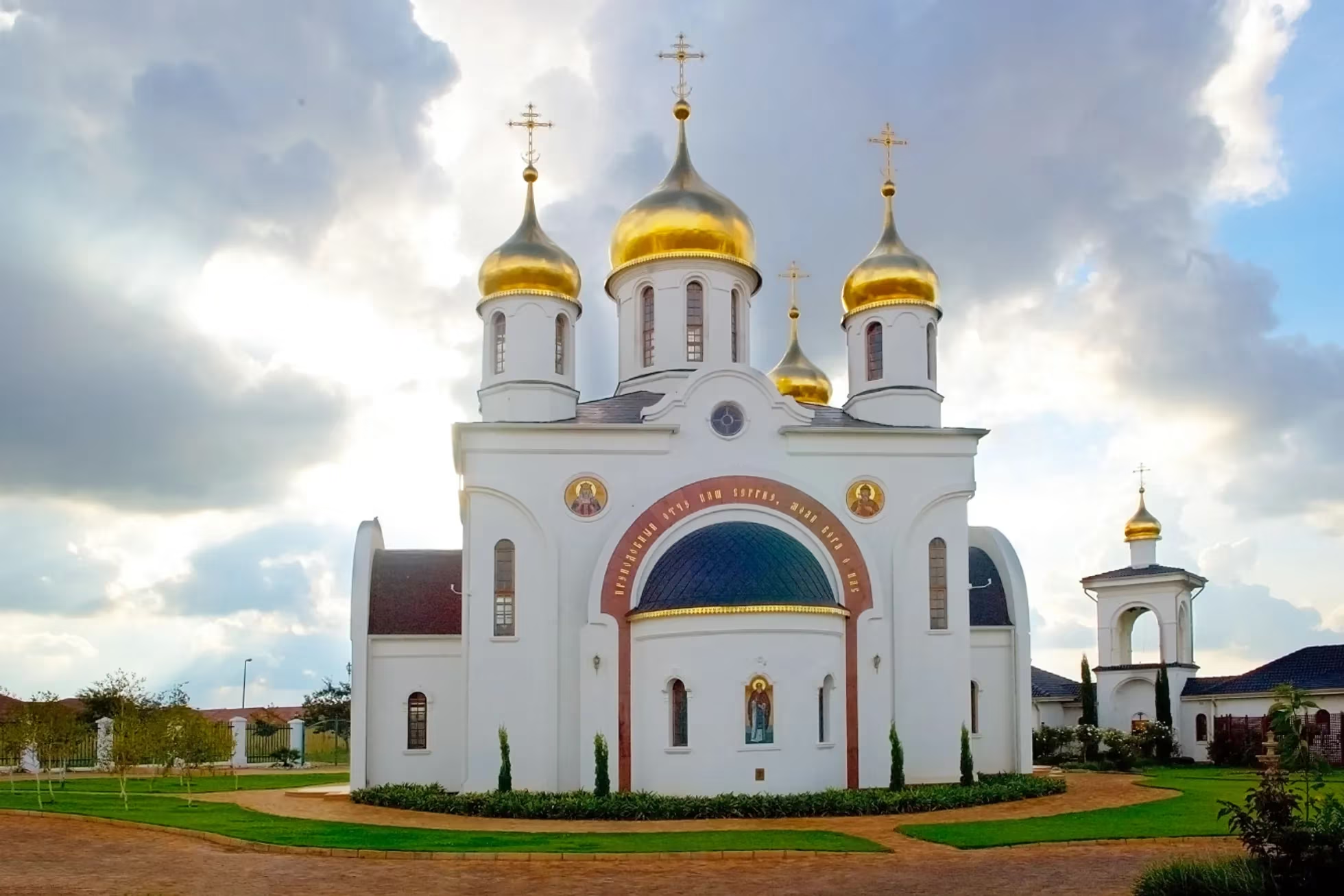
Between 2022–2025, the Russian Orthodox Church sharply expanded its presence in Africa, reaching at least 34 countries, notes Bloomberg. Until recently, south of the Sahara there was just a single ROC parish—in South Africa—while the church’s other African structures were located in Egypt, Tunisia, and Morocco. Now, more than 350 parishes and communities are registered across the continent. The head of the missionary department of the ROC’s African Exarchate, Priest Georgy Maksimov, describes this as possibly the most extensive territorial expansion in the church’s entire history.
The number of ROC clergy in Africa has risen to 270. A substantial share previously served in other Orthodox jurisdictions, including Greek ones. The shift has been driven by higher pay, funding for church construction, and the prospect of accelerated advancement within the ecclesiastical hierarchy.
Bloomberg views the ROC’s activity as part of a broader strategy to bolster Russian influence in Africa. Lacking the capacity to compete with the West and China in terms of investment and economic footprint, Moscow is turning to other instruments—religion, culture, and language.
In South Africa, ROC congregations are more often joined by Afrikaners—members of the country’s white population, among whom conservative and traditionalist views are particularly strong.
After the start of Russia’s full-scale war against Ukraine, seven “Russian Houses”—cultural centers—opened in a number of African countries, and Russian authorities say they plan further expansion, including talks on a new center in Namibia. Russian-language instruction has begun at universities in Abidjan and Harare. In 2024, the Innopraktika Foundation, headed by Katerina Tikhonova, Vladimir Putin’s daughter, launched a lecture program at Dakar University with the stated aim of promoting Russian culture and language.
According to Russia’s foreign minister, Sergey Lavrov, by the end of 2025 more than 32,000 students from African countries were studying at Russian universities, while the educational quota for the continent was increased almost threefold, exceeding 5,300 places.
On their own, religious and educational expansion remains limited in scale, but they contribute to shaping an image of Russia as a “friendly great power.” The same logic underpinned symbolic shipments of grain and fertilizers, assistance in mapping fish resources off the coasts of Morocco and Senegal, as well as other humanitarian initiatives launched by Moscow in Africa after the war began.
Complementing this strategy is the development of Russia’s own media platforms. The state-run agency Sputnik already operates an editorial center in Ethiopia, with another planned to open in 2026—in South Africa.
At the same time, Russia is actively recruiting young women from African countries through the “Alabuga Start” program. Formally, it is presented as employment in a special economic zone in Tatarstan; in practice, many participants ultimately end up at enterprises linked to the production of military drones. In South Africa, Kenya, and Botswana, official investigations into such recruitment are already under way.
Of the 54 African states that are members of the United Nations, Russia has military cooperation agreements with 43. It remains the continent’s largest supplier of weapons. The “African Corps”—a structure formed on the basis of the Wagner private military company and controlled by the GRU—continues to operate in the region. Russian companies are also involved in security-related projects and mineral extraction across many African countries.