Russian crude prices have climbed to their highest levels in more than 13 years—driven by a global oil rally tied to the crisis surrounding Iran.
Urals, the country’s main export grade, reached $116.05 a barrel on April 2 at the port of Primorsk—Russia’s largest oil terminal on the Baltic Sea, according to Argus Media data.
Urals Oil Price (Dollars per Barrel)
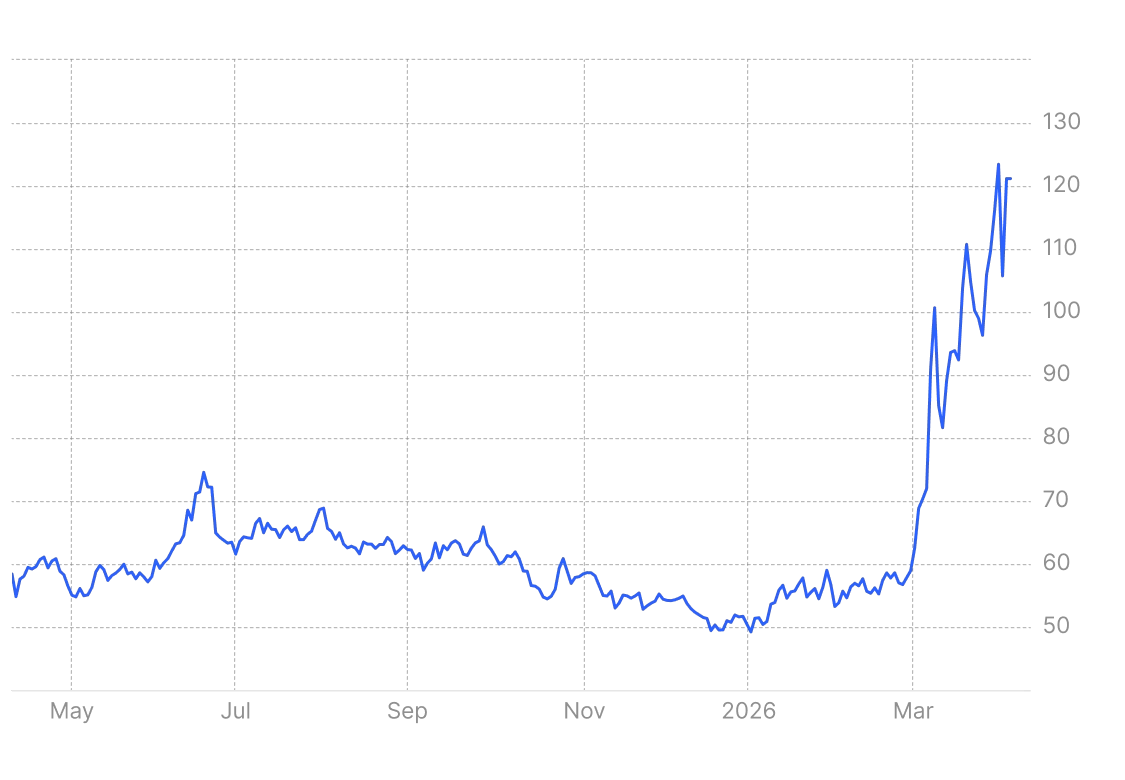
That price, excluding shipping costs, is almost twice the $59 a barrel assumed in this year’s budget. The extra oil revenue is easing pressure on the Kremlin’s financial system as the war in Ukraine continues.
The escalation in the Middle East has effectively cut off about a fifth of the world’s oil supplies passing through the Strait of Hormuz. US President Donald Trump demanded that Tehran reopen this critical route, threatening to destroy key infrastructure and setting a deadline of 8:00 p.m. Eastern Time on Tuesday.
At the Black Sea port of Novorossiysk, Urals reached $114.45 a barrel on Thursday, also according to Argus Media. The discount on Russian crude against the global Dated Brent benchmark for cargoes shipped from western ports narrowed to less than $27.75 a barrel—the lowest level since mid-December.
By the time it reaches India, Urals is already trading at a premium to Brent—it rose to $6.1 a barrel, up from $3.9 two weeks earlier. Even so, it remains unclear how much of the gap between the export price and the delivered price ultimately accrues to Russia.
Moscow’s ability to capitalize on the global price surge is nevertheless being constrained by Ukrainian attacks on oil infrastructure and refining capacity. Kyiv has intensified strikes on seaports—above all on the Baltic, from which about 40% of Russia’s seaborne oil is shipped—disrupting loading operations and cutting export revenues.