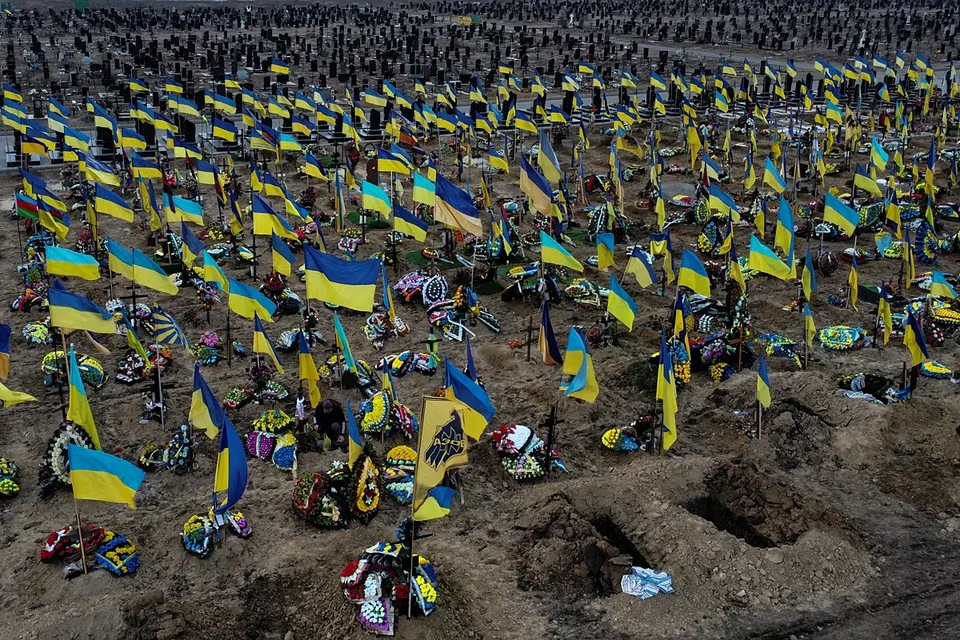
The combined military losses of Russia and Ukraine have surpassed two million people. That threshold, according to an assessment by the Washington-based Center for Strategic and International Studies (CSIS), was reached after four years of grinding war.
According to a CSIS report published on Wednesday, the bulk of the losses have been suffered by Russia. Since the start of the full-scale invasion in February 2022, the Russian army has lost about 1.4 million soldiers killed and wounded.
The number of Russian service members killed is estimated at roughly 450,000. That is more than the US military’s combined losses in all wars since World War II.
Ukraine’s losses, according to the researchers, range from 525,000 to 625,000 people, including up to 150,000 killed. In absolute terms, they are lower than Russia’s, but for Kyiv they are structurally more severe: Ukraine is losing a larger share of its smaller armed forces.
On the front line, Russia retains roughly a threefold advantage. According to CSIS, Moscow has about 400,000 troops against 250,000 Ukrainian defenders at the front.
The precision of such calculations, however, remains limited. The researchers relied on estimates from the US and British governments, noting that Moscow systematically conceals its real losses, while Kyiv does not publish official statistics for reasons of operational security.
The high cost of the offensive has not produced rapid territorial gains for Russia. On some sections of the front, Russian forward units are advancing by less than 165 feet a day.
In early 2026, the situation on the battlefield changed noticeably. In February, Ukrainian forces carried out an offensive in the south and achieved a net gain in controlled territory for the first time since 2023.
That pace was briefly accelerated after Elon Musk restricted the Russian military’s access to the Starlink satellite network. Communications disruptions increased the mobility of Ukrainian units and temporarily reduced their vulnerability to Russian drone strikes.
In the spring of 2026, the area under Russian control continued to shrink. In April and May, Russian forces ceded about 400 square kilometers—the first net monthly territorial deficit for Moscow since August 2024.
At the same time, Russia is facing growing manpower constraints. According to CSIS calculations, the current level of losses—30,000 to 34,000 people a month—exceeds the inflow of new contract soldiers, which stands at about 27,000.
To replenish the army, the Kremlin is using unconventional recruitment mechanisms. Moscow is mobilizing prisoners, offering large payments, using criminal cases as leverage for recruitment, and has carried out its first draft on this scale since World War II.
The shortage of personnel also led to the deployment of more than 10,000 North Korean troops to the Kursk region in 2024–2025, where they were used to counter Ukrainian operations.
Ukraine, for its part, is expanding its long-range strike capabilities. Its forces are conducting an active air campaign using autonomous systems and missiles against targets inside Russia, including Moscow and the Crimean Peninsula.
Russia’s Defense Ministry recently said that Russian air defenses had intercepted 419 drones over a single operational week.
Seth G. Jones, the author of the CSIS report, noted that ordinary Russians are increasingly feeling the effects of a deteriorating economic situation and regular drone strikes on cities.
Against the backdrop of changes on the battlefield, US diplomatic engagement has sharply declined. President Donald Trump, at a recent summit in France, publicly distanced Washington from the war.
He described the US role primarily in terms of weapons supplies and made clear that the conflict holds no strategic significance for Washington. Trump cited the scale of human losses as the main argument for a swift settlement.
Such a shift undermines the long-standing system of American security guarantees for European allies.
At the same time, supporters of aid to Ukraine in the US Congress insist that containing Russia remains a necessary condition for defending NATO’s eastern flank.
The shift in strategic position is expected to be discussed by allies at the NATO summit, scheduled to take place on Tuesday in Ankara, Turkey.
Analysts warn that without sustained pressure from the West, the Kremlin will be prepared to continue absorbing mounting losses while maintaining military mobilization.
A Study by the Center for Strategic and International Studies Estimates Total Russian and Ukrainian Losses in the War at Nearly 2 Million People
Putin Announces Deployment of Russia’s Starlink Equivalent and Vows to Intensify Strikes on Ukraine
Russia Promised to Stop Recruiting Kenyan Citizens to Take Part in the War Against Ukraine
Kim Jong Un Ceremonially Welcomes North Korean Troops Returning to the DPRK After Demining Operations in Russia’s Kursk Region