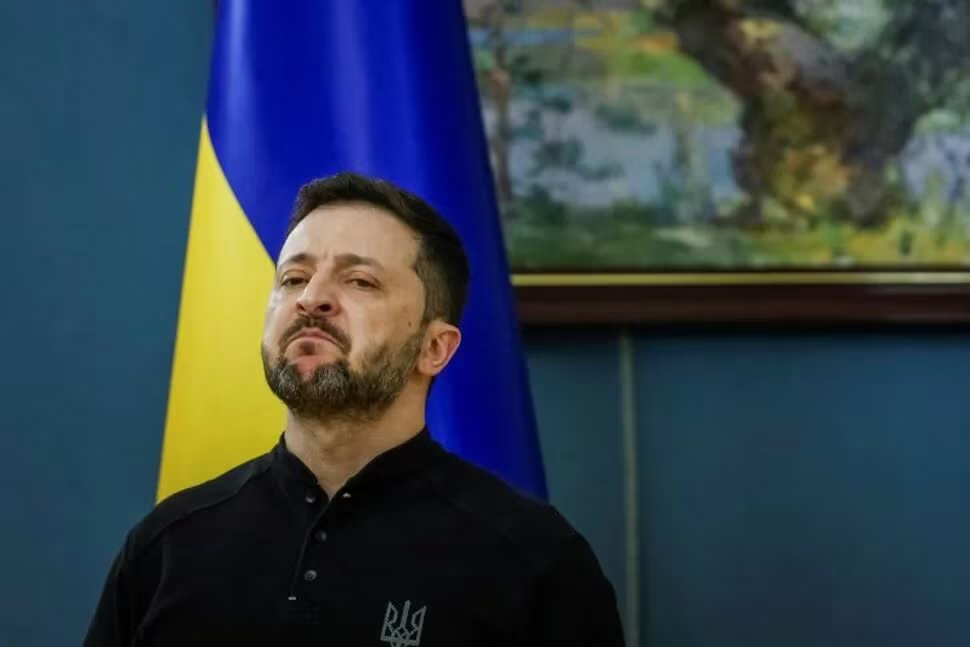
Over the past five weeks, President Volodymyr Zelensky has repeatedly stated in public that Russia is preparing an offensive from Belarus toward Chernihiv and Kyiv, searching for the locations of Ukraine’s senior leadership, and has drawn up a list of roughly twenty “decision-making centers” targeted for future missile and drone strikes. Each of those statements came after meetings with the heads of the Ukrainian General Staff, military intelligence, foreign intelligence, and the Security Service of Ukraine—meaning they were presented not as political rhetoric, but as the outcome of intelligence assessments.
The chronology unfolded as follows. On April 17, Zelensky first publicly said intelligence agencies had observed “road construction toward Ukrainian territory and the preparation of artillery positions” along the Belarusian border zone. On April 23, he repeated the warning to journalists, saying the Russians had “many different, sick, and fantastical ideas,” and that Belarus should not be dragged into them. On May 15, following a meeting of the wartime Stavka command, he made three statements in succession: that the Russian General Staff was “considering operational plans” from Belarusian territory—either against the Chernihiv-Kyiv direction or against a NATO member state; that military intelligence had obtained documents listing around twenty targets being prepared for strikes, including Bankova Street; and that Moscow had “become active again—they are looking for where we are located.” On May 20, he held another Stavka meeting and ordered the reinforcement of the northern direction.
At the same time, the agencies formally responsible for confirming such threats have been saying something very different. State Border Guard Service spokesman Col. Andriy Demchenko stated during the national telethon broadcast on April 20 and again on May 19 that “neither equipment movements nor troop buildups” had been observed near the Belarusian border, and that there were “no Russian units on Belarusian territory capable of carrying out another invasion.” The same assessment has been offered by the independent OSINT project Conflict Intelligence Team, whose analysts say they have not observed any transfer of Russian military units into Belarus. Satellite images of construction activity, they argue, reflect standard military operations rather than preparations for a ground invasion. On May 18, Kremlin spokesman Dmitry Peskov described Zelensky’s statements about an offensive from Belarus as “incitement.”
These statements are emerging at a moment when the country’s domestic politics are dominated by an entirely different agenda. On May 11, the Specialized Anti-Corruption Prosecutor’s Office announced charges against former presidential office chief Andriy Yermak in a case involving alleged money laundering tied to the construction of elite housing near Kyiv. On May 14, the High Anti-Corruption Court ordered him held in custody with bail set at 140 million hryvnias—around $3.1 million. The money was raised over four days, and Yermak was released from detention on May 18.
Until the end of November 2025, Yermak was far more than simply the head of the Presidential Office. He had led the institution since February 2020 and for five years was regarded as Zelensky’s closest political ally. In June 2021, the president himself described him on the “1+1” television channel as “a truly strong manager,” “a real patriot of Ukraine who works 24/7 solely for Ukraine,” and promised that Yermak “will leave together with me.” Yermak submitted his resignation on November 28, 2025—the same day investigators searched his properties as part of a NABU probe into an alleged $100 million laundering scheme in the energy sector, known as the “Mindich case.” He is now formally accused in a separate episode, and Ukrainian media are already discussing the possibility of a second set of charges.
At the same time, another issue is unfolding that may irritate Ukrainian society more than any other. During the first three months of 2026, Ukraine’s ombudsman’s office received 1,657 complaints regarding the actions of territorial recruitment centers—one and a half times more than during the same period a year earlier. Artem Novov, head of the specialized defense-sector prosecutor’s office for the central region, said in March 2026 that bribes for exemption from mobilization ranged from $4,000 to $80,000. In April, high-profile arrests targeted officials from the Peresyp district recruitment center in Odesa and a district recruitment office in Bila Tserkva. The issue is increasingly viewed as systemic: society is no longer reacting to isolated incidents, but to a mechanism in which the state mobilizes some citizens while exempting others for money, effectively operating outside a single set of rules.
In Lviv and Odesa, civilians intervened in cases of forced mobilization and helped free men allegedly being held unlawfully
Against this backdrop, rhetoric about an existential external threat performs a certain function. It shifts the center of public attention away from Bankova Street and the anti-corruption court’s cashier desk toward Belarus and “decision-making centers.” It also places security officials in a position where they are expected to publicly validate the threat—even when their own subordinates appear on national television saying there is no troop concentration. Commander-in-Chief Oleksandr Syrskyi told the outlet Militarnyi on May 19 that the Russian General Staff was “actively calculating and preparing offensive operations from the North,” but he did not cite either timelines or concrete signs of preparations on the ground.
The unanswered question is not whether a threat from Belarusian territory exists at all. That threat has existed since February 2022, and Belarus is indeed being used by Russia as a platform for launching Shahed drones and supporting logistics. The real question is different: to what extent does the concentration of presidential statements in the third week of May 2026 reflect actual Russian troop movements—and to what extent does it reflect the internal political dynamics in Kyiv, where the authorities are beginning to lose their monopoly over the national narrative.