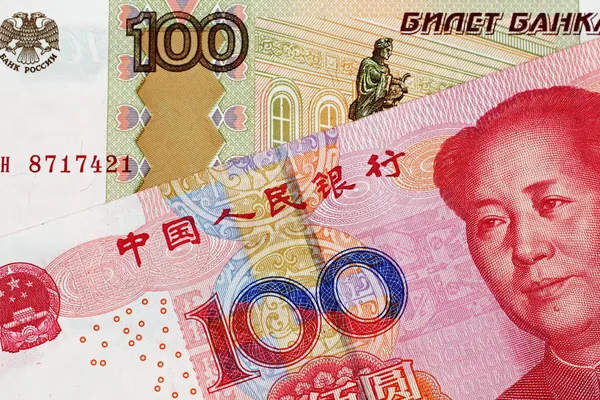
Russia has carried out its first bond issuance denominated in Chinese yuan, raising nearly $3 billion as it seeks to finance the war against Ukraine while deepening financial ties with Beijing. The Finance Ministry said it had placed sovereign bonds worth 20 billion yuan ($2.8 billion), giving Moscow access to China’s low interest rates to cover domestic needs. The deal included 12 billion yuan in notes maturing in 2029 at 6 percent and 8 billion yuan maturing in 2033 at 7 percent.
Finance minister Anton Siluanov said “we have managed to establish a liquid sovereign benchmark that will guide corporate borrowing and foster deeper bilateral financial cooperation between Russia and China.” More than half of the issue, the ministry noted, was purchased by banks that in recent years have expanded their yuan holdings through trade operations with China.
In scale, this placement far exceeds other yuan issuances made this year by governments shifting toward China’s currency amid Beijing’s efforts to internationalise the renminbi and weaken the dollar’s dominance. Hungary placed 5 billion yuan in bonds in China in September, while the emirate of Sharjah sold 2 billion yuan in October. For Russia, the yuan has effectively become a new reserve currency, especially after its access to dollar- and euro-denominated funding was cut off and the Central Bank’s foreign assets were frozen following the 2022 invasion of Ukraine.
Russia’s economy is straining under a key interest rate above 16 percent and inflation at 7 percent, driven higher by rising production costs for goods the country once imported. Sanctions that have curtailed access to dollar financing are increasingly constraining oil and gas exports—the backbone of the Kremlin’s budget. The new issuance is meant to help plug a widening deficit and, as Maximilian Hess, founder of the consultancy Enmetena Advisory, noted, “gives the Chinese side more confidence that Russia is aligning itself with their geoeconomic agenda of yuan internationalisation.” He added: “I genuinely believe Beijing would welcome such a move.”
Indonesia and Pakistan are considering entering the Chinese market with so-called panda bonds next year, while several countries—including Russia—prefer to raise funds abroad through dim sum bonds. Russia, however, pays a higher yield than other offshore renminbi issuers: the Development Bank of Kazakhstan, which launched Central Asia’s first dim sum bond, raised funds at 3.3 percent.
Major Chinese borrowers in Africa and Asia—among them Kenya, Angola and Sri Lanka—have also agreed this year to refinance their dollar-denominated loans from Chinese banks in yuan. Even so, sovereign issuances in China remain rare: foreign governments need strong credit ratings to attract Chinese investors, and they must navigate the complexities of moving funds out of the country.
Китай открывает долговой рынок и порты для России
Москва получает доступ к юаню и энергетическим поставкам, обходя западные санкции

Военный парад в Пекине собрал союзников Китая и показал новые вооружения
Си Цзиньпин заявил, что страна не примет диктата США и предупредил Тайвань
In bilateral trade this year, Beijing posted its first deficit with Russia after Moscow imposed tariffs on cheap Chinese cars while maintaining exports of oil, coal and other energy commodities. According to the Centre for Research on Energy and Clean Air, China has purchased nearly half of Russia’s oil exports since late 2022, including almost $7 billion worth in October. This came shortly before the United States imposed sanctions on Rosneft and Lukoil, affecting producers responsible for roughly half of Russia’s export volumes. A substantial share of the National Wealth Fund’s liquid assets—estimated at $50 billion—is now also held in yuan.
The prospect of Russian companies tapping yuan-denominated loans on a regular basis could offer them cheaper funding than rouble borrowing, whose cost has risen amid an interest rate of 16.5 percent as of October. Hong Kong–listed Rusal became the first Russian company to issue panda bonds in 2017 and placed yuan bonds in Russia in 2022. Yet a stable dim sum market for Russian borrowers has not taken shape. According to Hess, “Russian companies have been borrowing in Chinese yuan for some time, but the room for expansion remains enormous.” He added that, in time, the volume of such borrowing could match previous levels in dollars.