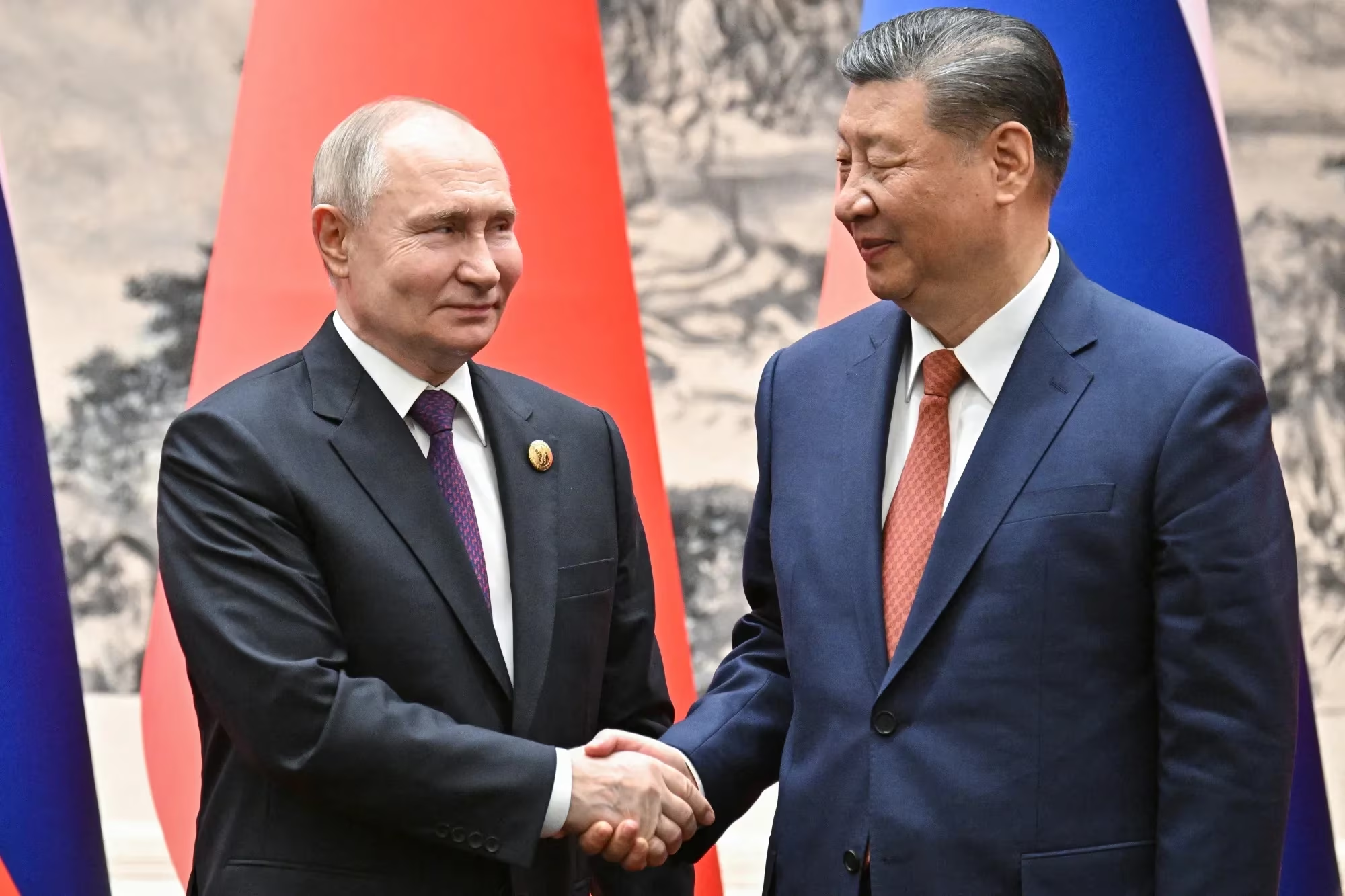
Moscow and Beijing are increasingly building cooperation among authoritarian states, forming networks that facilitate the global spread of repressive practices—according to researchers who used artificial intelligence tools to analyze these activities.
The US-based nonprofit Action for Democracy said in a report published on Wednesday, March 18, that it had developed a dedicated index to track seven forms of cooperation—from financial support and diplomatic engagement to propaganda and technology sharing.
The analysis found that China and Russia “sit at the center of global authoritarian cooperation” and are jointly involved in roughly half of all recorded cases. The authors stress that such ties are self-reinforcing: for example, “surveillance infrastructure exported to one country becomes a template for the next.”
“Left untracked, these dynamics risk producing a world in which repression scales across borders, while democratic responses remain fragmented and reactive,” the report states.
This convergence has largely gone unnoticed, even as it has emerged as a significant byproduct of the deepening ties between Moscow and Beijing following Russia’s full-scale invasion of Ukraine in early 2022. The process is unfolding against the backdrop of mounting military pressure by Chinese leader Xi Jinping on democratic Taiwan—with a view to eventually bringing the island of 23 million people under Beijing’s control.
The deepening cooperation is also taking place as many observers see democratic norms in the United States eroding under President Donald Trump—particularly through his statements casting doubt on election results.
Trump has also largely abandoned his predecessor Joe Biden’s push to promote democracy abroad—including initiatives such as the 2021 summit that brought together representatives from around 110 countries. A Chinese official at the time dismissed the gathering as a “joke.”
Action for Democracy warns that autocratic regimes are “deliberately scaling up and deepening their cooperation,” using instruments such as international forums and shared media networks.
These mechanisms enable countries to “standardize narratives, build connections, and regularly exchange practices and personnel.”
The report is based on an online database comprising more than 72,000 instances of cooperation between states, compiled from roughly 400 million sources across more than 100 languages.