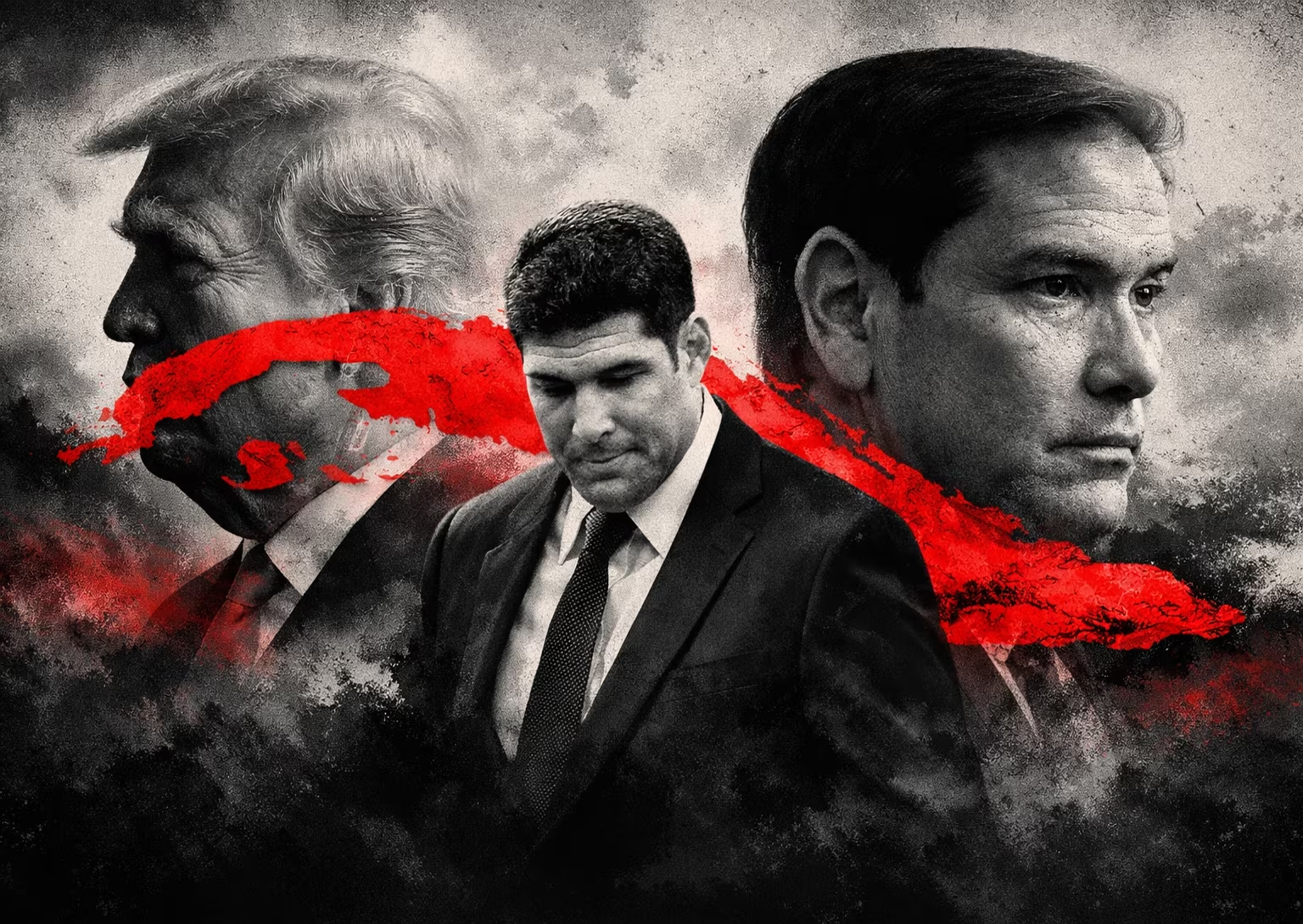
U.S. Secretary of State Marco Rubio has been holding discreet contacts with the grandson and trusted confidant of Cuba’s de facto leader, Raul Castro, three sources told Axios. The talks are taking place against the backdrop of unprecedented pressure from Washington on the island’s authorities.
According to the sources, the dialogue is being conducted outside Cuba’s formal institutions. In doing so, the Donald Trump administration is effectively acknowledging that the 94-year-old Castro remains the country’s central decision-maker. “I wouldn’t call this ‘negotiations’—it’s more a discussion of possible future scenarios,” a senior Trump administration official said.
Rubio and his team view Castro’s 41-year-old grandson and his circle as representatives of a younger, business-oriented segment of Cuba’s elite—one for whom revolutionary communism has run its course and who see value in closer ties with the United States. “Our position—the position of the U.S. government—is that this regime must go,” the same source said. “But what that ultimately looks like is for President Trump to decide, and he has not yet made that decision. Rubio continues his engagement with the grandson.”
The younger Castro, known in political circles by the nickname Raulito, is also referred to as El Cangrejo—“the Crab”—because of a deformed finger. After 67 years of U.S. sanctions and a chronic crisis of governance in Cuba, the totalitarian system is, according to sources, closer to collapse than at any point in recent history. The country is teetering on the brink of a humanitarian catastrophe.
The power grid is failing, hospitals are cutting back on surgeries, shortages of food and fuel are worsening, and tourist flows are plunging. In some cities, piles of uncollected garbage are accumulating on the streets. The situation deteriorated sharply after January 3, when Trump ordered the seizure and extradition of Venezuelan leader Nicolas Maduro, who had effectively supplied Cuba with free oil. By January 29, Trump had threatened sanctions against Mexico—another major fuel supplier to the island.
According to U.S. officials, the success of the American operation against Maduro and the clear technological superiority of the U.S. military made a powerful impression on Cuba’s leadership. The United States suffered no losses in the operation, while at least 32 Cuban intelligence officers and military personnel responsible for Maduro’s security were killed. At the same time, Washington’s decision to keep Maduro’s key allies in power—most notably his vice president, Delcy Rodriguez, who became acting president—was read by Cuban insiders as a signal that Trump and Rubio are prepared for selective deals with adversaries.
Sources say that before the seizure of Maduro, Rubio and other Trump administration officials had been in contact with Venezuela’s elite—following the same model now being applied to Cuba. “They’re looking for their next Delcy in Cuba,” said one interlocutor familiar with the discussions.
Trump’s advisers, according to sources, have also engaged with other influential figures in Cuba, but the younger Castro is seen as the most promising channel. “He’s his grandfather’s favorite, he served as his bodyguard, and he’s connected to people who run the giant military-commercial conglomerate GAESA,” one source said, describing the Rubio-Castro exchanges as “unexpectedly” friendly. “There are no political tirades about the past. This is about the future,” he noted, adding that shared Cuban roots and similar accents typical of Miami and its suburbs create a particular rapport. “Raulito could be from Hialeah. It’s a conversation between ordinary guys from Miami’s streets.”
Analysts draw parallels with Venezuela and suggest that Trump may not be seeking the complete dismantling of Cuba’s regime, instead leaving some officials in place. The logic behind this approach is traced to the memory of the failure of total de-Baathification after the U.S. invasion of Iraq in 2003. Under a possible deal, some members of the Castro family—including Raul Castro himself—could avoid exile, a prospect that would provoke sharp backlash from the Cuban diaspora in Florida.
At the same time, Rubio has not been in contact with the formal head of state, Miguel Diaz-Canel Bermudez, or other senior officials. In Washington, they are viewed as party apparatchiks incapable of articulating or negotiating genuine change, a source familiar with the administration’s thinking explained.
The Cuban government, responding to reports of Rubio’s contacts with the younger Castro, issued a statement previously provided to a Mexican journalist. In it, Havana dismissed rumors of U.S. talks with another member of the Castro family—Alejandro Castro Espin, a senior intelligence official. “There is no high-level dialogue between the governments of the United States and Cuba. There is not even dialogue at the mid-level. There is only an exchange of messages,” the statement said. It also noted that regular contacts with the U.S. State Department had existed as recently as a year ago but have since been fully cut off.
The State Department did not deny that Rubio had communicated with Raulito Castro, but a spokesperson declined to discuss details. At the same time, officials in Washington acknowledge that turning Cuba into a U.S. ally would be a far more difficult task than in the case of Venezuela, where an organized opposition exists and the economy is in better shape than Cuba’s impoverished command-and-control system.
Hostility between hardline supporters of the regime in Havana and the Cuban diaspora in Miami is deeply entrenched on both sides of the Florida Straits. Last week, Republican lawmakers of Cuban origin in Congress urged Trump to pursue charges against Raul Castro over the 1996 downing of an aircraft carrying members of a U.S. humanitarian organization. The Trump administration did not respond to the request.
Trump has yet to make a final decision on Cuba. As with Venezuela, he has tasked trusted advisers, including Rubio, with preparing possible options. According to a source, Trump’s attention is currently focused more on efforts to settle wars involving Iran and Ukraine, while on Cuba Rubio is still assembling a range of scenarios.
“Cuba right now is a failed state—they don’t even have jet fuel so planes can take off,” Trump told reporters late Monday aboard Air Force One. “We’re talking to Cuba right now…and they should definitely make a deal.”