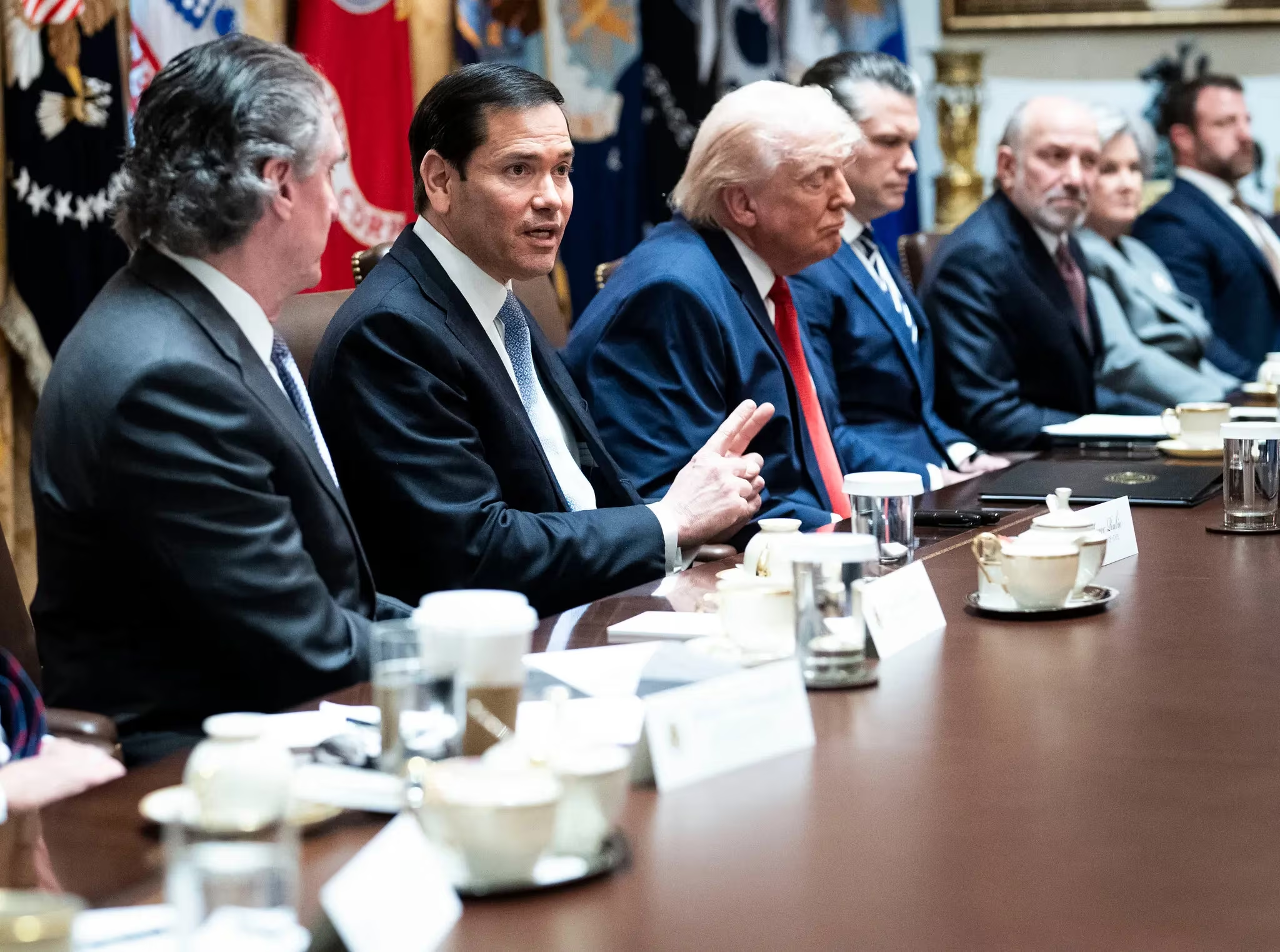
U.S. Secretary of State Marco Rubio said Washington’s allies in Europe and Asia should take part in securing the Strait of Hormuz, a vital artery for global oil and gas flows, after Donald Trump decided to extend the deadline given to Iran to fully restore shipping. “It is in their interest to help,” Rubio said before departing for France for a meeting of G7 foreign ministers. He noted that the United States is less dependent on this route, whereas it is critical for the global economy: “A very small portion of our energy passes through the Strait of Hormuz. It is in the interest of the entire world, so they should step up and deal with it.”
He added that in recent days Iran has allowed several tankers to pass, even though since the start of the war on February 28 the strait has effectively been closed to most Western-linked vessels. Roughly one-fifth of global oil and gas supplies transit through it, and the restrictions have already pushed energy prices higher.
Earlier, Trump said Iran had allowed eight vessels to pass as a “gift”—a gesture of goodwill ahead of possible negotiations. He had initially demanded the full restoration of shipping by Friday, but later extended the deadline by ten days—to April 6, 8:00 PM. Rubio stressed that energy flows have partially resumed: “Volumes are gradually increasing. Not what they could be, but there is movement.”
According to Rubio, signals continue to be exchanged between the United States and Iran through intermediaries, and “some progress has been made” in efforts to end the war. Two sources familiar with the diplomatic contacts said Washington’s 15-point plan for resolving the conflict had been conveyed to Tehran via Pakistan. Asked about the possibility of a direct meeting between the sides, Rubio was noncommittal: “We’ll see how things unfold. I don’t want to make premature conclusions or predictions.”
Rubio also echoed Trump’s earlier skepticism toward NATO allies. According to him, the president was merely pointing to statements by some European leaders that this is “not their war.” “Ukraine is not America’s war either, yet we have contributed more to it than any other country,” he said, adding that this issue still requires further assessment.
Trump’s calls to deploy naval forces to protect shipping in the Strait of Hormuz have found little support—European and Asian leaders have either ignored them or declined. Distrust toward Washington has deepened following the imposition of tariffs, Trump’s remarks about Greenland, and his attempts to move closer to Vladimir Putin. Allies also note that the United States and Israel launched the war without prior consultations.
China was also among the countries Trump appealed to for support, yet Iran continues to allow oil tankers bound for China to pass through the strait. In Beijing, there is a view that deeper U.S. involvement in another Middle Eastern conflict could be strategically advantageous, despite the resulting instability in energy markets.
Responding to a question about Russia’s role, Rubio said Moscow is focused on its own war against Ukraine: “Russia is primarily occupied with the current conflict.” At the same time, U.S. officials say Russia has nevertheless shared intelligence with Iran, including satellite imagery showing the positions of American ships and military personnel.