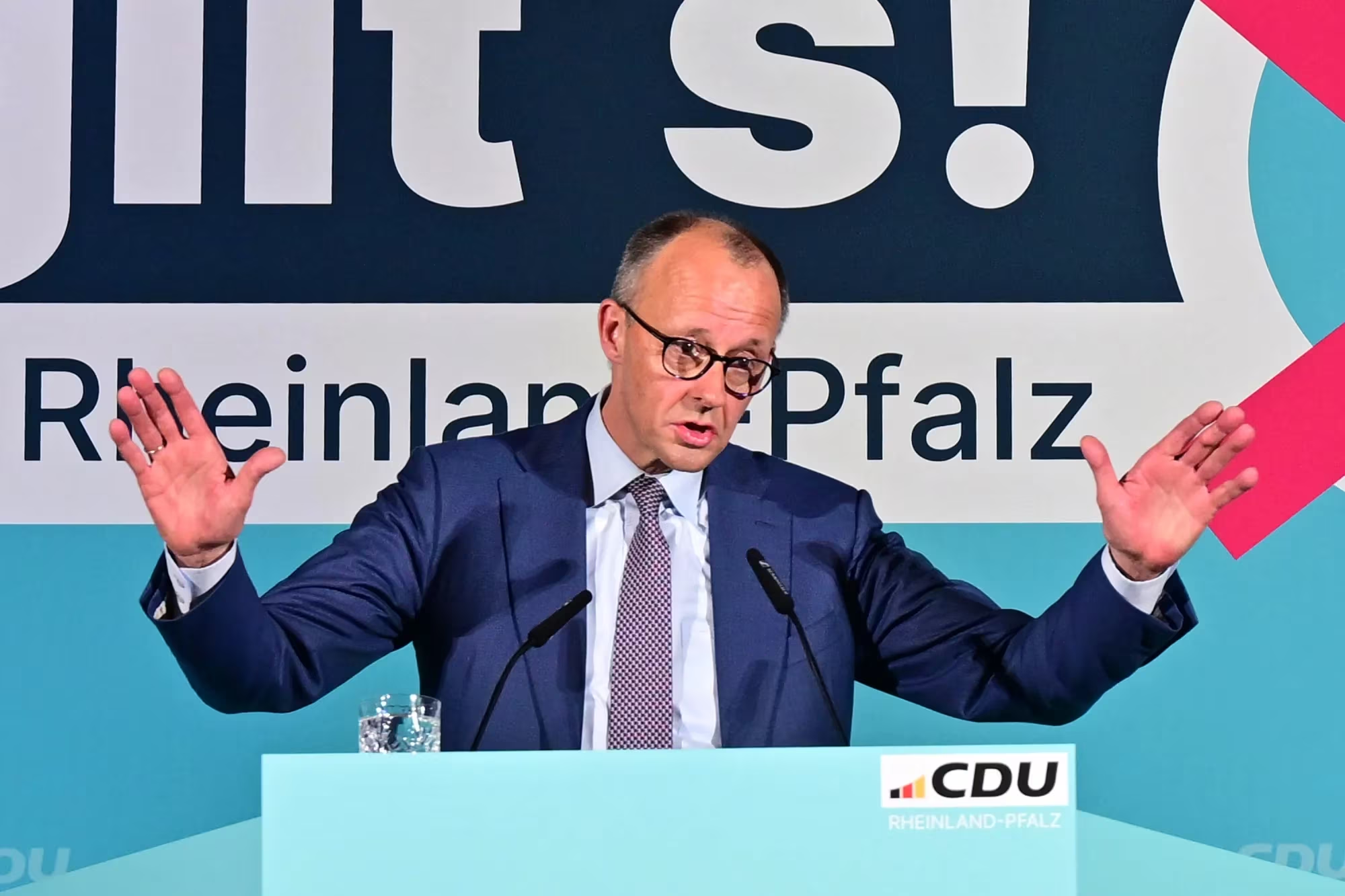
On Sunday, March 22, Friedrich Merz faces another chance to secure a regional election victory—just two weeks after his conservative party suffered a painful defeat in one of Germany’s most prosperous southwestern regions.
If the Christian Democratic Union fails to take power in the wine-producing state of Rhineland-Palatinate, it would deal a serious blow to Merz. Yet a defeat for the Social Democratic Party, which has governed the region for 35 years, would be even more consequential—particularly against the backdrop of an internal crisis following its worst result in history, recorded on March 8 in neighboring Baden-Wuerttemberg.
The result is a scenario in which Berlin’s governing coalition risks losing regardless of the outcome. Efforts to push through reforms have proven difficult and have yet to resonate with voters, while pressure from the far right continues to mount. Additional strain comes from a deepening energy crisis, technological shifts in industry, and weak economic growth—all of which are undermining Merz’s attempt to relaunch Europe’s largest economy.
Polls point to a narrowing gap in Rhineland-Palatinate: what had recently appeared to be a comfortable lead for the CDU is rapidly eroding as the vote approaches. According to a ZDF poll published on March 19, Merz’s conservatives stand at 29%—just two percentage points ahead of the SPD.
Sonntagsfrage zur Landtagswahl in Rheinland-Pfalz • FG Wahlen / ZDF: CDU 29 % | SPD 27 % | AfD 19 % | GRÜNE 9 % | DIE LINKE 5 % | FREIE WÄHLER 4,5 % | Sonstige 6,5 %
— Wahlrecht.de (@Wahlrecht_de) March 19, 2026
➤ Verlauf: https://t.co/dp1XRp7ENQ
🗓️ Nächste Landtagswahl: 22. März 2026#ltwrp #ltwrp26 pic.twitter.com/oaB77WMsET
A similar pattern played out in Baden-Wuerttemberg, where Merz’s party saw its double-digit lead over the Greens all but evaporate in the weeks leading up to the vote. In the end, the environmental party prevailed by less than one percentage point, retaining control of a region home to Mercedes-Benz AG and Porsche AG and extending its 15-year hold on power.
The setback was significant for Merz. Just weeks before the election, he had secured backing for his leadership at a party conference in Stuttgart and confidently predicted two victories in southwestern Germany in March, describing the Christian Democratic Union as the “DNA of this republic.”
Yet, as in the Baden-Wuerttemberg campaign, the conservatives are up against an incumbent Social Democratic premier—Alexander Schweitzer—whose personal popularity far exceeds that of their candidate, regional CDU leader Gordon Schnieder. According to a ZDF poll, Schweitzer is backed by 40% of voters, compared with 25% for Schnieder, even though he is not directly elected.
Voting will conclude at 6:00 PM local time on Sunday, after which Germany’s main broadcasters will release exit polls offering an initial indication of the outcome. Ballots will be counted throughout the evening.
For the SPD, Merz’s coalition partner in Berlin, the stakes may be even higher. Its 5.5% result this month—on the brink of clearing the threshold to enter the state parliament—marked the party’s worst performance in the region since the Second World War.
Yet in Rhineland-Palatinate, the Social Democrats have long held a dominant position, retaining the office of minister-president since 1991. SPD co-leader and German Vice Chancellor Lars Klingbeil made clear that the setback on March 8 makes a victory on Sunday all the more essential.
A defeat would intensify pressure on the party and could further complicate its coexistence with the conservatives in the federal government. Significant disagreements already persist between the partners over pension policy, the system of unemployment benefits, and fiscal discipline.
At the same time, the election will serve as a gauge of support for the far-right Alternative for Germany, whose backing, according to polls, has more than doubled and is approaching 20% compared with the previous election five years ago. Three more regional votes later this year—particularly in the eastern states of Saxony-Anhalt and Mecklenburg–Western Pomerania—will take place against the backdrop of the party’s growing strength.
In Saxony-Anhalt, Alternative for Germany could theoretically secure an outright majority, which would, for the first time since its founding in 2013, allow it to form a regional government. The party advocates an end to immigration and the mass deportation of non-citizens of Germany.