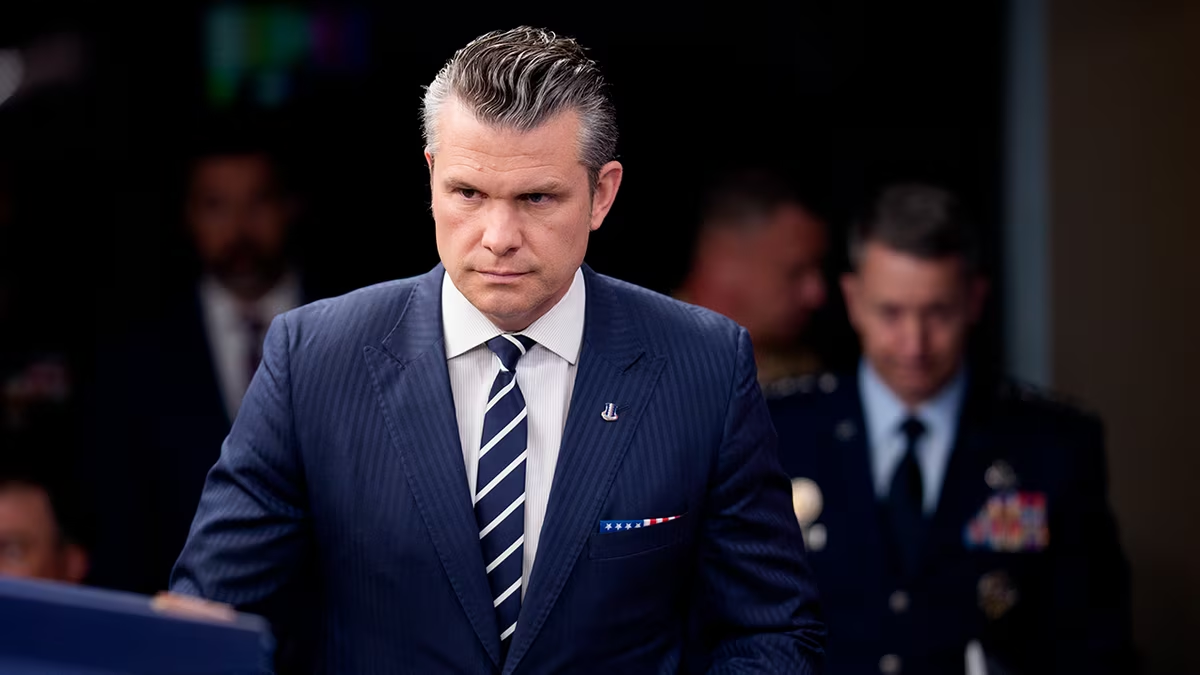
The missile strike on September 2 against a Venezuelan vessel suspected of drug trafficking became one of the most controversial episodes of U.S. operations in the Caribbean Sea. After the initial attack, some people aboard survived, but they were soon hit again in a follow-up strike captured on video. The Pentagon’s refusal to release the footage—which Defense Secretary Pete Hegseth has described as too sensitive for public disclosure—has triggered sharp divisions in Congress and raised questions about the transparency of the administration’s decision-making.
Republican senators are publicly questioning Defense Secretary Pete Hegseth’s decision not to release the full video of the September 2 strike on two individuals who survived the first attack on the Venezuelan vessel. In doing so, lawmakers are effectively revisiting one of the Trump administration’s key operational decisions in the Caribbean Sea.
The dispute between senators and the administration over whether to make the footage public is unfolding against the backdrop of mounting pressure on Republicans amid President Donald Trump’s increasingly hard-line approach toward Venezuelan President Nicolás Maduro.
“My starting position is to make the video available,” said Senator John Cornyn, a Texas Republican and a senior member of the Intelligence Committee, referring to the footage of the missile strike on two people who survived the initial attack on the Venezuelan vessel in September. “That would be the right thing to do,” he added.
U.S. Defense Secretary Pete Hegseth Suspected of Ordering the Killing of Two People From a Sunk Drug Boat
He Is Unlikely to Face Any Consequences
U.S. Launches New Strike on a Vessel in the Caribbean
Three People Killed in the Operation, Bringing the Total Death Toll to at Least 70
According to Cornyn, releasing the video would help defuse Democratic accusations that Hegseth is trying to conceal an “atrocity on the high seas.” He noted that keeping the footage secret is “the best way to fuel conspiracy theories,” while acknowledging that the final decision rests with the defense secretary.
Senator Lindsey Graham, a South Carolina Republican, also said that the video of the follow-up strike on the survivors should be broadly accessible to members of Congress—something Hegseth has yet to allow. “I believe this video should be made available to everyone in Congress,” Graham told reporters when asked whether the Pentagon should share the footage of the strike. “I don’t think most Americans care about this video at all. I want all of us to see it,” he added.
Hegseth himself said after a briefing on Tuesday that the footage is too sensitive for public release. “In line with the long-established policy of the Department of War—the policy of the Department of Defense—we are, of course, not going to release a top-secret, full, and unredacted video to the general public,” he told reporters.
Secretary of State Marco Rubio also took part in the closed briefing.
Senator Josh Hawley, a Missouri Republican, said he understands Hegseth’s reluctance to release the full, unredacted video of the second strike on the two people who survived the initial missile blast. However, he questioned why the footage could not be partially redacted to protect sensitive information. “I do think that anything that can be edited and released would be helpful. And I say that because I haven’t seen the video myself, but those who have tell me it largely vindicates the secretary’s position,” Hawley said. If the footage can be appropriately censored in a way that allows the public to see the key segments, he added, “that would be great.”
Senator Thom Tillis, a North Carolina Republican, urged the administration to release the video of the second strike and renewed his call for the publication of all unclassified materials related to the convicted sex offender Jeffrey Epstein. “We’ve got to release the video. We’ve got to get the Epstein files out. We’ve got to release any footage that in no way compromises mission integrity—just put it all out there,” he said. As long as the materials remain withheld, Tillis added, “everyone is left guessing what’s in them,” which is precisely why, he said, “it’s so important to release the video.” “We simply have to be as transparent as possible,” Tillis stressed.
Senate Democratic leader Chuck Schumer directly confronted Hegseth over the refusal to release the footage during a briefing on Tuesday, December 16. He rejected Republican claims that the video exonerates either Hegseth himself or the commander who oversaw the strike, Admiral Frank Bradley, who earlier this month had already briefed senior lawmakers on the incident. “This morning I demanded, in front of all the senators, looking Hegseth in the eye, that he allow every senator to see the unredacted video of the events of September 2. I’ve seen it. It turns your stomach. It’s horrific, and people need to see it,” Schumer told reporters after the briefing.
Senior military officials are expected to present the full recording of the September 2 strike to members of the Senate Armed Services Committee. Senate Republican leader John Thune of South Dakota, however, declined on Tuesday to say directly whether he supports Hegseth’s decision not to release the video, despite calls from senators in both parties. “I’ve left that question to the Senate Armed Services Committee,” he said. “I trust their judgment.”
Committee chairman Roger Wicker, a Mississippi Republican, and his Democratic vice chair, Jack Reed of Rhode Island, are pressing the Pentagon to provide the video to the full committee, according to Senate sources. “There is almost no transparency in this administration, and nothing illustrates that more starkly than the concealment of what happened on September 2,” Schumer said after the briefing. He stressed that releasing the footage is necessary “to determine whether we followed the law—we are a law-abiding country.” What is unfolding in the Caribbean, he added, is unprecedented and “could lead to yet another endless war.”
Some Republican senators, including Graham—one of Trump’s closest allies—acknowledge that they lack sufficient clarity about the president’s broader objectives toward Venezuela. “Most Americans want to know what comes next. I want to know what comes next. Is the overthrow of Maduro official policy? If not, it should be. And if he goes, what happens then?” Graham told reporters. “I need a clearer answer about what follows Maduro’s departure,” he added.
Democrats and a number of national security experts argue that the follow-up strike on the survivors could meet the definition of a war crime. They say Trump has failed to provide a sufficient legal justification for the use of lethal force against vessels suspected of drug trafficking—an activity that has traditionally fallen under the jurisdiction of the Coast Guard and the Drug Enforcement Administration.