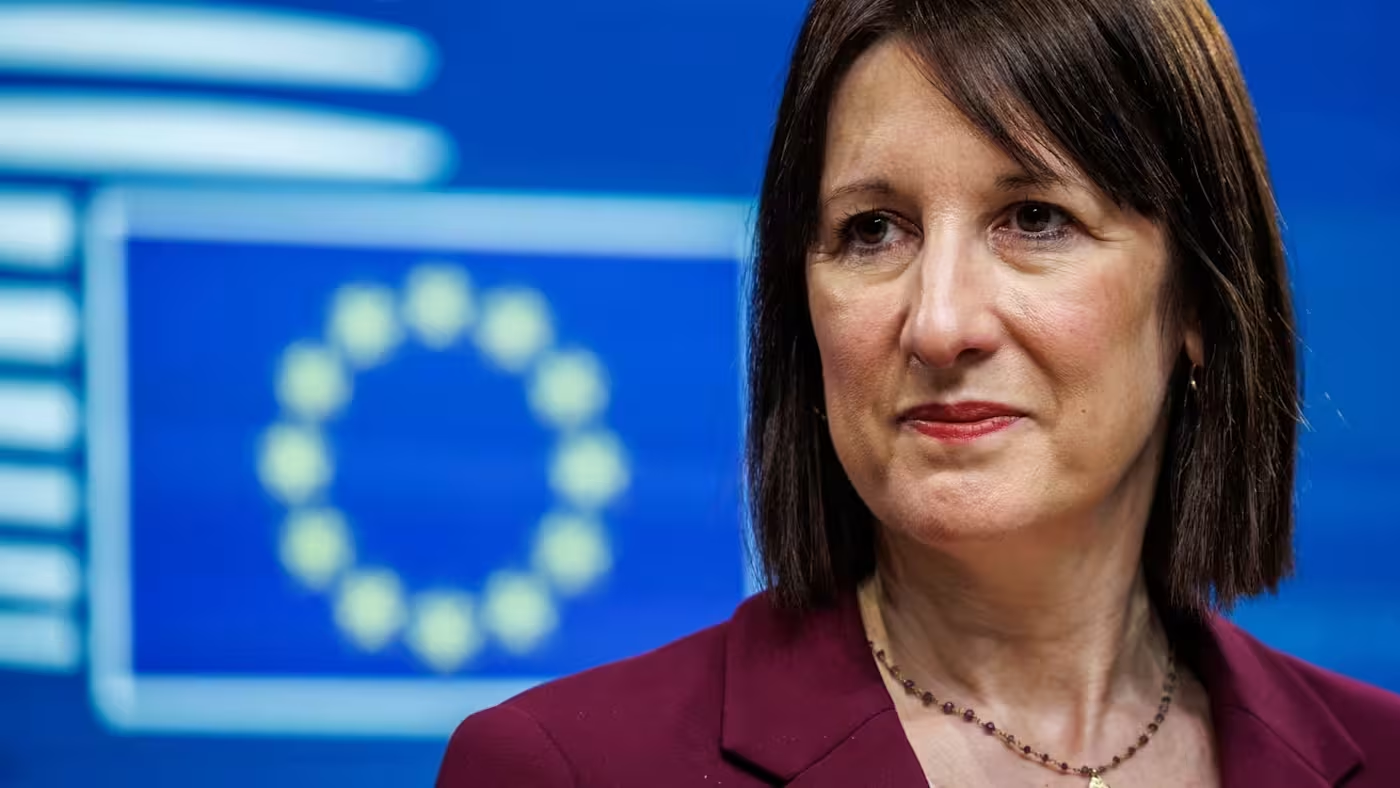
Rachel Reeves said she intends to compete for the “biggest prize” in global trade by betting on closer ties with the European Union. Against this backdrop, the UK chancellor signaled she is prepared to step back from a potential clash with Brussels over environmental standards governing the protection of natural habitats.
Presenting plans to deepen economic and defense ties with the EU, Reeves on Wednesday effectively outlined a course toward the gradual dismantling of Brexit’s legacy. In her words, “the biggest prize is obvious—it’s the European Union,” and “economic gravity is a reality that cannot be wished away.”
She made clear that London is willing to unilaterally align its regulations with Brussels’ rules if that helps expand trade with the bloc. Under this new approach, the chancellor is expected in the coming weeks to soften the recommendations of an official report that had urged scrapping parts of habitat-protection rules for wildlife and plants in order to accelerate infrastructure projects.
Reeves does not want to roll back regulatory requirements that existed even before Brexit. People close to her fear that undermining EU environmental rules would trigger a dispute with Brussels and complicate further rapprochement with the single market. “The issue is what is better for the economy overall,” one ally of the chancellor explained. “It’s simply about finding the right balance.”
After several days of political turbulence in Westminster, Reeves and Prime Minister Keir Starmer are seeking to reassure businesses and Labour MPs, telling them they intend to restart the process of the UK’s economic reintegration with the EU.
Speaking at the London School of Economics at an event organized by a Brussels-based think tank, Reeves stressed that there are three major economic blocs in the world—the US, China, and Europe. London, she said, will look for growth opportunities across all trade fronts, but only one of these blocs sits “right on our doorstep,” making deeper integration with Europe the central priority.
Reeves has previously spoken about her willingness to align British rules with European ones to remove trade barriers in traditional sectors, including the chemicals industry. While she has yet to spell out which other areas this approach might cover, she has told colleagues that new avenues of cooperation are expected to be identified at an EU-UK summit later this year.
According to Reeves, London will examine options for further integration with the EU through sector-by-sector alignment of standards—both through negotiations and unilaterally. She also voiced concern that countries are beginning to build “mini-fortresses” and called for closer cooperation among states that share common values. “I would like to create a broader club of like-minded partners,” she said.
Starmer is expected this week to deliver a pro-European speech, including on defense cooperation, at the Munich Security Conference. According to British officials, he also plans to reaffirm London’s interest in joining the second round of the pan-European defense fund, provided an acceptable contribution can be agreed. Such participation would allow British companies to carry out up to 50 percent of the work on joint projects and to act as their coordinators.
On Wednesday, Reeves acknowledged her frustration with the slow pace of talks with European countries on defense. “There is no question about the urgency of defense issues,” she said. This could involve joint efforts to improve the efficiency of defense spending, an expansion of shared procurement, and the use of cheaper financing tools in the sector.
The chancellor is also pressing the EU not to discriminate against British companies under the new “made in Europe” initiative. As she has told colleagues, “we are Europe too and should be part of this,” adding that the EU has no scope to exclude countries that share common values.
As part of a broader “reset” in relations launched last year, Reeves is pushing within government what her allies describe as an “ambitious youth mobility scheme” that would allow more young Europeans to work in the UK.
The first major test of her EU-facing strategy will be how she responds to a government-commissioned report on cutting regulatory barriers that have made the UK “the most expensive place in the world” to build nuclear power plants.
The work on the document was led by John Fingleton, a former head of the competition authority. In the final report, he said: “By simplifying regulation, we can maintain—or even raise—safety standards and finally begin delivering nuclear capacity safely, quickly, and at an affordable cost.”
Reeves has previously been sharply critical of rules protecting newts, bats, and “micro-snails” at the expense of housing and infrastructure development. However, people close to her say she is cautious about any steps that could jeopardize the UK’s future access to the single market.
Under the post-Brexit Trade and Cooperation Agreement between the EU and the UK, both sides committed not to weaken labor, social, and environmental standards below their December 2020 level—the so-called “non-regression” rules.
In December, Starmer spoke positively about Fingleton’s report, saying its call for deregulation should be applied to nuclear construction “across the entire industrial strategy.” This month, EU financial services commissioner Valdis Dombrovskis said after meeting Reeves that the EU would consider British proposals to remove post-Brexit trade barriers “with an open mind.” Brussels, he added, is “ready to discuss various avenues within the context of the single market.”