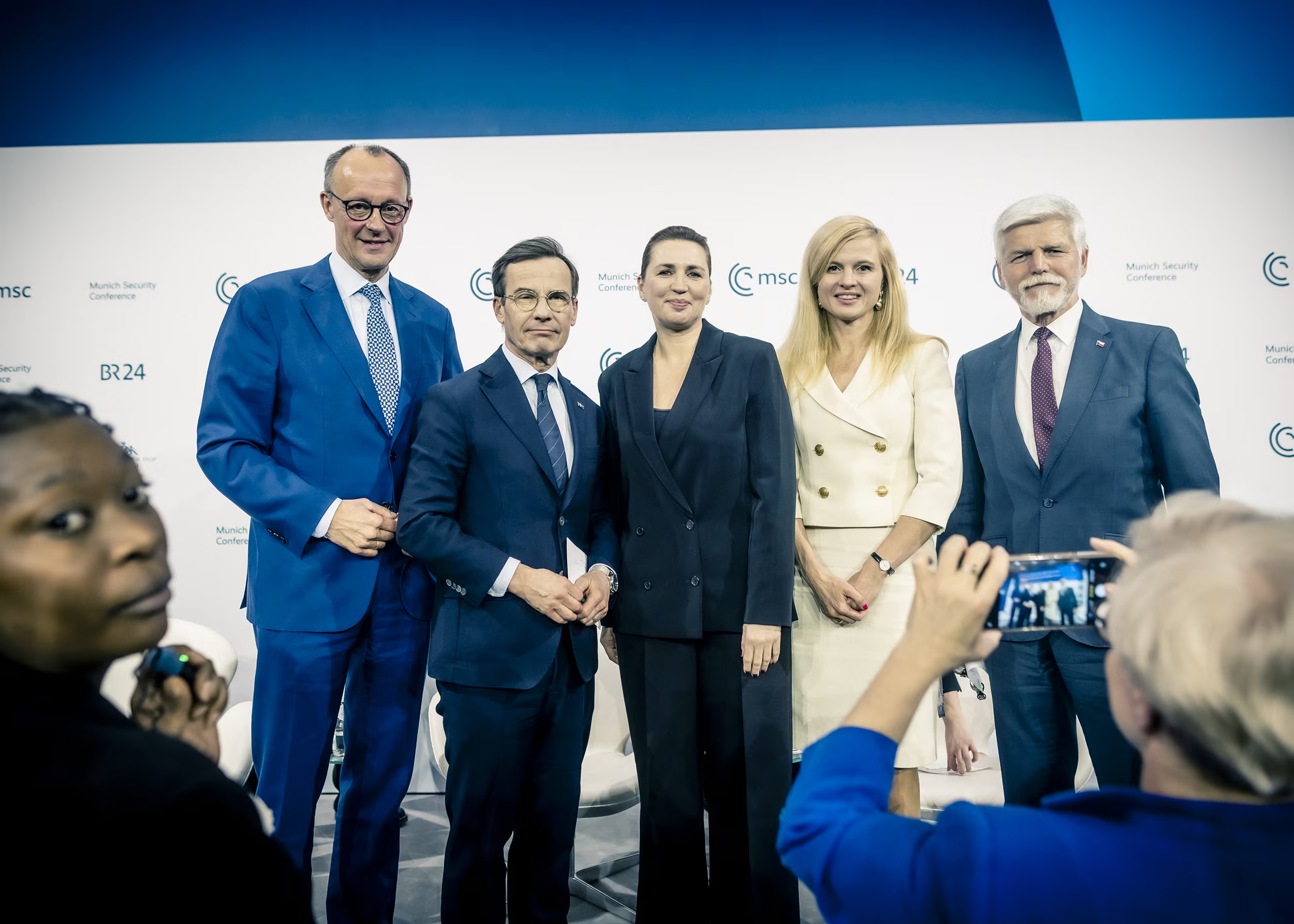
If one reduces the statements made by European politicians at the Munich Security Conference to a common denominator, their strategy against the backdrop of a sharp shift in US foreign policy can be described quite simply. Europe simultaneously registers a threat from Donald Trump, treats Russia as an adversary, and concludes that “ending the war in Ukraine entails additional risks for the continent.” This logic translates into a push for accelerated movement toward so-called strategic autonomy from the United States, preparation for a possible confrontation with Russia even without American support, and a rejection of a hasty peace in Ukraine until Moscow has been exhausted both militarily and economically.
This approach effectively steers Europe toward the prospect of a war on two fronts—which in itself creates a systemic threat.
Meanwhile, Trump’s logic toward Europe is already fairly transparent. The European Union is one of the United States’ key competitors in the global market, second only to China in this respect. It is no coincidence that Trump regularly claims the EU was created to “destroy the United States.” Against this backdrop, Europe has been actively debating versions of a scenario in which Washington is allegedly prepared to “abandon” the continent, renounce NATO security guarantees, or even reach an understanding with Moscow on a division of spheres of influence. Yet there is no tangible evidence that such a scenario exists.
Trump does indeed display a hard-line and often openly hostile stance toward Europeans, whom he regards as “freeloaders” accustomed to benefiting from their alliance with the United States without contributing proportionately. He pushes through unequal trade agreements and attacks both European institutions and individual states. But the aim of this policy is not to share influence over Europe with the Kremlin. Rather, it is about turning Europe into a US-dependent vassal—effectively a colony—by leveraging its critical reliance on the American security system. This is precisely why the United States has no intention of abandoning NATO, viewing the alliance as an effective instrument for preserving its dominance on the continent.
Within this framework, Europe is expected to follow the American course and channel its resources into purchasing US goods, including energy supplies. Pressure to abandon Russian oil and gas fits the same logic. Trump wants to extract value from the European economy on his own terms, without sharing it with Russia—or, even more so, with China.
In European capitals, there is hope that Washington can be persuaded to view the EU as a junior but nonetheless useful partner within the framework of the “global West.” This line is pushed most actively by the British and by individual politicians such as Merz. Trump, however, while accepting additional defense contributions and higher military spending, has no intention of offering Europe any meaningful reciprocal guarantees. He treats the American “nuclear umbrella” over NATO as a service for which Europeans already owe the United States.
A strong and unified Europe has no place in Trump’s new geopolitical outlook, as it would retain at least a theoretical capacity for independent geopolitical and geoeconomic maneuvering distinct from Washington’s line. From this follows US interest in weakening the EU, encouraging internal conflicts, and even entertaining the prospect of its fragmentation. Dealing with individual states placed in direct dependence is far easier than engaging with a consolidated union.
Layered onto this is an ideological confrontation between Trump’s right-wing politics and the EU’s liberal-left elites. In Europe, many hope that a potential return of the Democrats to power in the United States would restore the situation “to how it was under Grandpa Biden.” Yet there are no guarantees either that Trump will lose power in the near term or that his successors would abandon the new course if it proves effective in strengthening American dominance and boosting the US economy. From this perspective, Europe’s full dependence on America appears maximally advantageous for Washington.
Thus, Europeans face a stark choice—either accept the role of an American colony, with the gradual degradation of the economy and the dismantling of the welfare state amid rising military expenditures, or attempt to organize resistance to the new US course. In the latter case, the question of the war in Ukraine and policy toward Russia would inevitably come to the fore.
The war’s key geopolitical outcome has been a sharp rapprochement between Europe and the United States, coupled with an equally sharp deterioration in relations with Moscow. Yet at a moment when Trump’s policies are taking on an existential character for the EU, a logical step would be at least the normalization of relations with Russia, a necessary condition for which is an end to the war in Ukraine. Otherwise, Europe risks finding itself in a two-front conflict—a scenario that would be catastrophic—while the continuation of the war only deepens the EU’s dependence on American military support and effectively deprives it of room for maneuver in its dealings with Washington.
It is therefore no coincidence that in the United States, advocates of a hard line view an end to the war in Ukraine as undesirable. Its continuation binds Europe even more tightly to America through fear of Russia, constrains Moscow’s activity on other fronts, weakens it economically, and provides justification for sanctions pressure, including the displacement of Russian oil and gas from global and European markets.
Even so, Ukraine, Russia, and Europe have in many ways been fortunate that Trump himself is interested in bringing the war to a swift conclusion. His motives combine strategic calculations—seeking at least Moscow’s neutrality in a confrontation with China and avoiding the risk of escalation up to the nuclear level—with tactical aims, including domestic political dividends ahead of congressional elections, the use of unfrozen Russian assets, and the launch of business projects with Russia. Not everyone in the president’s inner circle or in the Republican Party shares this approach, where the defense-industrial complex and the oil-and-gas lobby wield significant influence. For now, however, it is the position of the head of state that sets the administration’s course.
The problem is that neither Europe, nor Ukraine, nor Russia is rushing to take advantage of this window of opportunity to end the war. European thinking continues to rest on the notion that an end to the fighting would allegedly lead almost immediately to a Russian attack on the EU. Public rhetoric creates the impression that Europe and Russia are on the brink of a direct clash—plans are being discussed for deploying troops to Ukraine, blockading the Baltic, and intercepting tankers carrying Russian oil, while within Russia’s expert community there is talk of nuclear strikes on Paris. European media continue to stoke expectations of war with Russia, which objectively plays into the hands of the American course by deepening Europe’s dependence on the United States.
After the Greenland episode, a few voices in Europe began calling for a tougher line toward Trump and for dialogue with Moscow, but for now they remain marginal. Russia, for its part, is signaling readiness for negotiations, though on the terms of the so-called “Anchorage,” including the withdrawal of Ukrainian forces from Donetsk Oblast. The Kremlin is counting on Trump’s desire for a quick deal to push him toward pressuring Kyiv. If that does not happen and talks drag on, there is a risk that the US president will, over time, shift toward the positions of the “hawks” in his entourage, for whom the continuation of the war in Ukraine is a tool of pressure on Russia.
In this situation, Moscow still faces a choice—either to continue the war in pursuit of an unattainable maximum, or to agree to a halt in hostilities along the front line in exchange for the greatest concessions still achievable. This could serve as a means of strengthening its economic and geopolitical position, given that the United States may at any moment pivot toward a course of frontal confrontation with Russia, for which ending the war is precisely what Moscow would need to prepare. For now, however, there are no signs that the Kremlin is ready for such a maneuver, although historical precedents do exist.
For Kyiv, the situation appears no less risky. Since the Maidan and the annexation of Crimea, Ukrainian foreign policy has been built around preventing any form of accommodation between the West and Russia, on the assumption that a deterioration in their relations would automatically strengthen support for Ukraine. After the start of the full-scale war, this logic became firmly entrenched. Any attempts at dialogue with Moscow are met with hostility, while escalation between Russia and the West is greeted with enthusiasm. The current bet is on dragging out negotiations and on the expectation that Republican “hawks” will either draw Trump into a hard confrontation with Russia or that US domestic problems will block any rapprochement between Moscow and Washington.
In practice, such a strategy is extremely dangerous for Ukraine. It prolongs a destructive war for an indefinite period and, against the backdrop of rising overall tensions, increases the risk of radical escalation up to and including the nuclear level—an outcome that would be catastrophic for the country. The only sustainable security guarantee for Kyiv remains a strategic normalization of relations between Europe and Russia, under which Ukraine would cease to be an object of geopolitical confrontation and would be able to develop in a peaceful environment.
For now, this scenario remains very distant, and developments are moving rather in the opposite direction. Even so, amid large-scale geopolitical shifts, a rapprochement between Moscow and Europe’s capitals cannot be ruled out entirely. An alliance between Russia and the EU is objectively complementary, but in the past it was blocked first by ideological differences and later by the conflict over Ukraine. In the new reality, ideology is clearly receding into the background, and it is precisely the end of the war in Ukraine that could serve as the starting point for bringing the Russian–European confrontation to a close. Implementing such a pivot would be extraordinarily difficult, given the fragmentation of the European Union, the need for reciprocal steps from Russia, and the difficulty of reaching agreements between Moscow and Kyiv. Yet the alternative—continued war and an intensifying confrontation with the risk of escalation—appears maximally destructive for all parties.