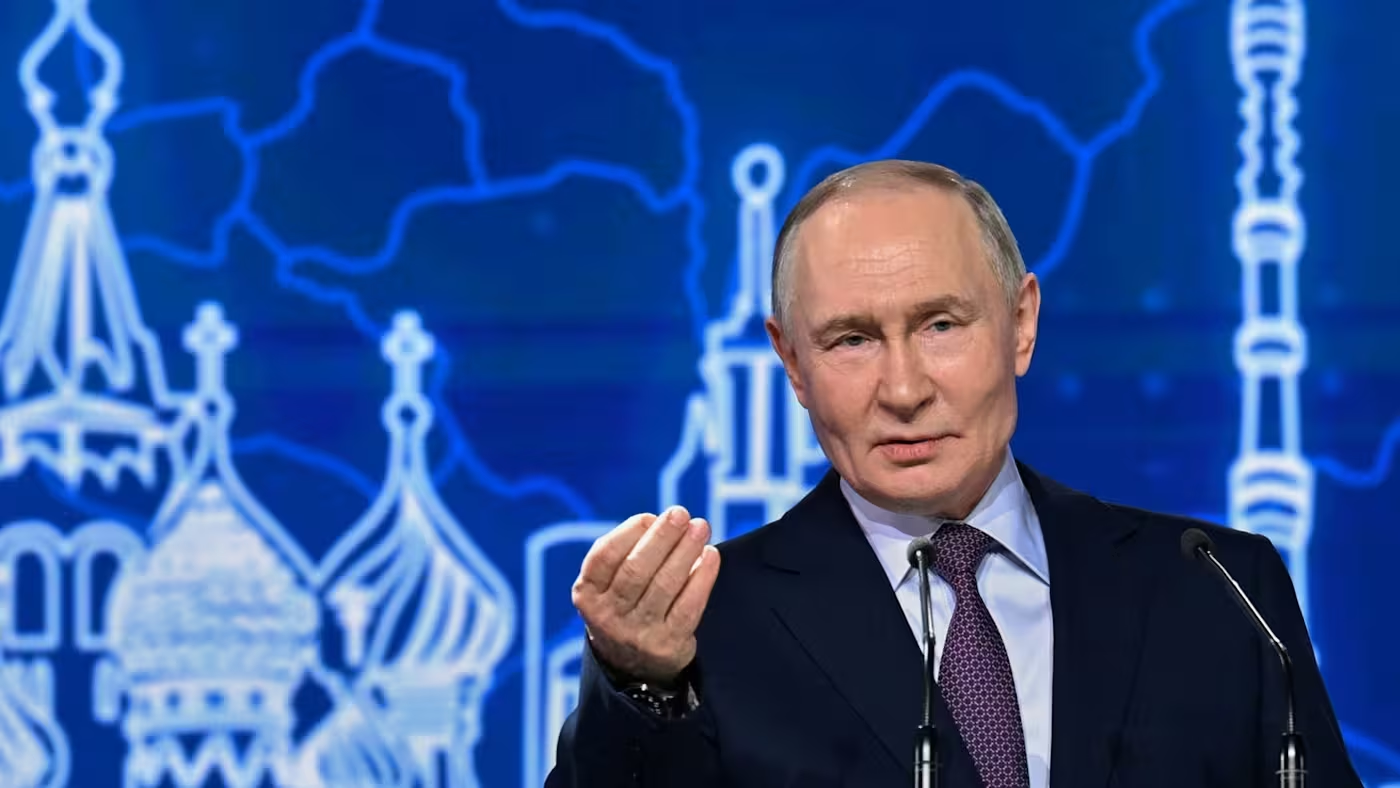
Vladimir Putin has appealed to leading Russian businessmen to make contributions to the state budget, seeking to stabilise public finances amid the ongoing war against Ukraine, according to three people familiar with the matter.
Speaking on Thursday to a group of influential business figures, the president made clear that he intends to carry the military campaign through to a “victorious end” despite mounting pressure on the budget. According to two interlocutors, Putin said Russia would continue fighting until it secures control over the remaining parts of the Donbas not yet under its authority. He presented this decision as a response to Ukraine’s refusal to withdraw its forces from the region during recent US-mediated negotiations.
One source noted that Putin had previously considered a compromise option—turning the Donbas into a “demilitarised zone” or a “special economic zone” with US backing—but abandoned the idea after Kyiv made clear that surrendering the region was a “red line”.
The appeal to oligarchs marks another attempt by the authorities to shift part of the war’s costs onto business—and the first time Putin has done so directly. Since the full-scale invasion, the Kremlin has already taken similar steps: in January, the VAT rate was increased by 2 percentage points—to 22%—a move expected to generate an additional 600 billion roubles ($7.4 billion) over three years, largely at the expense of small and medium-sized businesses. In 2023, a one-off 10% windfall tax was also imposed on a number of large companies, raising 320 billion roubles.
On the same day, Economy Minister Maxim Reshetnikov said the authorities were considering introducing another such tax this year if the rouble continues to weaken.
Defence spending rose by 42% to reach 13.1 trillion roubles last year.
Putin’s remarks were first reported by the independent outlet The Bell. His spokesman, Dmitry Peskov, did not respond to a request for comment.
A personal appeal from the president to the business elite leaves little room for refusal. Despite concerns about the war’s economic consequences, major entrepreneurs have largely remained loyal to the authorities. According to sources, at least two participants in the meeting signalled their readiness to make voluntary contributions.
Suleiman Kerimov, who has been linked to the recent controversial transfer of control over the online retailer Wildberries, expressed willingness to contribute around 100 billion roubles. Metals magnate Oleg Deripaska also agreed to take part in financing the budget. Representatives of both businessmen did not respond to requests for comment.
At the same time, the situation on the battlefield is becoming more complicated: the intensive use of drones has slowed the advance of Russian forces in the Donbas—a region that has remained a cornerstone of Kyiv’s defence since 2014—and led to a sharp rise in losses.
The latest round of peace talks in January stalled amid Ukraine’s refusal to accept Russia’s sweeping territorial demands and Putin’s insistence on achieving the objectives set out in February 2022.
Russia’s budget deficit for January and February has already exceeded 90% of the annual forecast, driven in part by US sanctions that have forced Moscow to sell oil at steep discounts and deterred buyers.
Additional—but temporary—support for revenues came from a rise in oil income—to $150 million a day—following the outbreak of war between the US and Israel and Iran about a month ago. On Thursday, Russian authorities said that Urals crude is no longer trading at a discount to Brent, while earlier this month the US eased sanctions on Russian oil exports.
The finance ministry had planned to tighten the rules governing the transfer of excess oil revenues into the depleted National Wealth Fund, but those plans were revised after the outbreak of the conflict involving Iran.
Alexander Shokhin, head of the Russian Union of Industrialists and Entrepreneurs, said Putin had urged businesses to channel additional income into strengthening their own balance sheets. According to Shokhin, the president expressed hope that the war involving Iran would end “within three to four weeks”, while at the same time warning financial authorities and businesses “not to count on this inflow of revenues lasting long”.