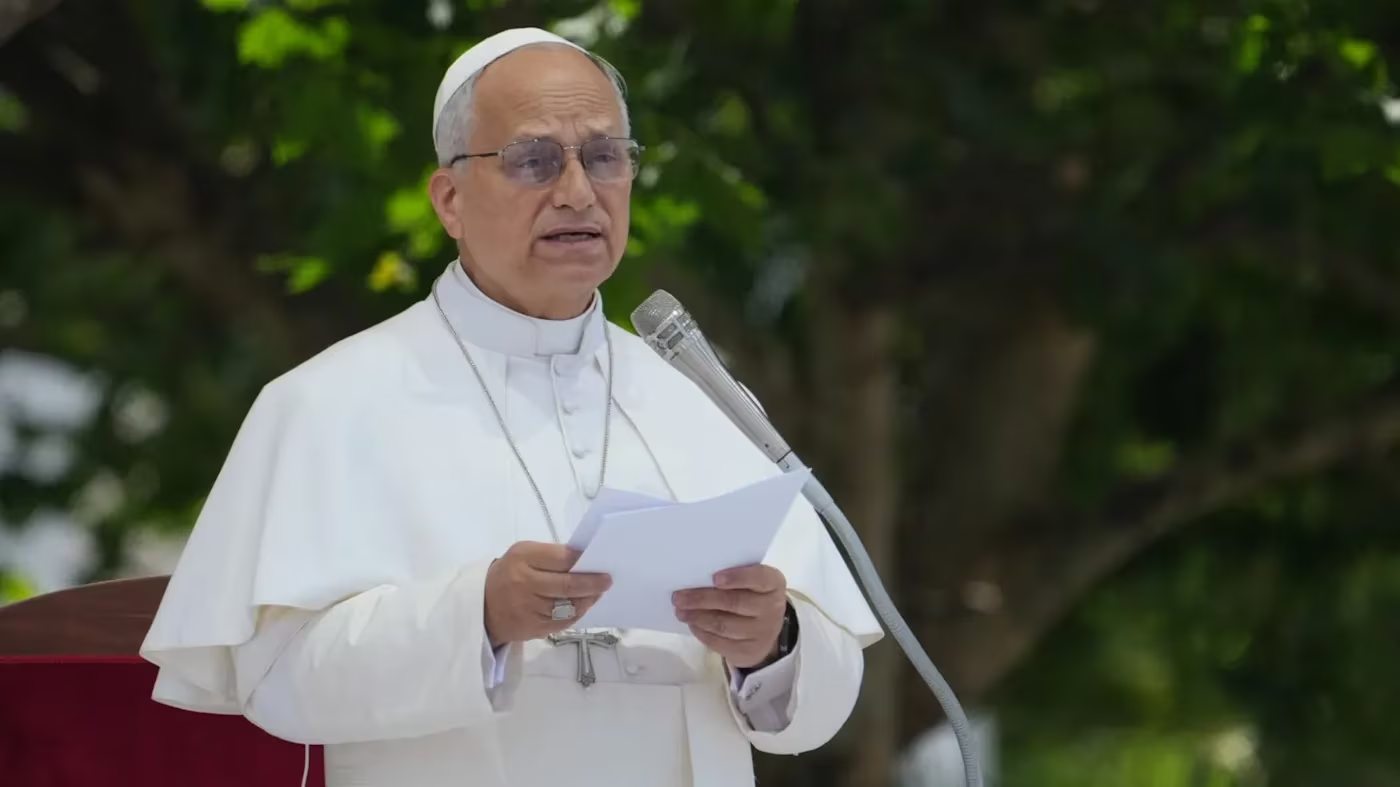
Pope Leo called for artificial intelligence to be “disarmed” through strict regulation and limits on its military use, warning of the dangers posed by a technological revolution driven by the “idolatry of profit.”
In his first encyclical since becoming pontiff, Leo said the development of AI—controlled by major private companies and built on “opaque algorithms”—poses the threat of “new forms of dehumanization.”
Presenting the document at the Vatican, the pope said he had reached “deeply troubling conclusions” about the nature of artificial intelligence and the urgent need for measures to limit its harmful effects.
Leo drew parallels between AI and nuclear technology, arguing that artificial intelligence, like atomic energy, must remain under public oversight and be regulated according to principles of “moral discernment.”
“Artificial intelligence must be disarmed,” the pontiff said. “I understand that this is a strong word, but it was chosen deliberately.”
“The Church has long advocated nuclear disarmament. Now artificial intelligence also requires disarmament—liberation from the logic that turns it into an instrument of domination, exclusion, and death.”
The pope also warned about algorithms that could restrict access to healthcare, employment, or security on the basis of biased data.
The encyclical Magnifica Humanitas, regarded as the Catholic Church’s official moral teaching on contemporary issues, comes amid growing criticism of AI—from concerns about its use in medicine and government contracting to fears among parents about its impact on children.
Anthropic co-founder Christopher Olah also attended the presentation of the document, acknowledging that the questions surrounding artificial intelligence extend far beyond the AI community itself.
According to Olah, developers increasingly face a contradiction between the desire “to do the right thing” and mounting commercial, geopolitical, and personal pressures.
In the encyclical, the pope also criticized transhumanist and posthumanist ideas associated with parts of Silicon Valley, including views linked to Peter Thiel and Elon Musk. According to the pontiff, AI is being developed in an intellectual environment where some people are regarded as “less useful, less desirable, and less worthy.”
Leo said the Church has a duty to speak out about new forms of exploitation tied to AI, including the spread of harmful content, rare mineral extraction, and human trafficking.
He also issued a historic apology for the Catholic Church’s role in justifying slavery in the past.
“This is a wound in Christian memory from which we cannot consider ourselves detached,” the pontiff wrote.
“For this, on behalf of the Church, I ask forgiveness,” he added.
The pope spoke especially forcefully against the use of artificial intelligence in warfare. AI technologies were already used during Donald Trump’s campaign against Iran to support military planning and decision-making.
“It is unacceptable to delegate lethal or irreversible decisions to automated systems,” Leo said, calling for an “identifiable and verifiable” chain of responsibility and mandatory human oversight over strike decisions.
“When the decision to launch a strike becomes automated or opaque, the risk of evading responsibility increases,” the document states.
The pope also renewed his criticism of the U.S. war against Iran, which had already caused tensions with the Trump administration and disputes with Washington.
U.S. Vice President JD Vance and Defense Secretary Pete Hegseth had attempted to justify the strikes on Iran through the concept of “just war,” which exists within Catholic tradition.
However, Leo explicitly rejected that interpretation.
“The theory of ‘just war,’ which has too often been used to justify any war, is now obsolete,” the pontiff wrote.