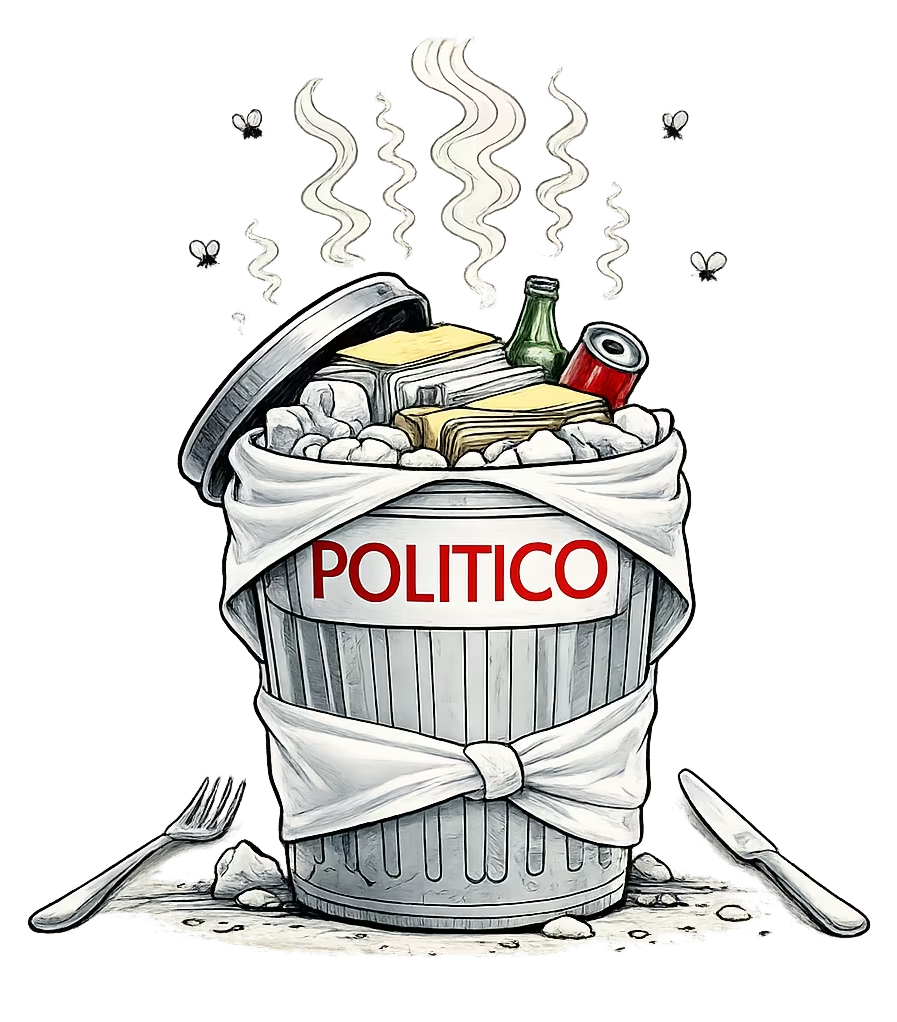
Politico published a piece citing unnamed European diplomats, claiming that Slovak Prime Minister Robert Fico, after a meeting with US President Donald Trump at Mar-a-Lago, shared extremely harsh assessments of the American president’s condition with EU leaders.
The article includes quotations in quotation marks attributed to Fico. In particular, Politico claims that at a closed summit last week the Slovak prime minister allegedly said that Trump had “lost his mind” and described his condition as alarming. These remarks are presented as a retelling conveyed to the outlet by sources familiar with the substance of the discussions.
The key feature of this story is that it revolves around “quotes” that are not corroborated by any public statement, document, or recording. In Politico’s account, they exist in a single form only—as words that sources attribute to Fico in a private conversation. In such cases, readers are effectively left to judge the credibility of the claim by indirect signals: the outlet’s reputation, the logic of the context, and the consistency of the figure’s public actions.
Fico has made no such assessments publicly. On the contrary, he has not only declined to confirm them but has described his meeting with Trump in positive terms, expressed support for the US president, and portrayed the encounter as a success. After the EU summit concluded, Fico delivered sharp criticism of the EU leadership—and in those statements the target was not Trump but European leaders. Trump, by contrast, was held up by Fico as an example for Europe.
After the article was published, Fico issued a rebuttal. In it, he said he rejects Politico’s reporting and calls it false, arguing that the outlet is spreading fabrications based on claims without witnesses or evidence. According to him, no one “heard or saw anything,” yet this did not prevent Politico from “inventing a lie.” The White House also stated that the information presented by Politico is fake.
Formally, Politico relies on a construction standard in political journalism: citing sources who agreed to speak on condition of anonymity and attributing sharp language to those sources. This is how leaks about closed consultations, diplomatic negotiations, and internal discussions—by definition not publicly documented—are often reported.
The problem, however, is that this case does not concern decisions or facts that can later be verified, but assessments of a political leader’s mental state, relayed through third parties. That makes the publication particularly vulnerable: such claims are nearly impossible to prove, yet they carry an obvious political impact. Even if they are later disproved, the mere appearance of such a text creates an informational residue that is difficult to erase entirely.
The context sharpens questions about the sources and the motives behind the leak. The article appeared amid a deterioration in Fico’s relations with the EU leadership and against the backdrop of his demonstratively favorable stance toward Trump. A publication in which Fico is said to have remarked behind closed doors that Trump had “lost his mind” is objectively capable of damaging his ties with Washington—while simultaneously calling his public line into question.
This raises an unavoidable question: to what extent do such reports reflect the actual substance of closed-door conversations, and to what extent do they become a tool in the hands of those seeking a specific political effect. For a leak via the media, it is sufficient for a single circle of participants to want to lock in a “preferred” version of events while remaining beyond accountability. In such a scenario, the outlet’s authority turns into an amplifier: even cautious attribution “according to diplomats” makes a phrase part of the international agenda.
Politico has been criticized before for its tone and for conclusions built on sources and interpretations. Previously, the outlet published a piece on Belgian politician Bart De Wever in the context of frozen Russian assets, which was also seen as an attempt to present a political position through the prism of whom it “benefits,” rather than through verifiable facts. Such texts inevitably raise the question of where informing ends and the construction of a political narrative begins.
The Fico episode illustrates how this risk zone operates. Politico publishes “quotes” that sources attribute to the prime minister; Fico publicly denies them; the White House calls the report fake; and the reader is left between two versions—anonymous and official. In such cases, the quality of journalism is defined not only by what is written, but by how clearly the limits of knowledge are marked: what is confirmed, what is second-hand, and what cannot be verified.
This is precisely why publications of this kind inevitably become the subject of dispute not only over specific words, but over standards: how far a “serious outlet” can go when it turns sharp assessments not backed by primary evidence—even if placed in quotation marks—into news of international significance.