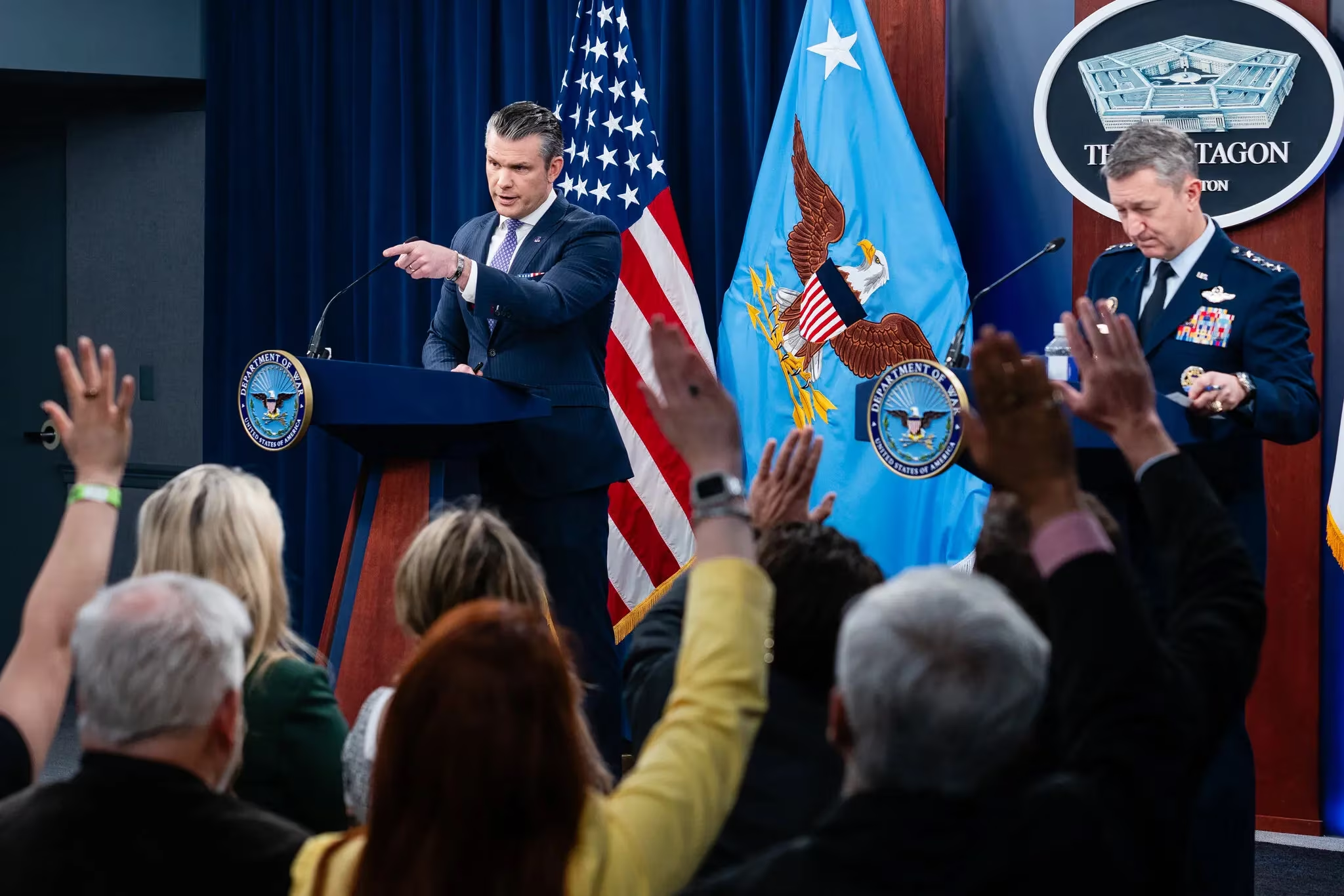
The United States has established such a degree of control over Iranian airspace that, for the first time since the war began, it is sending B-52 bombers directly over Iranian territory, Defense Secretary Pete Hegseth said at a Pentagon briefing on Tuesday, March 31.
At the same time, he said, Iran still retains the ability to strike neighboring countries using missiles and drones. “They will launch missiles—we will shoot them down,” Hegseth said, appearing alongside Chairman of the Joint Chiefs of Staff General Dan Caine at the first public briefing on the war in nearly two weeks.
Hegseth claims that the United States is “closer than ever to victory,” though he declined to give a timeline for the end of the conflict, saying that will depend on President Donald Trump and the course of negotiations with Iran. According to him, the talks are “real, ongoing, in an active phase and, it seems to me, gathering momentum.”
Iran has publicly denied taking part in direct negotiations with the United States. Foreign Minister Abbas Araghchi said on Tuesday that Tehran had not responded to the 15-point proposal conveyed by Washington and had not put forward any initiatives of its own.
The Pentagon’s assessment came as fuel prices in the United States continued to rise—average gasoline prices climbed above $4 a gallon for the first time since 2022, when Russia launched its invasion of Ukraine. A month of fighting has driven a sharp increase in oil and gas prices and sent stock markets downward.
On Tuesday, however, oil fell markedly on international markets—to a little above $100 a barrel—while stocks advanced in a broad rally, pointing to investor expectations that the conflict may soon come to an end. Optimistic statements from Trump and his administration have repeatedly offered temporary support to markets and helped restrain fuel-price growth, but the effect has proved short-lived amid continuing combat.
Commenting on the jump in energy prices caused by the closure of the Strait of Hormuz, Trump suggested on social media that other countries should “summon some overdue courage, go into the Strait and simply TAKE it.”
He directed the remark at “all those countries that cannot get aviation fuel because of the Strait of Hormuz, such as the United Kingdom.”
“You will have to learn to defend yourselves, the United States will no longer help you—just as you did not help us,” Trump wrote, adding: “Produce your own oil!”
Trump has repeatedly urged allies to play a more active role in the war being waged by the United States and Israel. Yet many countries find themselves caught between the desire to restore fuel supplies and the determination to avoid being drawn into a conflict they did not choose, that their publics do not support, and that could put their armed forces at risk.
Hegseth effectively echoed the president’s position, saying that countries affected by the blockade “could begin learning to defend themselves.” In his words, this is “not only a problem for the United States,” in response to a question about whether securing the Strait is a core task for Washington.
General Caine said American air power is focused on destroying the supply chains that sustain Iran’s production of missiles, drones, and ships, in order to deprive the country of the ability to replenish lost weaponry after thousands of airstrikes, including those carried out with aging B-52s.
Unlike more modern aircraft, these bombers, designed in the early 1960s, lack high maneuverability, stealth, and speed, making them vulnerable to air-defense systems. Their use over Iranian territory suggests that the American command believes Tehran’s ability to shoot down such targets has been largely suppressed.
According to Hegseth, strikes were carried out against Tehran overnight Monday, while Trump posted video of powerful explosions in Isfahan—a city in central Iran with a population of about two million and home to weapons-production facilities and elements of the country’s nuclear infrastructure.
Hegseth also said that the past 24 hours saw the lowest number of Iranian missile and drone launches since the war began. Even so, Gulf states reported significant attacks on Tuesday. The UAE said its air defenses intercepted eight ballistic missiles, four cruise missiles, and 36 drones launched from Iran. In the port of Dubai, a Kuwaiti oil tanker caught fire after a drone strike—its owner, Kuwait Petroleum Corporation, blamed Iran. Dubai authorities said the fire had been contained and no oil spill had occurred.
Saudi Arabia’s Defense Ministry said it had intercepted eight missiles, most of them headed toward Riyadh. Kuwait’s military reported responding to missile and drone attacks. The Israeli military also recorded the launch of a missile from Iranian territory.
On Tuesday, Iran’s Islamic Revolutionary Guard Corps issued threats against some of America’s largest corporations, accusing them of assisting U.S. and Israeli strikes. “From this moment, the principal institutions involved in such operations will be regarded as legitimate targets,” the statement said, naming 18 companies, including Apple, Google, and Meta. The document, circulated by Iranian state media, urged employees of those companies “in all countries of the region” to leave their workplaces and remain at least one kilometer away from their offices.
This is not the first such signal from Tehran. Earlier this month, Iran had already warned of possible attacks on “hostile technological infrastructure” belonging to seven American technology companies.
The humanitarian and economic consequences of the war continue to widen. According to a UN Development Programme report published on Tuesday, the conflict could push another four million people in Arab countries below the poverty line, while the region’s combined economic output could contract by as much as 6 percent. The document speaks of “deep and far-reaching socio-economic consequences for the entire Arab region.”
According to Human Rights Activists News Agency, at least 1,574 civilians have been killed in Iran since the war began, including 236 children. In the Gulf states, Iranian attacks have killed at least 50 people. In Israel, as of Friday, the death toll had reached at least 17. U.S. losses stood at 13 service members killed, with hundreds more wounded.
Lebanon’s Health Ministry said that by Tuesday more than 1,260 people had been killed in the country, while over 3,750 had been wounded.
Against that backdrop, Israel on Tuesday gave its clearest signal yet of its intention to retain control over a large part of southern Lebanon even after the ground operation ends—a step that could carry grave consequences for more than half a million people in the country.
Israel’s defense minister, Israel Katz, laid out plans to hold “all the territory” from the border to the Litani River—a strip up to 20 miles deep—after the offensive is over. He also confirmed that this would entail demolishing border settlements and barring hundreds of thousands of residents from returning.
“The return of more than 600,000 residents of southern Lebanon who fled northward will be completely prohibited south of the Litani until the security of the residents of northern Israel is ensured,” he said.
Israeli officials say the aim of the operation is to create a “security zone” to prevent southern Lebanon from being used by the Iran-backed Hezbollah movement to launch attacks on Israel. But Katz’s latest remarks have sharpened fears of a possible return to Israeli occupation of the region—more than a quarter-century after the end of its previous 18-year presence, which concluded in 2000.