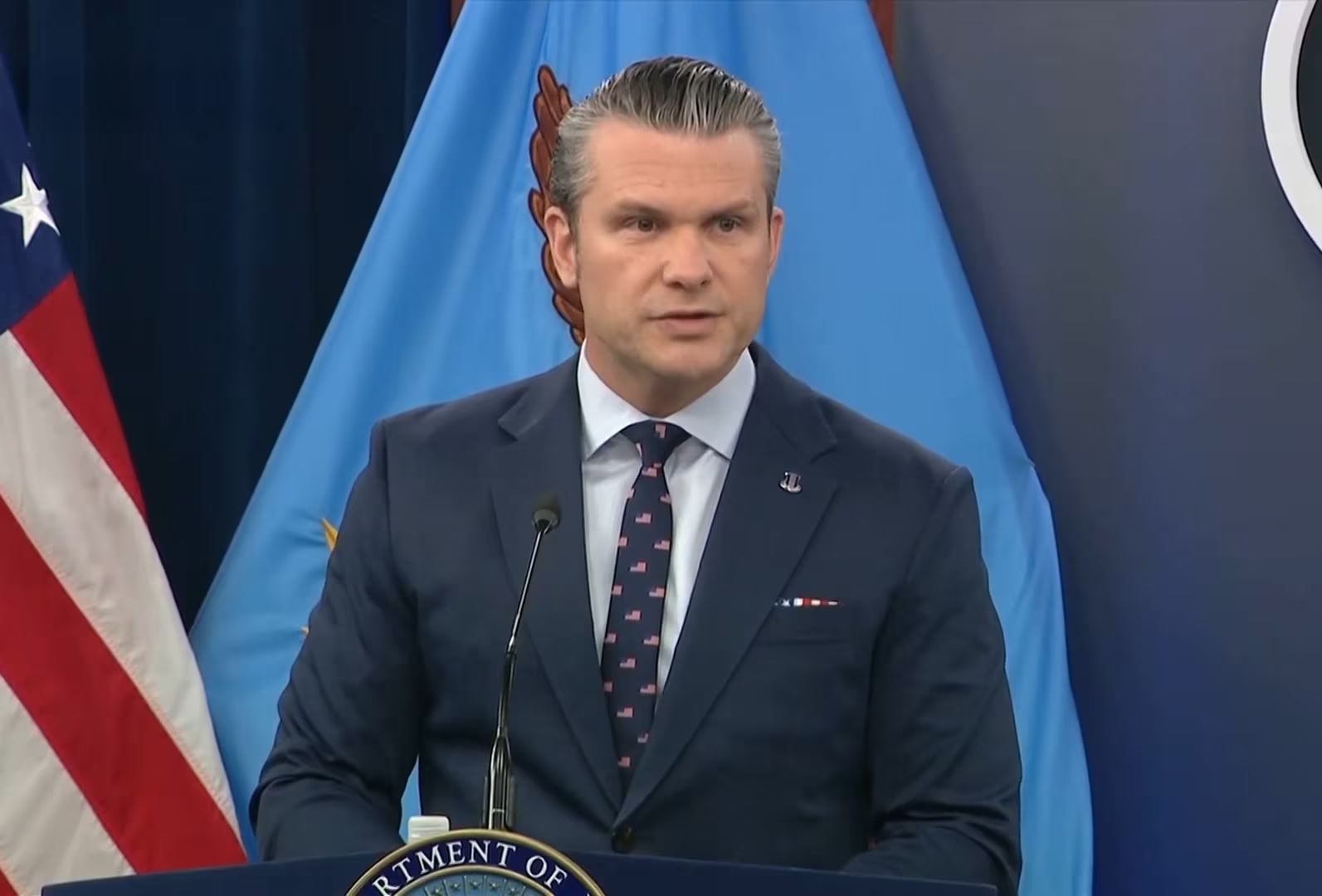
U.S. Defense Secretary Pete Hegseth said on Friday, March 13, that the day would become the most intense and deadliest of the entire American air campaign in Iran, even as President Donald Trump continues to send mixed signals about when the war might end.
“Never before has a modern and capable military—such as the one Iran once possessed—been destroyed so quickly and rendered so unable to wage war,” Hegseth said at a morning press conference.
Chairman of the Joint Chiefs of Staff General Dan Caine echoed that assessment at the same briefing. “Today will be our most intense day of kinetic activity across the entire area of operations,” he said.
The acceleration of strikes is largely due to the fact that the United States and Israel have managed to disable a significant portion of Iran’s air defense systems. This has allowed their aircraft to operate directly over Iranian territory, deploying large numbers of comparatively inexpensive precision-guided bombs and thereby reducing reliance on more costly long-range missiles.
According to Hegseth, such long-range munitions now account for only about 1 percent of the weapons being used—a significant shift compared with the early stages of the campaign.
The growing intensity of the strikes also reflects the broader strategy of the operation—to deprive Iran of the ability to project military power while simultaneously increasing pressure on the country’s leadership in the expectation that it will accept Washington’s demands.
“With every passing hour we see—and they know that we see—the military capabilities of their evil regime being dismantled,” Hegseth said. “They can barely maintain communications, let alone coordinate. They are disoriented, and they know it themselves. Our response? We will keep up the pressure, we will keep advancing and moving forward. No mercy, no quarter for our enemies.”
Even so, there are still few signs that the resolve of Iran’s leadership is weakening, despite the war approaching the two-week mark.
Earlier this week, amid a sharp rise in oil prices, Trump suggested that the war could end “soon, very soon.” Since then, however, both he and Hegseth have adopted a harsher tone.
“We are totally destroying Iran’s terrorist regime—economically and in other ways,” the president wrote on social media early Friday morning. “The Iranian fleet is gone, their air force is gone, their missiles, drones, and everything else are being destroyed.”
At the same time, Iran has found a way to strike at the global economy—effectively halting shipping through the Strait of Hormuz, one of the key arteries of world trade. Hegseth said the U.S. military has “no clear evidence” that Iran has placed naval mines in the strait. Instead, Iranian forces are using missile strikes and small boats to pursue and damage commercial vessels.
Reopening the strait to shipping represents an extremely complex military task, especially if Iran retains control over its side of the waterway. Hegseth declined to specify how long it might take before the U.S. Navy could begin escorting civilian cargo vessels.
“There is a reason why one of our top priorities has been destroying their navy,” he said. “We have a plan for every possible scenario. This is not a strait we will allow to remain a contested zone.”
He described the operation to secure passage through the strait as “an issue we are dealing with and will continue to deal with—and one people should not worry about.”
Hegseth also said he had ordered a general not affiliated with U.S. Central Command to conduct an investigation into the February 28 strike that hit a primary school in Iran. According to Iranian authorities, at least 175 people were killed, most of them children. The New York Times reported that a preliminary military inquiry had determined that the United States was responsible for the strike.
According to the findings of the review, the strike on the school building occurred because of a targeting error. U.S. forces were striking a nearby Iranian base, of which the school building had previously been a part. According to sources familiar with the investigation, Central Command officers generated the target coordinates using outdated data provided by the Defense Intelligence Agency.
Hegseth declined to specify who might bear responsibility for what happened, saying he would wait until the investigation was complete.