The detention in Hungary of seven Oschadbank cash-in-transit officers, who were transporting two armored vehicles loaded with foreign currency and gold, has once again drawn attention to how cash valuables are now delivered to Ukraine. This system changed radically after the start of the full-scale war—on February 24, 2022.
Once Ukraine closed its airspace, not only passenger flights but also the transport of cargo—including cash—came to a halt. Before the war, banks’ cash-in-transit services flew in dollars, euros and banking metals by aircraft, clearing them through customs at Boryspil Airport, from where the valuables were distributed to bank vaults in armored vehicles. Since 2022, such shipments have been carried out exclusively overland—from European countries, primarily Austria, and then across Ukrainian territory. The route has become longer and more complicated, yet in wartime no viable alternative has remained.
For a long time, the main supplier of foreign cash and banking metals to Ukraine remained Raiffeisen Bank Ukraine, which accounted for roughly 70% of the market. It carried out deliveries in cooperation with its parent structure in Vienna—Raiffeisen Bank International. Over time, state-owned banks also joined these operations—PrivatBank and Oschadbank.
The scale of these shipments has grown significantly. In 2025, Ukrainian banks imported $11.8 billion in foreign cash into the country; in 2024—$15.9 billion, whereas in the pre-war year of 2021 the figure stood at $4.3 billion.
It was as part of such a delivery that Oschadbank’s cash-in-transit officers found themselves in Hungary with two armored vehicles carrying cash and gold. The convoy was traveling from Austria to Ukraine, performing a standard operation to deliver valuables intended for Oschadbank’s own cash desks and those of its partner banks.
Small gold bars—typically weighing up to 100 grams—are usually sold to the public through bank cash desks, while larger ones are intended for corporate clients, primarily the jewelry industry. As a rule, such shipments are paid for by customers in advance—once a prepayment is made, the bank arranges delivery of the metal. It was precisely such a routine shipment that the Oschadbank employees—later detained—were carrying out.
This delivery route had long been in use and had not previously caused any problems.
“We have been delivering foreign cash and banking metals along this route not for months but for years. Practically every week, with the same partner—the Austrian Raiffeisen Bank—and with a standard package of documents. There is nothing new or extraordinary about it. That is why we see the detention of the cash-in-transit officers as a politically motivated order. We have sent appeals to Hungarian and European law enforcement authorities and are demanding the return of the employees and the armored vehicles carrying cash and metals. If the currency valuables are not returned promptly, we plan to apply to a European court, since this concerns the theft of funds and lost profits,” a source at Oschadbank told Strana.
Later, this information was officially confirmed by the bank itself.
“Since the start of the full-scale invasion, the transport of foreign currency and banking metals has taken place exclusively overland. Such runs are carried out by Oschadbank’s armored cash-in-transit vehicles on a weekly basis,” the bank said in a statement.
The Hungarian authorities said the cash-in-transit officers would be deported to Ukraine in the near future—according to some reports, this has already happened. At the same time, the Hungarian side has not disclosed the fate of the seized foreign currency and gold.
Andriy Pyshnyy, the governor of the National Bank of Ukraine and a former head of Oschadbank, has sent his deputy Oleksiy Shaban to Hungary to help resolve the situation surrounding the detention.
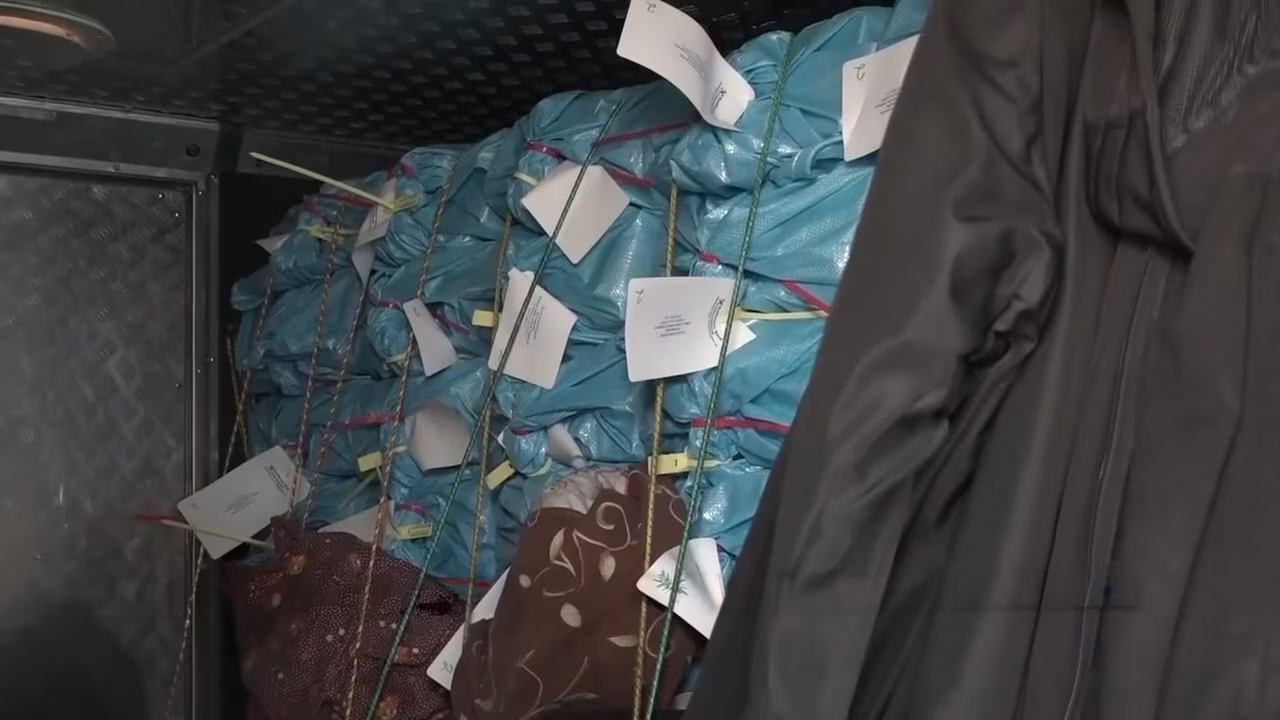
Meanwhile, the Hungarian government published photographs of the seized currency and gold bars, describing the operation as the “Ukrainian Gold Convoy.”
Video of the detention of the Ukrainian cash-in-transit officers.
“On Thursday, seven Ukrainian citizens were brought to justice, including a former general of the secret service, who were transporting $40 million, €35 million and 9 kilograms of gold from Austria to Ukraine through Hungary. An investigation has been launched on suspicion of money laundering, and seven Ukrainian citizens are being expelled from Hungary,” a statement on the official Facebook page of the Hungarian government said.