Hungary’s election campaign is entering a phase of unusual intensity—the kind of political heat the country has not seen in years. The main contenders are the governing party, Fidesz, led by Prime Minister Viktor Orban, and the most popular opposition force, Tisza, headed by Peter Magyar. In practice, the race has become a duel, with both sides framing it as a “battle of good versus evil”. That rhetoric has deepened the country’s social divide and fuelled concerns about whether the losing camp will accept the result—and whether the vote could trigger a wave of protests.
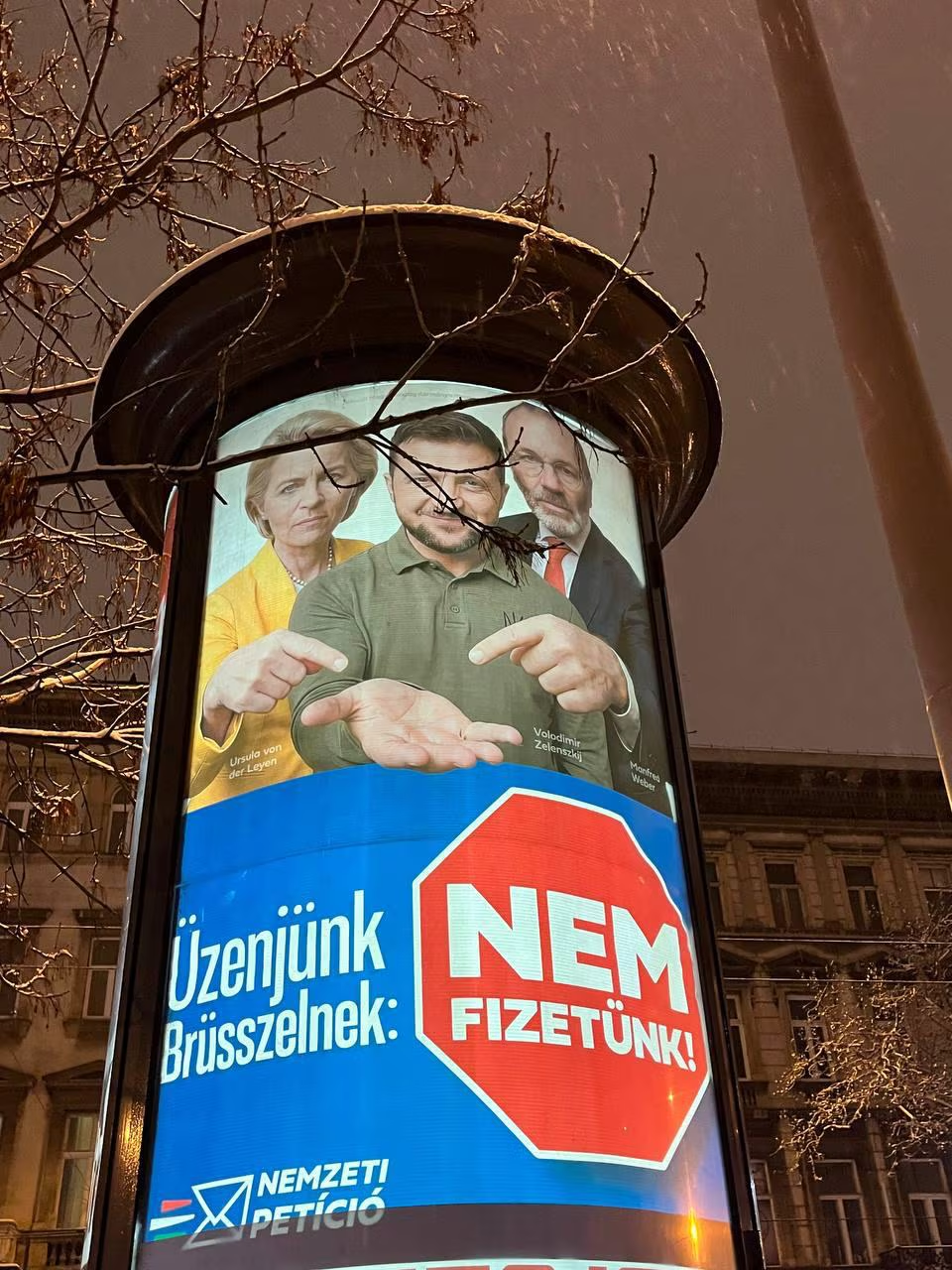
One of the central tools of political mobilisation has been Ukraine. During the campaign, the image of President Volodymyr Zelensky is being actively used in political advertising, including to draw citizens into a so-called “National Petition”—a survey on EU support for Ukraine. One poster urges: “Let’s send a signal to Brussels: ‘WE won’t pay!’” Zelensky is shown alongside European Commission President Ursula von der Leyen and Manfred Weber, leader of the European People’s Party group in the European Parliament. Another poster links Zelensky to Peter Magyar, the leader of Tisza: a staged visual exchange runs between them—“Send weapons!”—“Yes, of course!”—while a caption next to Magyar claims: “He can’t refuse them.”
Orban has built his message around the slogan “we won’t let Hungary be dragged into the war”, accusing his opponents of wanting to spend Hungarians’ money on helping Kyiv. Magyar and his allies, in turn, argue that Orban is acting in Moscow’s interests. The prime minister himself calls Magyar a “Kyiv project” and accuses the Ukrainian authorities of meddling in the election. Kyiv rejects those claims, though it does not hide its interest in Orban’s defeat: in recent years he has become the Ukrainian leadership’s main adversary in Europe and has repeatedly threatened to block Ukraine’s path into the European Union.
Although the election is not scheduled until April 2026, it has already reshaped Hungary’s political reality. Since 2010, the country’s political scene has been dominated by Viktor Orban and his party, Fidesz, which won comfortably in 2014, 2018 and 2022. But heading into the next contest, Orban is no longer the unchallenged favourite. His principal rival is 44-year-old Peter Magyar, who for the first time in many years has created a credible threat to the incumbent prime minister.
Magyar emerged from the political-administrative milieu tied to Fidesz and was closely integrated into the system of power, including through his former wife, Judit Varga, who served as justice minister. The trigger for his break with the ruling elite was a high-profile “paedophilia” scandal sparked by a decision by Hungary’s president, Katalin Novak, to pardon a man convicted of trying to conceal sexual abuse at a children’s home. Seizing on the episode, Magyar announced his move into opposition, accusing the authorities of corruption, nepotism and dishonest tactics against political opponents.
After taking over the Tisza party—Tisztelet es Szabadsag Part, the “Party of Respect and Freedom”—Magyar quickly managed to consolidate the protest vote. On foreign policy, he contrasts Orban’s confrontational line towards the European Union with his own “constructiveness” and willingness to seek compromises with Brussels—for which pro-Orban circles have branded him a “Brussels puppet”.
Ukraine remains an especially sensitive subject—and one that is repeatedly used against the opposition leader. Orban has taken a hard line towards Kyiv, urging Europe to end support for Ukraine and pressing for a rapid peace without preconditions. Against that backdrop, relations between Budapest and the Ukrainian authorities have become openly hostile. At the same time, Magyar has to account for public sentiment in Hungary, where the belief that the country should keep its distance from the war is widespread, and any aid to Ukraine—especially military support—remains unpopular. He therefore tries not to make the issue central, though that has not spared him accusations of “working for Kyiv”.
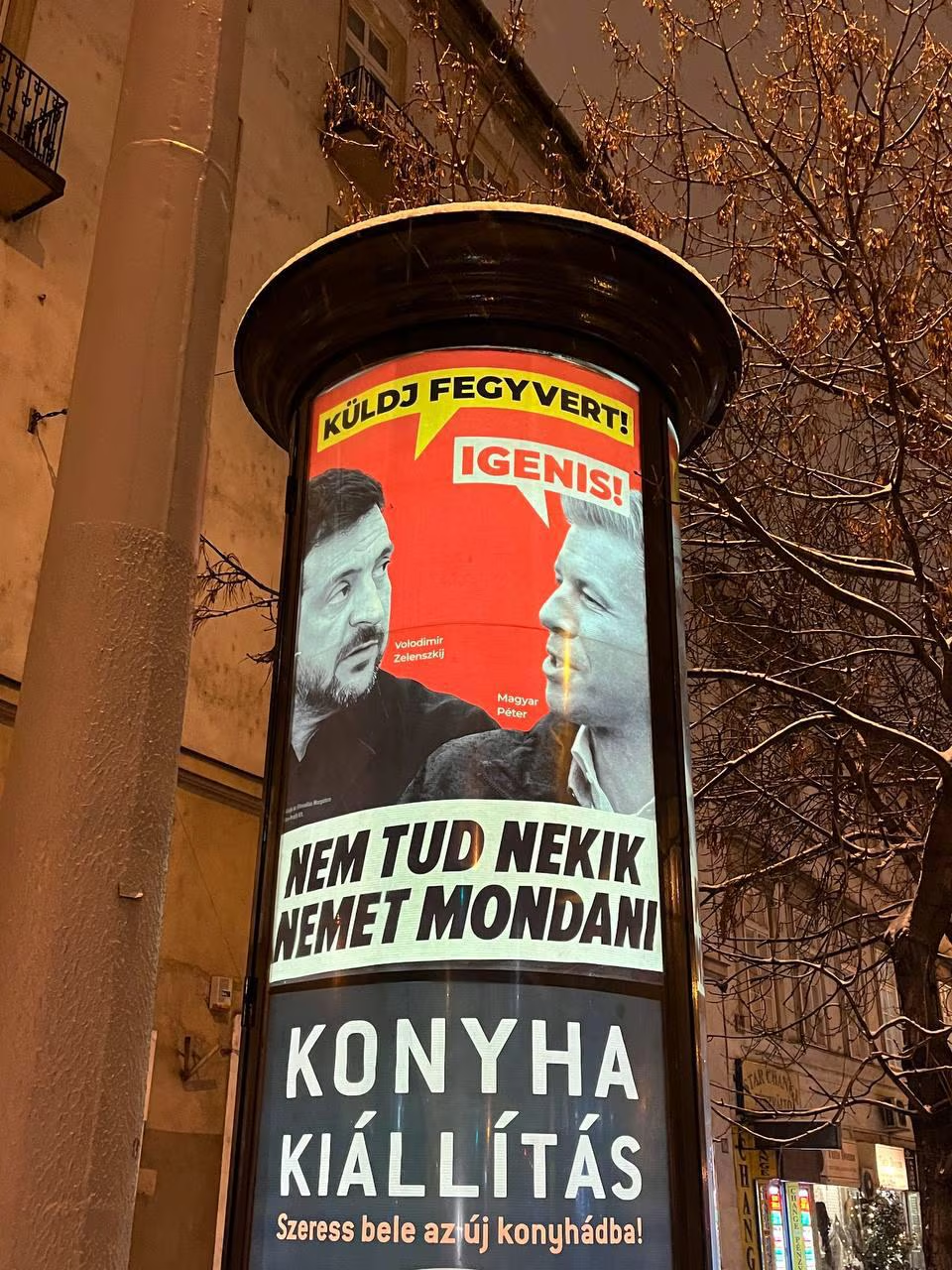
On a poster in Budapest, Volodymyr Zelensky says: “Send weapons!”
Peter Magyar: “Yes!”
Below: “They do not belong to us and do not speak on behalf of the nation.”
Peter Magyar: “Yes!”
Below: “They do not belong to us and do not speak on behalf of the nation.”
Agoston Mraz, head of the Nézőpont Institute think-tank, argues that “the Ukrainian leadership is backing Peter Magyar’s campaign”, and believes that, combined with the fact that Volodymyr Zelensky “openly criticises Mr Orban”, this allows Fidesz to keep the focus on a contrast between “war and peace”. Magyar himself travelled to Kyiv in the summer of 2024, describing the trip as humanitarian and insisting that he held no meetings with senior Ukrainian officials.
For a sizeable share of Hungarians unhappy with Orban’s policies—or simply weary of his long years in power—Magyar now looks like the country’s number-two politician. “These people say it doesn’t matter who wins this election—as long as it’s not Orban. Even Magyar, though there are plenty of complaints about him,” notes Gabor Stier, a Hungarian journalist.
Polling offers a mixed picture. According to the Median research firm, 40% of respondents say they are ready to vote for Tisza—or 51% among those who have made up their minds—while Fidesz stands at 33% (39% among decided voters). Surveys closer to the government paint a different landscape: Nézőpont Institute puts Fidesz on 47%, Tisza on 40%, with a further 6% backing the ultranationalist Mi Hazank.
Government supporters argue that Tisza has already hit its electoral ceiling, while the opposition—citing its own numbers—claims majority support. Orban, for his part, stresses that it is under his leadership that Budapest’s position is taken into account in the EU, the United States, Russia, China and Turkey, pointing to arrangements he says he reached with Donald Trump to exempt Hungary from sanctions targeting Russian energy companies.
In Brussels, Hungary’s campaign is being watched closely, with officials fully aware that the outcome will reverberate far beyond the country’s borders. An Orban victory could accelerate the consolidation of right-wing forces across Europe, while his defeat would deal a serious blow to the continent’s wider right-conservative camp. “This election isn’t only about Orban—the stakes are higher,” Stier stresses, noting that the result could shift the balance of power in the European Parliament.