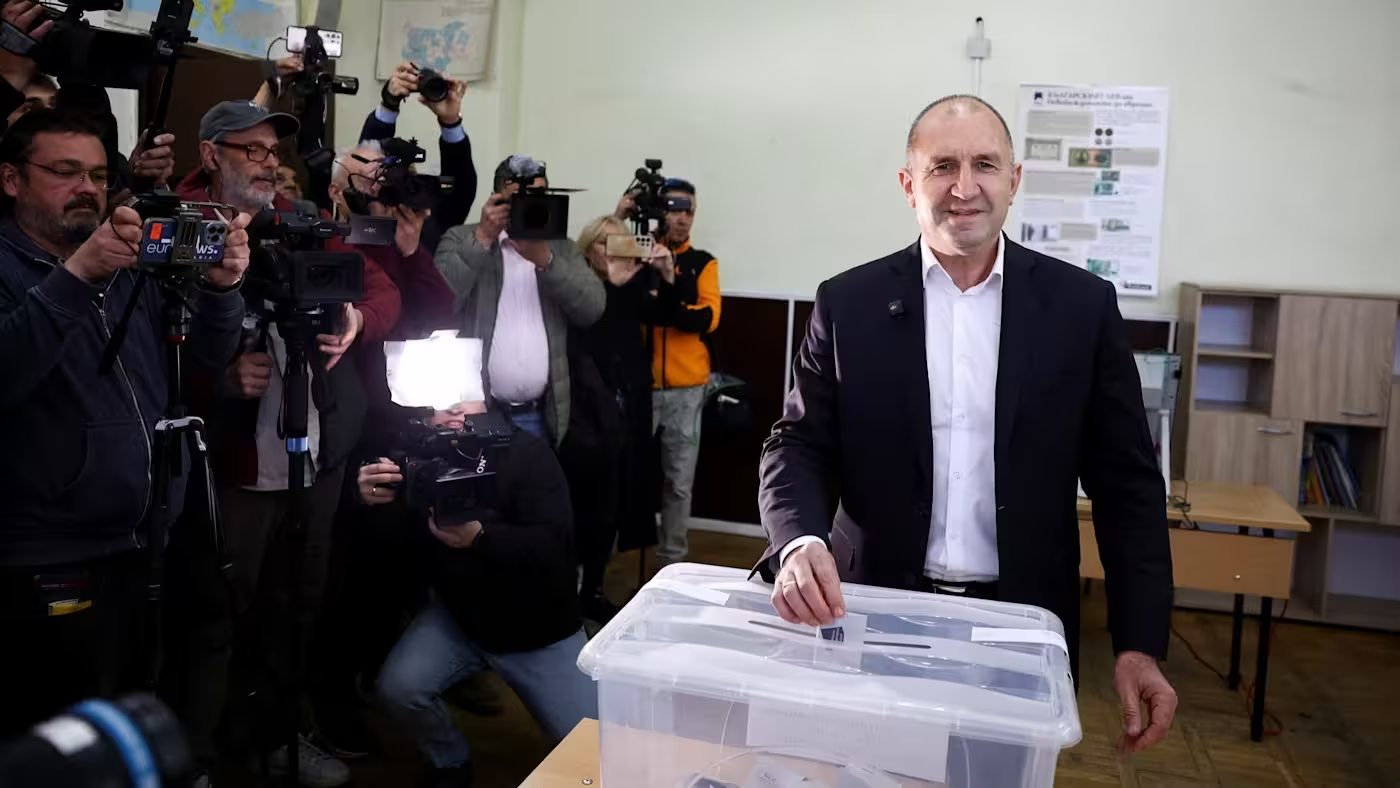
Former Bulgarian President Rumen Radev, who opposes sanctions on Russia and military aid to Ukraine, is leading in the country’s eighth parliamentary election in the past five years, according to exit polls, giving him a chance to pull Bulgaria out of its prolonged political deadlock.
According to a poll by Alpha Research, released by the state broadcaster BNT, Radev’s coalition, Progressive Bulgaria, won about 38% of the vote in Sunday’s ballot. Sociologists estimate that would give it around 105 seats in the 240-seat parliament. Its closest rival—the GERB party led by longtime Prime Minister Boyko Borissov—trails by nearly half: about 16% and 46 seats.
The scale of the lead, however, does not guarantee Radev an easy path to forming a majority—a task that in recent years has stumped every election winner. The seat distribution could still shift if the Socialists, a potential Radev ally, fail to clear the 4% threshold. Alpha Research puts them at 4.1%.
“For me, the main thing is to form a regular, stable government. Going back to the polls again is not an option,” Radev told reporters after voting.
The European Union’s poorest country has been living through a political crisis ever since anti-corruption protests five years ago brought Borissov’s dominance in national politics to an end. Radev, the country’s most popular politician, left office as head of state in January to enter the election race: a new wave of protests had by then toppled the fragile coalition formed around Borissov’s GERB. Promising to fight what he calls a corrupt elite, Radev managed to build support across the political spectrum, including from many of his rivals.
A former Air Force general trained in the United States, he brought back to the polls voters disillusioned with politics after a series of campaigns marked by near-record low turnout. According to the exit poll, by 7 p.m. local time on Sunday about 47% had voted—up from 38% in the previous election in October 2024.
Radev has repeatedly and publicly ruled out an alliance with Borissov, but the alternatives are not straightforward either. Third place, with roughly 14% of the vote and 40 seats, goes to a pro-European anti-corruption alliance. Radev has regularly criticized it for supporting various Borissov governments, though he has not ruled out a coalition with it.
The Socialists look like Radev’s most logical partner, but after votes from Bulgarians abroad are counted—where support for the party is weaker—they risk failing to enter parliament at all. The exit poll gives them 11 seats.
The Movement for Rights and Freedoms party, led by Delyan Peevski—the tycoon under U.S. sanctions whom many see as the embodiment of state capture (Peevski denies the accusations)—is projected to win about 8.4% and 24 seats. Radev built a significant part of his campaign around opposition to Peevski’s continuing influence over the Bulgarian government and rules out any alliance with the party.
Radical nationalists from the Revival party, who campaigned for the country’s withdrawal from NATO, are winning 4.9% and 14 seats. They were kept in isolation in previous parliaments, but under current circumstances a deal with Radev is theoretically possible.
The first attempt to form a government will belong to Radev. If he fails, the acting president will hand the mandate to Borissov. Failure on the third attempt would mean another snap election.