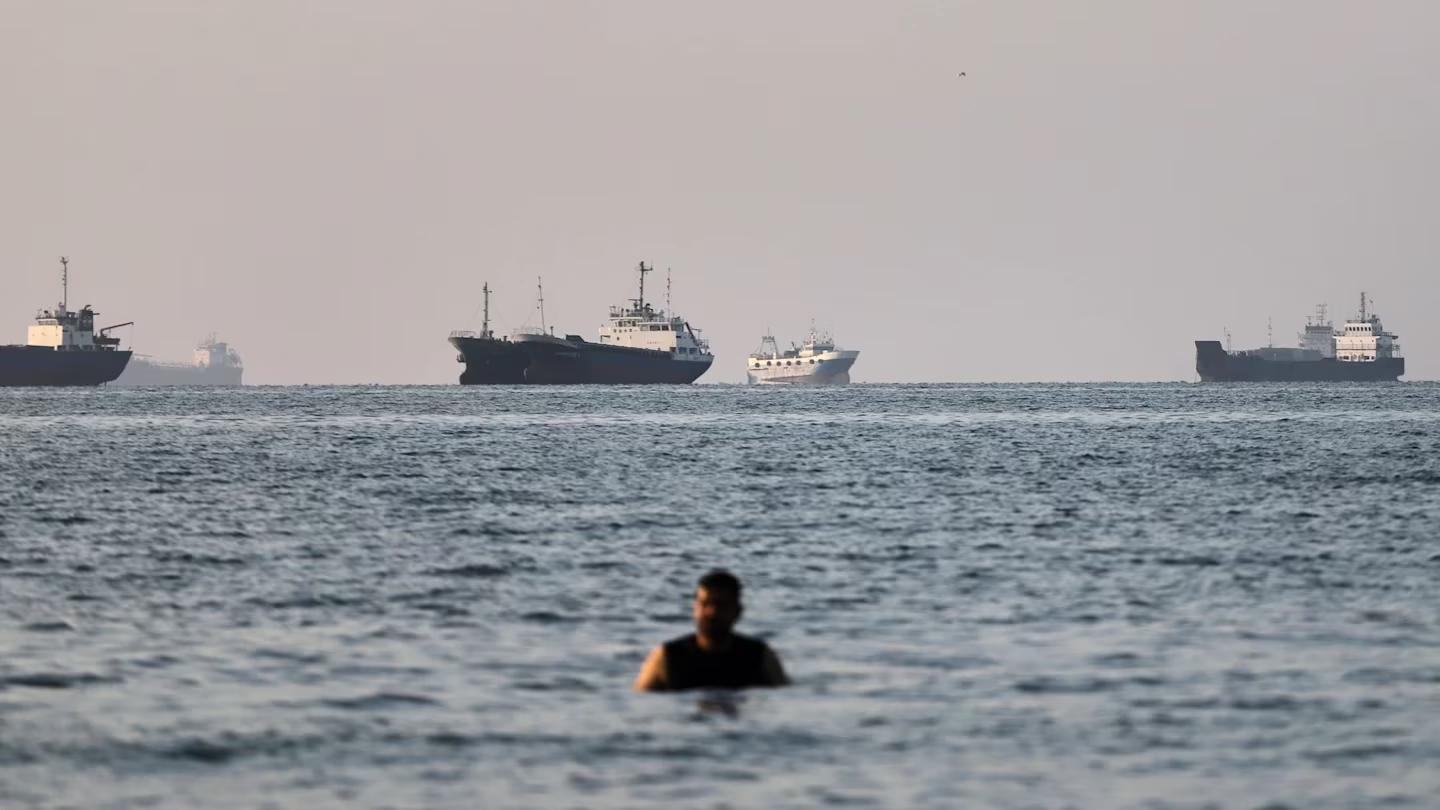
The global oil market has so far avoided the severe summer crisis traders feared after the closure of the Strait of Hormuz. Despite a lack of signs that supplies through this key route will soon recover, oil prices remain below $100 a barrel.
Back in April, traders and analysts warned that the market was approaching a “tipping point” after which a sharp rise in prices, fuel shortages and economic recession were possible. But after China cut oil imports and global stockpiles were drawn down, the market proved more resilient than expected, even amid continuing disruptions caused by the conflict in the Middle East.
On June 8, Brent rose to $98 a barrel as Israel and Iran exchanged missile strikes. But by Tuesday morning the price had fallen below $93—well below the levels seen in the early stage of the war, despite continuing supply disruptions from the Persian Gulf region, home to some of the world’s largest oil producers.
China was the main reason for the reprieve. Traders estimate that in May it cut oil imports by about 5 million barrels a day—almost half the global supply shortfall caused by the closure of the strait. Chinese refineries either reduced processing or switched to domestic inventories as prices rose sharply.
U.S. Strategic Petroleum Reserve Is Near Historic Lows
Analysts warn, however, that the market’s apparent stability rests on an unprecedented drawdown of commercial inventories and strategic reserves that cannot continue indefinitely. The market’s resilience will be tested in the coming months, when summer demand reaches its peak.
“We are in much, much better shape than almost everyone expected,” said Eugene Lindell of FGE NexantECA, a consultancy in the chemicals and energy sector. “But that is no reason for complacency, because the underlying factor has not gone away.”
According to him, inventories are falling not only in the United States, where weekly data show a decline, but also “quite sharply” in Europe, where far less data is published.
Oil fell below $100 a barrel in late May and has remained below that mark for almost two weeks, despite the continuing military stalemate.
“Trading below $100 after three months of the strait being closed is quite unexpected—at the beginning, no one would have bet on that,” said Frédéric Lasserre, head of market analysis at commodities trader Gunvor.
“The main explanation is China. They have a lot of inventories, and they have no desire to go into the market and buy at $80 or $90-plus a barrel, especially if there is a sense that the strait could reopen and oil prices could fall,” he added.
Because China reduced purchases, it became easier for other Asian countries to buy oil. That eased the regional shortage and reduced pressure on global prices.
“There is not much need now for prices to rise further, because in terms of closing the deficit the job has already been done. It is expensive for consumers, but it is not the dramatic situation that people expected,” Lasserre said.
Other market participants believe this equilibrium may prove temporary. Amrita Sen, founder of the consultancy Energy Aspects, said the United States has now become the key region to watch. The country, she said, is sending record volumes of fuel and oil to Europe and Asia while reducing its own reserves to their lowest level in two decades.
“The tension is really in the U.S., because they have exported too much,” Sen said. “If the U.S. has to pull back and exports less, then the rest of the world will start to panic.”
In recent weeks, executives at U.S. oil companies have also warned that the current situation is unstable.
“We are approaching unprecedented inventory levels. That is, really, really low levels. You can debate whether we reach those very low levels in two weeks or in three. But when you get to that point, prices will rise sharply,” Neil Chapman, senior vice-president at ExxonMobil, said at a conference organized by the research firm Bernstein.
In the coming weeks, seasonal fuel demand will rise. Chinese refineries have scaled back activity, but in the rest of the world refiners typically increase output by about 4.5 million barrels a day during the peak of summer demand, Sen said.
Traders also warn that the market’s current stability depends on whether China continues to stay on the sidelines. If the world’s second-largest economy begins buying oil actively again while the strait remains closed, available supply could quickly shrink.
“How long will the strait now remain closed?” Lasserre said. “If it is another two weeks, perhaps we will avoid the worst—a global recession. If it is another three months, I doubt we will manage to avoid it.”