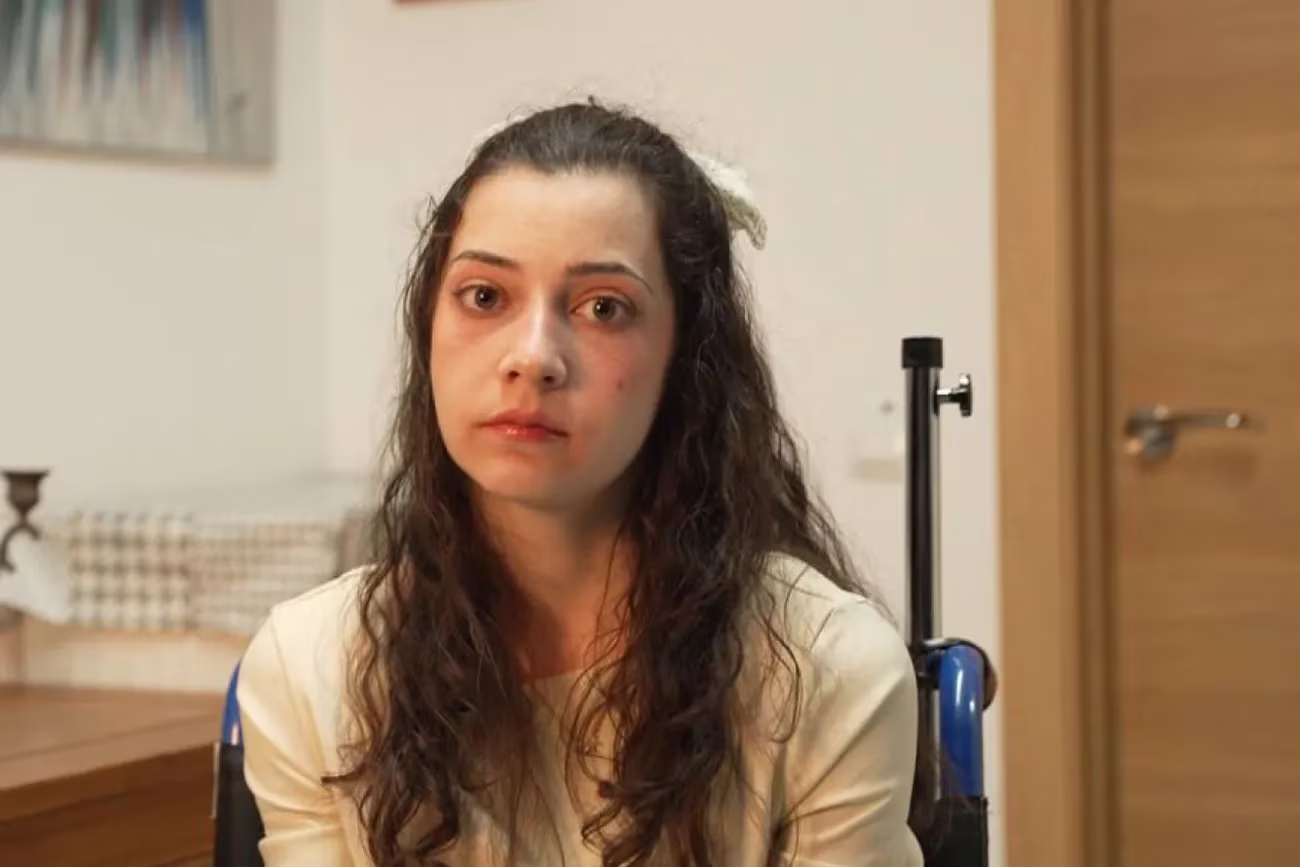
Noelia Castillo Ramos—a 25-year-old resident of Spain, partially paralysed—has been granted the right to euthanasia after nearly two years of confrontation with her own family. The procedure is expected to take place on March 26, 2026.
Her childhood unfolded amid social instability: her parents struggled with drug addiction, lost their home, and separated. From the age of 12, she lived in shelters, and after reaching adulthood was placed in a social centre, where she became the victim of a brutal gang rape.
After that, she made several attempts to take her own life. During one of them, she jumped from a window and survived, but sustained injuries that left her paralysed in both arms and legs. Since then, she has lived with constant pain.
In 2024, Noelia submitted a request for euthanasia, which was approved by the relevant commission. Medical specialists determined that her condition is irreversible and accompanied by chronic suffering.
The young woman’s father, Jeronimo Castillo, with the backing of the ultra-Catholic organisation Abogados Cristianos, secured a court order temporarily suspending the procedure. He argued that, because of pain, medication, and her psychological state, his daughter was not capable of making independent decisions.
For nearly two years, Noelia continued to live against her own decision. In an interview with the Antena 3 television channel on February 24, she said: “I can’t go on with this family, I can’t go on with the pain, I can’t go on with everything that torments me in my head.”
All of her immediate relatives—her father, mother, and sister—opposed her choice. “My father shouted that I have no heart, that I don’t think about others, that everything I say is a lie. And yet he ignores me. He doesn’t call or write. Why does he want me to live—to be in a hospital?” she said. According to her, her mother also did not accept the decision: “She says she understands, but in reality she does not.”
She spent most of her time at a social-medical centre in Sant Pere de Ribes, where she plans to undergo the procedure alone: “I don’t want anyone to see me close my eyes.”
The legal battle passed through five levels of jurisdiction. The court of first instance and the High Court of Catalonia upheld her right to euthanasia, rejecting her father’s claims of incapacity. Abogados Cristianos appealed to Spain’s Supreme Court, but the complaint was dismissed in January 2026. Subsequently, both the Constitutional Court and the European Court of Human Rights confirmed that the procedure could not be overturned.
Euthanasia and assisted dying were legalised in Spain in 2021. Since then, up to two thousand people have made use of the provision. Approval requires a multi-stage medical and legal process. Spain is among a small group of countries—alongside Belgium, the Netherlands, and Luxembourg—where both active physician-assisted death and self-administered death under medical supervision are permitted.