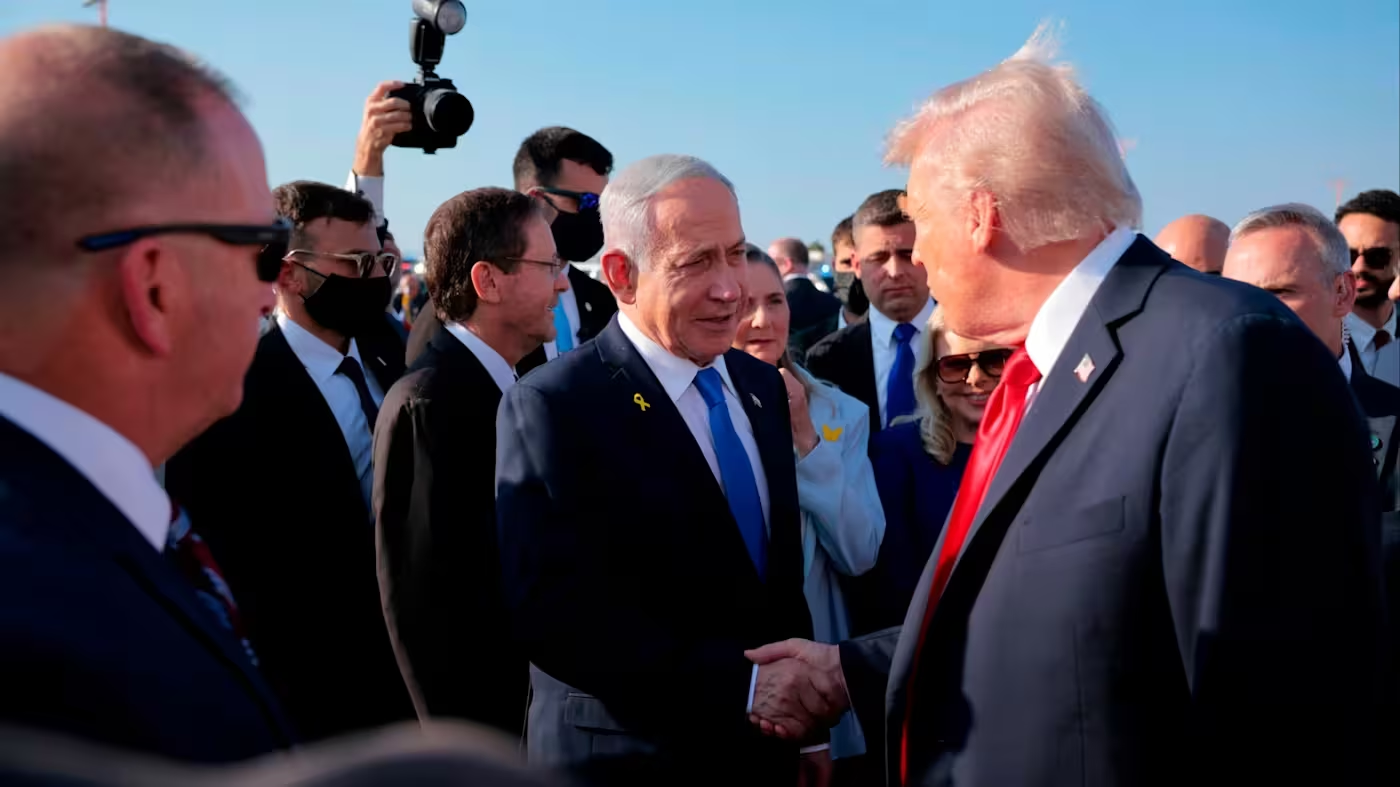
Benjamin Netanyahu intends to hold pivotal talks with Donald Trump on Monday at the US president’s Mar-a-Lago residence. Ahead of the meeting, differences have emerged between the two sides over Gaza and other regional security issues.
The visit to the United States will mark the Israeli prime minister’s sixth meeting with Trump over the past year—no other head of state has met the American leader more frequently. The talks come at a sensitive moment for the Gaza ceasefire agreement reached between Israel and Hamas in October.
The truce, which halted a two-year war, has broadly held, despite near-daily clashes and mutual accusations of violations by both sides.
Washington insists that a transition to the “second phase” of the ceasefire must begin in January. This phase envisages the establishment of a so-called “peace council” and an executive committee to administer the territory, the creation of a Palestinian technocratic body to handle day-to-day governance, and the deployment of a multinational peacekeeping force.
Under the terms of the US-brokered agreement, Israeli troops—which currently continue to control roughly half of Gaza—are expected to withdraw from the enclave gradually as international forces are introduced to oversee Hamas’s disarmament and the transition to post-war reconstruction.
Serious questions remain, however, over the composition and mandate of the mission, known as the International Stabilisation Force. No country has so far declared its readiness to deploy troops, and no state has expressed an intention to disarm the Palestinian group by force.

An Israeli tank near the border barrier between Israel and the Gaza Strip. October 2025.
Israeli officials fear that Donald Trump, eager to underscore progress in implementing the ceasefire, will press Benjamin Netanyahu on a number of key issues—including the prospect of further Israeli troop withdrawals—while sidestepping the most sensitive question of Hamas’s disarmament.
“The concern is that Trump could pull the rug out from under them,” says a source familiar with the thinking inside the Israeli government.
“The Americans naively believe it is possible to move forward without securing Hamas’s renunciation of weapons…for now, there is no real plan for resolving the issue of Hamas’s arms,” he adds.
Another potential source of tension between Netanyahu and Trump could be the question of Turkey’s and Qatar’s future involvement in Gaza’s post-war governance—two countries regarded as close to the current US administration—as well as the Western-backed Palestinian Authority, which exercises limited powers in the West Bank.
The Israeli prime minister has consistently rejected any role for these three actors in the devastated enclave.
Separately, Netanyahu is expected to underscore what Israel sees as a renewed threat from Iran—just six months after the 12-day war between the two countries in June. According to Israeli officials, the Islamic republic is rapidly rebuilding its ballistic missile arsenal.
“He will tell him: ‘We cannot allow them to rebuild this capability,’” said a source familiar with the position of Israel’s leadership.
Differences between Washington and Jerusalem may also surface over the fragile ceasefire in Lebanon, brokered by the US in November 2024 between Israel and Hezbollah, which brought an end to a year of open hostilities on that front.
The Iran-backed group has yet to fully comply with the disarmament requirement set out in the agreement. Israeli authorities argue that the Lebanese government has acted with insufficient resolve to compel Hezbollah to meet all of its obligations. Israel itself, meanwhile, continues to carry out regular strikes against the group’s fighters and military infrastructure on Lebanese territory, despite the ceasefire in force.
US officials had previously indicated that the end of the year would serve as the final deadline for Hezbollah to meet the terms of the agreement, but that deadline is now widely expected to be effectively disregarded.