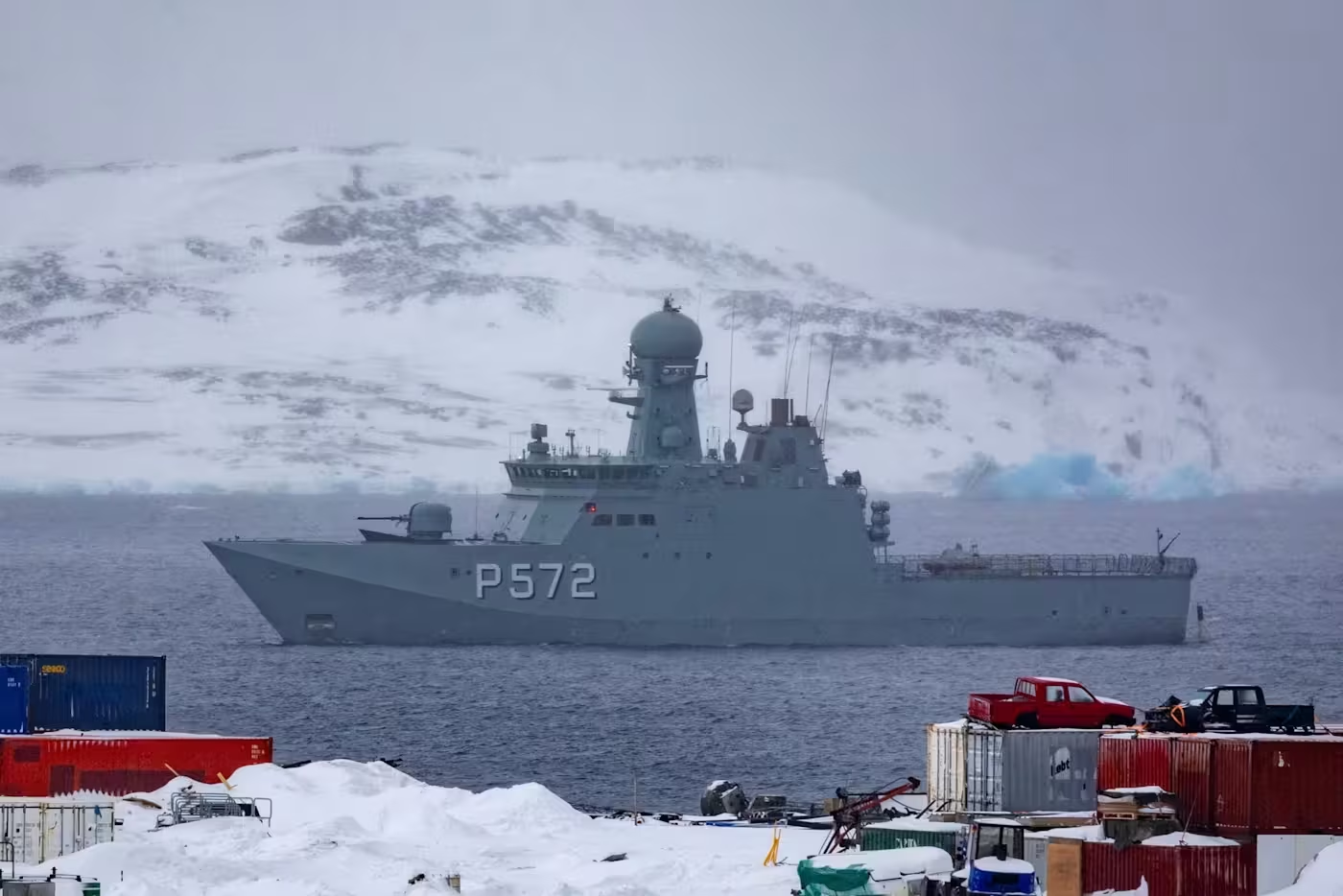
Greenland is becoming a test for Europe. After statements by Donald Trump expressing a desire to establish control over the island, a debate over the status of Denmark’s autonomous territory has abruptly turned into a measure of how capable the West is of holding a single line when pressure comes not from Moscow, but from Washington.
Poland’s prime minister Donald Tusk warns: without unity and strength, the continent risks emerging weak and divided. In Copenhagen, allies are expected to offer at least a public signal of support for sovereignty, yet within NATO there is a preference for avoiding any move that could aggravate relations with the future US president.
This pause is already irritating European capitals: they are calling on the alliance and its secretary-general, Mark Rutte, not to retreat into the shadows and to help defuse tensions between the US and Denmark before the debate over Greenland turns into a political crisis within the West itself.
NATO’s silence in response to Donald Trump’s threats to assert control over Greenland has triggered alarm in European capitals, where there are fears that the alliance is failing to perform its role in safeguarding Denmark’s rights. The organization has issued no public statement in support of Denmark’s and Greenland’s territorial integrity and sovereignty, nor has it responded to the US president’s declared ambition to gain control of the vast Arctic island that forms part of the Danish kingdom.
This has fueled frustration among the alliance’s European members, who are seeking to project a united front and ease strains in transatlantic relations. The situation stands in sharp contrast to recent steps by the European Union aimed at consolidating support for Copenhagen.
Mark Rutte, the alliance’s secretary-general and a figure widely seen as having warm personal ties with Trump, has been unusually inconspicuous amid a crisis touching on core security issues for member states. Proposals from Paris and other capitals to step up NATO activity in Greenland have yet to be implemented.
European officials acknowledge that the United States’ central role within the military-political bloc objectively limits the alliance’s ability to respond forcefully. Many of them warn, however, that the absence of any reaction only reinforces a sense of impunity for Trump in his dealings with allies and underscores Europe’s dependence on security guarantees from Washington.
“Since this clearly concerns countries that are all members of NATO, the alliance should initiate a serious discussion on the matter in order to reduce or ease tensions,” said Italian prime minister Giorgia Meloni. “This conversation should take place precisely within NATO.”
Trump has accused Denmark of allegedly failing to provide adequate protection for the island and of underinvesting in its security amid what he claims is growing activity by Russian and Chinese naval forces in the region. The White House has meanwhile said that alongside a purchase or other means of establishing control, a military option has not been ruled out.
For NATO and for Rutte personally, this has become a painful challenge. Any attempt at invasion or annexation by the United States would amount to a direct conflict between two allies and would call into question Article 5 on collective defense, which many members regard as the foundation of the alliance’s existence.
“They are demonstratively silent,” said one EU official. “Rutte was supposed to be the person Europe could rely on as an intermediary in dealing with Trump. But not this quiet.”
“Discussing such issues within NATO is undoubtedly difficult,” noted one alliance diplomat. “But if it is not done, it creates the impression that everyone is content with the situation.”
The alliance has issued not a single public statement, while Rutte, usually a constant presence in discussions of Euro-Atlantic security, confined himself to a brief, minute-long reply to a television presenter’s question about the crisis.
“We will not disclose details of diplomatic contacts, but the secretary-general, as always, is working closely with leaders and senior officials on both sides of the Atlantic,” said NATO spokesperson Allison Hart.
For most of last year, Copenhagen preferred to stay in the shadows on Greenland, avoiding public comment in response to sharp statements from Donald Trump and his administration and urging EU and NATO partners to follow the same line. That tactic was abandoned this week. Danish prime minister Mette Frederiksen said Trump was “serious” about his intention to establish control over Greenland and stressed that “if the United States decides to attack another NATO country by military means, everything stops. Including our NATO.”
European officials involved in talks in Brussels note that the statement reflected Copenhagen’s growing irritation at NATO’s silence and was meant to signal to the alliance just how high the stakes have become. Danish lawmakers have also urged NATO to play a more active role in the dispute with the United States. Karsten Bach, a lawmaker from the Liberal Alliance party, called for the situation to be discussed under Article 4 of the NATO treaty, which addresses threats to the security of member states.
“There is one country in NATO—the United States—that views the threat in the Arctic differently from the rest, and that is why I believe NATO should play a meaningful role in this conflict that has arisen between two alliance members,” he added.
The head of the European Commission, Ursula von der Leyen, said this week that “law is stronger than force” when speaking about Greenland, while European Council president António Costa remarked: “Nothing can be decided regarding Denmark and Greenland without Denmark or without Greenland.”
Leaders of NATO allies, including France, Germany, Italy, Poland, Spain, and the United Kingdom, issued a joint statement with Denmark stressing that they “will not stop defending” the principles of “sovereignty, territorial integrity, and the inviolability of borders.”
NATO officials and diplomats from member states working at the alliance say that behind closed doors there is active diplomacy and internal work underway to strengthen collective security in the Arctic region around Greenland. In their words, over the past couple of years regional states have shifted noticeably toward supporting a more assertive NATO leadership role.
“We have Baltic Sentry—why not create Greenland Sentry? That is something we can do,” said EU defense commissioner Andrius Kubilius, referring to a NATO mission launched a year ago to bolster the protection of critical infrastructure in the Baltic Sea.
“I do not know exactly how discussions on Greenland are conducted inside NATO,” he added. “But from the outside, NATO is in a special position,” he said, recalling that both Denmark and the United States are members of the alliance.
“With Ukraine, things are simpler for us. Russia has long been seen as an adversary. With Greenland, everything is far more complicated. The United States is our key ally, and that is precisely what makes the situation significantly more difficult,” said a senior Nordic diplomat.
Responding to a direct question about Trump’s threats, Mark Rutte said this week in an interview with CNN that he shares the US president’s assessment of growing Russian and Chinese activity in the region and the need to strengthen security. “Look at Denmark—it is investing heavily in its armed forces,” he said. “And the Danes are not opposed to the United States having a greater presence in Greenland than it does now. Taken together, all this shows that we must ensure security in the Arctic.”