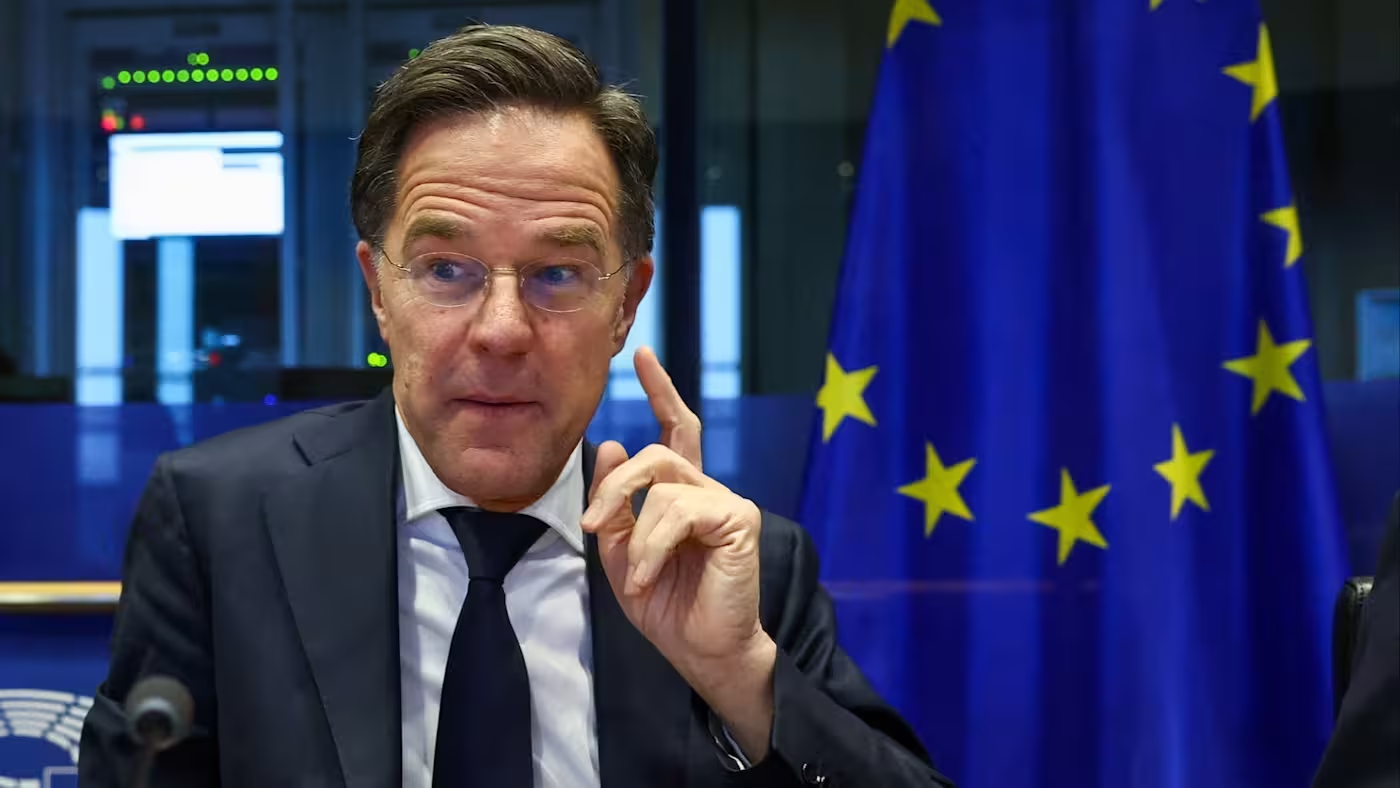
Europe is “indulging in illusions” if it believes it can ensure its own defense without US support, NATO’s secretary general said, pushing back against calls in several EU capitals to prepare for a future without the American military umbrella.
The remarks came against the backdrop of recent statements by Donald Trump, who had threatened to use military force to seize Greenland from fellow NATO ally Denmark and to impose trade tariffs on other allies that opposed him. Those comments unsettled European governments and reignited debate over the continent’s dependence on the United States. Although the US president walked back his threats last week, they prompted renewed calls to accelerate the development of Europe’s autonomous defense capabilities.
Mark Rutte, NATO’s secretary general, who said he had managed to persuade Trump to abandon those steps, dismissed such arguments on Monday. Addressing members of the European Parliament, he said that building a fully autonomous European defense system would be prohibitively expensive and would benefit only the alliance’s adversaries, including Russia’s president Vladimir Putin.
“If anyone here thinks that the European Union, or Europe as a whole, can defend itself without the US—keep dreaming,” he told lawmakers. — “You won’t be able to.”
Rutte also warned of the inevitable duplication of structures and resources. “I wish you luck if you want to go down that path, because you will have to find men and women in uniform—on top of what already exists,” he said. — “That will only make things more complicated. I think Putin would like that. So think again.”
The idea of dispensing with the American military umbrella that has underpinned Europe’s security since the Second World War has long remained marginal, and has been promoted largely by France.
In recent years, however, the concept of “strategic autonomy” has steadily entered the EU’s political mainstream. This shift has been driven by Donald Trump’s unpredictable approach toward NATO allies, as well as Russia’s invasion of Ukraine in 2022, which sharply intensified debate over how Europe can strengthen its own defense capabilities.
Last year, NATO allies agreed to raise defense spending to 5 percent of GDP by 2035, responding to Trump’s demand that European countries assume a greater share of responsibility for their own defense.
Experts warn, however, that fully replacing the United States’ role in safeguarding Europe’s security—particularly in areas such as advanced weaponry and other critical capabilities on which European armies have relied for decades—would come at a vastly higher cost.
“If you really want to act alone, forget the idea that this can be done with spending at 5 percent,” Rutte said on January 26. — “We are talking about 10 percent. You would have to build your own nuclear capability. That costs billions and billions of euros.”