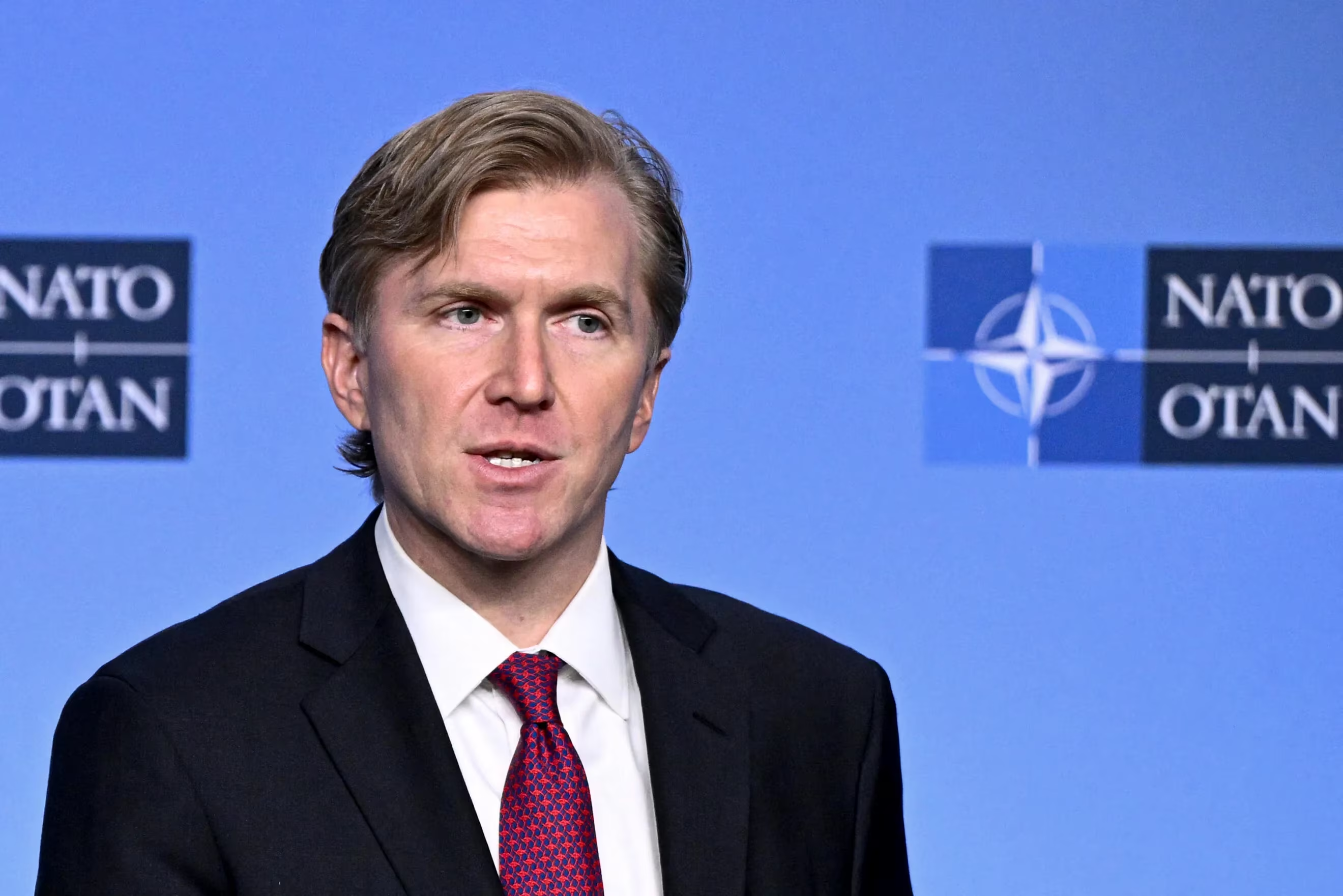
On February 12, Pentagon Deputy Secretary Elbridge Colby urged European countries to continue increasing defense spending, delivering a conciliatory speech that made no mention of Donald Trump’s earlier attempts to raise the issue of annexing Greenland. “The turning point has already been reached, and we can feel pride and confidence about that,” Colby said at a closed-door meeting of alliance defense ministers in Brussels.
A day earlier, NATO proposed a new Arctic mission intended to address Trump’s criticism that too little attention was being paid to the island’s security—a move widely seen as an attempt to ease tensions with the US president.
Colby, widely regarded as the architect of the recent US defense strategy and a tough critic of European allies, confirmed that Washington would “continue to provide extended US nuclear deterrence.” At the same time, he stressed that America expects “partnership, not dependence.” According to him, the United States will also supply, “in a more limited and targeted format,” key capabilities that European countries lack, while remaining committed to NATO’s collective defense under Article 5 of the alliance’s founding treaty.
NATO Secretary General Mark Rutte, who in recent months has focused on preventing the alliance from unraveling under Trump, praised Colby’s “excellent speech.” He also brushed aside concerns that US Defense Secretary Pete Hegseth had skipped the meeting. “We were very fortunate to have Elbridge Colby,” Rutte told reporters, calling him “one of the leading thinkers on the role of the United States in NATO.” According to Rutte, Colby has “for many years consistently argued that Europe and Canada must take defense spending more seriously.”
At the same time, Colby stressed that NATO will have to change as the United States under Trump increasingly shifts its focus toward “defending US territory and interests in the Western Hemisphere, as well as strengthening deterrence by denying access in the western Pacific.”
This, he said, means a transition to “NATO 3.0”—a model in which Europeans assume a larger share of the costs of their own defense, while the alliance’s activity is narrowed to its core mission—the defense of member states’ territory. The term quickly gained support among several allies. Norway’s defense minister Tore Sandvik called it “a useful way to explain a position we fully agree with.” “We understand that Americans need to be more engaged in the Pacific region—that also changes NATO,” he noted. “We in Europe have done too little.”
Overall, Colby’s remarks brought a sense of relief to European allies, some of whom had feared that the US representative would use the meeting to criticize them publicly. The tone of the speech stood in clear contrast to recent NATO summits, where US officials, including Hegseth, had reproached Europe for insufficient defense spending and for attempts to curb purchases of American weapons.
One NATO diplomat, speaking on condition of anonymity, described Colby’s remarks as “relatively positive and restrained.” Another diplomat said they felt like “the calm after the storm.”
Rutte himself played down criticism that the dispute over Greenland had damaged the alliance. “There will always be debates and disagreements in NATO,” he said. “I assure you, it would be very boring if there were none.”