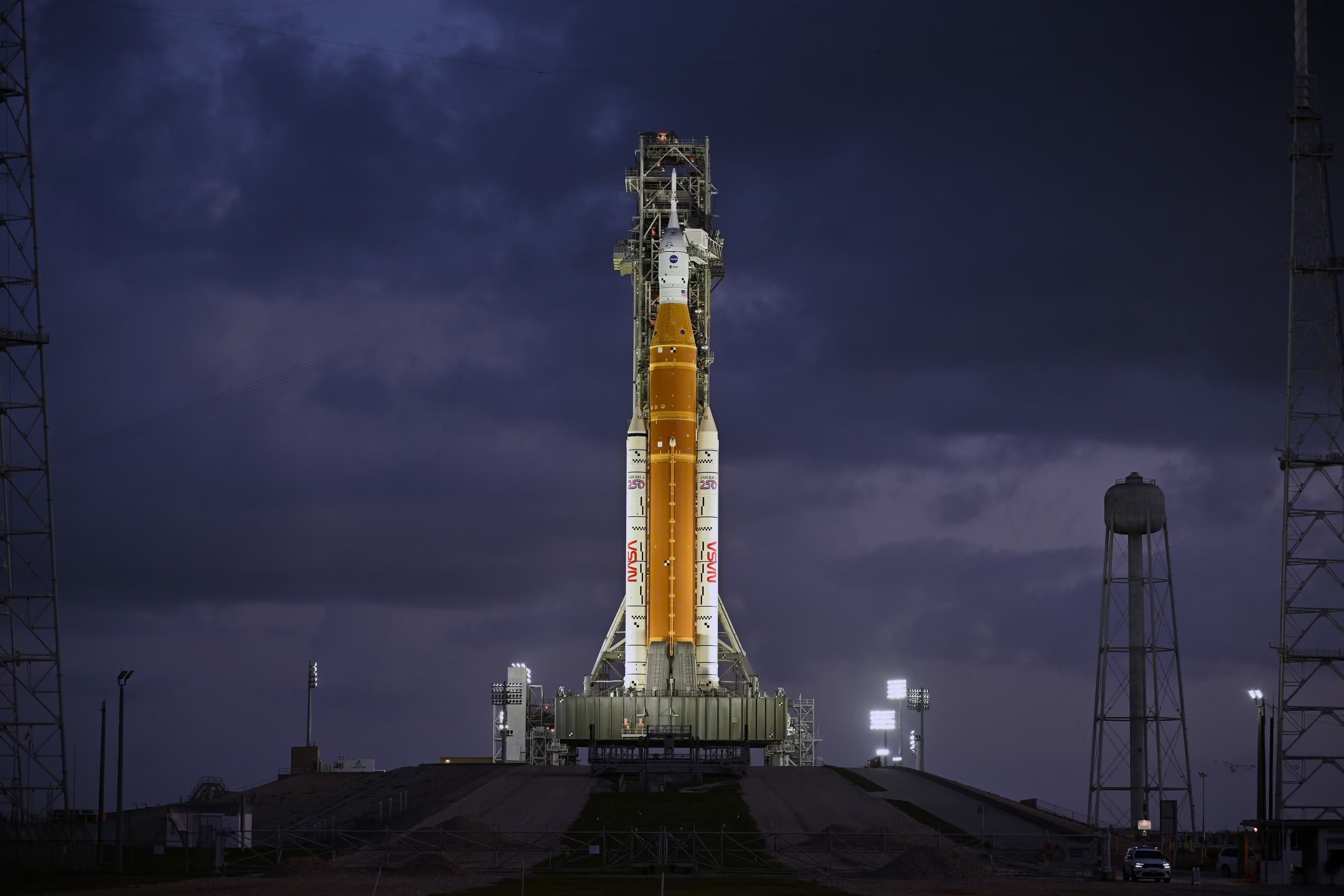
Shortly before sunset on Florida’s Space Coast, as many as 400,000 people are expected to gather on Wednesday along beaches and causeways to witness a rare spectacle— for the first time in nearly 54 years, a fully crewed NASA rocket will head for the Moon.
The launch of the Artemis II mission is scheduled for 6:24 p.m. ET, weather permitting and barring any technical problems. It will mark the first time since Apollo 17 in December 1972 that humans have ventured beyond low Earth orbit.
“The nation—and the world—have been waiting a very long time for this,” said mission commander Reid Wiseman, a NASA astronaut, speaking to reporters at the Kennedy Space Center on Sunday as the crew of three Americans and one Canadian arrived to enter quarantine ahead of launch.
Their 10-day test flight, which will not include a lunar landing, carries a series of significant milestones. NASA astronauts Christina Koch and Victor Glover will become, respectively, the first woman and the first person of color to travel into cislunar space—the region between Earth’s orbit and the Moon.
The mission’s fourth crew member, Canadian Space Agency astronaut Jeremy Hansen, will become the first non-American to make such a journey.
The Orion spacecraft on Artemis II could take its crew farther from Earth than any humans have traveled before. If the launch goes ahead on Wednesday, the astronauts will, on the sixth day of the mission, be more than 4,600 miles (7,400 km) beyond the far side of the Moon and nearly 253,000 miles from Earth, surpassing the April 1970 record of 248,655 miles set by Apollo 13.
Before Donald Trump returned to power, NASA had highlighted the diversity of the Artemis crews on its website. Last year, however, it dropped such language in line with the president’s order to remove practices and rhetoric tied to diversity, equity and inclusion (DEI) from federal institutions.
Glover, who is African American, and Koch had sought in the run-up to the flight not to dwell on the symbolic weight of their roles.
“It is not about celebrating the achievement of any one individual,” Koch said at the final prelaunch briefing on Monday.
“If there is something to celebrate, it is that we are living in a time when anyone with a dream can pursue it with equal opportunity. If we are not acting for everyone and alongside everyone, then we are not answering humanity’s shared call to explore.”
Glover put it in similar terms: “I live with that duality—on the one hand, the joy that a young girl can look at Christina and quite literally see her aspirations embodied… that Black boys and girls can look at me and say, ‘He looks like me—and he’s doing that?’ That matters, and I love that.”
“But I also hope we are moving toward a moment when we no longer have to talk about ‘firsts’. When this becomes simply the story of humanity—not Black history, not women’s history.”
Despite the political backdrop, a successful lunar flyby under Artemis II is crucial for NASA as the foundation for more ambitious plans. Last month, the agency’s new administrator, Jared Isaacman, unveiled a $20 billion proposal to build a lunar base by the end of the decade.
One of the mission’s objectives will be to photograph areas around the Moon’s south pole from an altitude of 4,000-6,000 miles, where the next human landing and the future base are planned.
The extended flight will also test critical systems—from hardware to life support—needed for future missions, including Artemis IV, scheduled for 2028, which is intended to return humans to the lunar surface.
The astronauts’ health will be monitored throughout the mission, including in studies of the effects of heightened radiation exposure and microgravity. They will spend the entire journey inside a capsule about five meters in diameter, with an interior volume comparable to that of a small camper, until splashdown in the Pacific Ocean after traveling 685,000 miles.
“Even the click of a pen cap can start to grate after 10 days inside a cramped capsule,” Wiseman said, having interacted with the crew almost daily since it was assembled in April 2023.
“We have built a good dialogue, and we talk about those things, but by day six, seven, eight, there will absolutely be moments when you think, ‘I need a little space—and there isn’t any.’ But we have a strong team.”
The 322-foot (98-meter) Space Launch System rocket and Orion spacecraft are already on the launch pad and will separate into stages during ascent. NASA says it has resolved the heat-shield problems that led to the tense return of Artemis I, as well as the helium leak that forced Artemis II back to the Vehicle Assembly Building in February and pushed the launch to April.
Under the latest forecast, issued on Tuesday, the probability of favorable launch weather stands at 80%. If the attempt is scrubbed, NASA will have opportunities to try again on each of the following five nights.
This week, in the Cape Canaveral and Cocoa Beach area, already crowded because of spring break, interest in the launch has risen sharply and hotels are virtually full.
A similar mood prevails at the Kennedy Space Center, where engineers and mission managers have spent years preparing the next stage of the Artemis program. The original plan had been to land humans on the Moon early in the decade, but the program has fallen significantly behind schedule and over budget.
“NASA was created to pursue big, bold objectives in the air and in space—to achieve what is almost impossible,” Isaacman said earlier.
“The next step is America’s return to the lunar environment. What we learn on this mission will allow us to return to the Moon’s surface once again. And when we get there, we will stay.”