In the first week of May 2026, the Dutch expedition vessel MV Hondius found itself at the center of an international crisis involving the WHO, several national governments, and KLM Royal Dutch Airlines. On board were 146 people from 23 countries, drifting in the Atlantic off Cape Verde. On shore: five confirmed cases of Andes hantavirus, three deaths, and a growing list of contacts across Singapore, the Netherlands, Switzerland, and South Africa. The president of the Canary Islands refused to allow the ship into Tenerife. The WHO, meanwhile, continued to assess the risk to the global population as low. This is a story not simply about a rare virus from the forests of South America, but about how the modern world has learned to respond to infectious signals—and why this case reveals what such responses will increasingly look like in the future.
A Pandemic-Style Response
The numbers as of May 7 looked like this: five confirmed Andes virus infections. Three deaths, one laboratory-confirmed as hantavirus-related, while two remained under investigation. One patient in intensive care in Johannesburg. One infected traveler identified after returning to Switzerland.
The world responded as follows. Authorities in Tenerife refused docking permission. Singapore isolated two of its citizens who had traveled on the same flight as one of the deceased passengers. KLM Royal Dutch Airlines sent alerts to passengers on that same route. The WHO publicly stated that Spain had both a moral and legal obligation to accept the vessel. The European Centre for Disease Prevention and Control activated its early warning protocol. Argentine epidemiologists began reconstructing the four-month route of the index patients while simultaneously trapping rodents along the route for testing.
Before 2020, five confirmed cases of a rare zoonotic infection would not have triggered such a response. What changed was not epidemiology, but the framework of perception. The post-pandemic reflex is now embedded in institutional procedures, in the political calculations of local authorities, and in public discourse. It is a framework in which the WHO can describe the risk as low while governments simultaneously behave as if it were moderate or high. The MV Hondius episode is the first major test of this new norm involving an infection nowhere near COVID in actual danger, yet comparable to it in media intensity.
Andes—The Virus That Breaks the Rule
The Orthohantavirus genus contains roughly 30 species affecting mammals. The overwhelming majority are strict zoonoses in humans. Infection occurs through rodents, via aerosols from their feces, urine, or saliva. Human-to-human transmission does not occur. That rule has held since the family was first described in the late 1970s—and it has been broken in exactly one place.
Andes virus is the only hantavirus with documented human-to-human transmission. The first confirmed outbreak occurred in 1996 in the Argentine Patagonian town of Epuyén. A localized cluster involving around two dozen cases included physicians who had contact with infected patients but not with rodents. Similar clusters in Argentina and Chile have appeared several times since—always localized, always linked to close household or medical contact.
What exactly makes Andes unique remains unclear. It is known that infected individuals shed viral particles in saliva and urine for several days before symptoms appear and during the first days afterward. It is also known that transmission requires close contact. There is no evidence of airborne spread over distance or of asymptomatic carriers capable of infecting others. Yet even the rare possibility of human-to-human transmission turns 146 passengers confined to a single ship into not just a medical situation, but a potential transmission chain.
To understand how much Andes stands apart, it is enough to compare it with other major members of the hantavirus family.
🧬 Strain
🌍 Region
🐭 Natural Host
🏥 Human Disease
👥 Human-to-Human Transmission
Andes (ANDV)
🇦🇷 🇨🇱 Argentina, Chile
🐭 Long-tailed pygmy rice rat
🫁 HPS, pulmonary syndrome, fatality rate 35-50%
⚠️ Documented
Sin Nombre (SNV)
🇺🇸 🇨🇦 United States, Canada
🐭 Deer mouse
🫁 HPS, pulmonary syndrome, fatality rate 30-40%
— Not documented
Puumala (PUUV)
🇪🇺 Europe, European Russia
🐭 Bank vole
🫘 HFRS, renal syndrome, fatality rate 1-2%
— Not documented
Hantaan (HTNV)
🌏 East Asia
🐭 Striped field mouse
🫘 HFRS, severe form, fatality rate 5-15%
— Not documented
Dobrava (DOBV)
🇪🇺 Balkans, Eastern Europe
🐭 Yellow-necked mouse
🫘 HFRS, severe form, fatality rate 10-12%
— Not documented
In this landscape, Andes is the sole anomaly. All other hantaviruses remain strict zoonoses, with outbreaks confined to regions inhabited by their rodent hosts. Andes does not have that boundary.
Birdwatching in Patagonia—How Tourism Crossed the Species Barrier
According to the WHO and Argentina’s health ministry, the index patients in this outbreak were a Dutch retired couple who boarded the vessel in Ushuaia on April 1. Before that, they had spent four months—from late November 2025 through early April 2026—traveling across Argentina, Chile, and Uruguay on a birdwatching tour. Their route passed through habitats of the long-tailed pygmy rice rat, Oligoryzomys longicaudatus, the principal natural host of Andes virus. Argentine epidemiologists are now reconstructing every stop on the journey while simultaneously trapping rodents along the route for testing.
This is not the first case of hantavirus infection among foreign tourists in Patagonia. It is a rare case in which such an infection ended up aboard an international cruise ship carrying passengers from 23 countries and became global news. Eco-tourism by affluent Europeans into endemic zones is a distinct and poorly studied category of zoonotic risk. SARS emerged from wildlife markets in China, Ebola from bushmeat hunting in Central Africa, MERS from camels in the Middle East. Andes arrived aboard a cruise ship carrying binoculars.
The target audience for birdwatching and wilderness expeditions consists largely of older affluent travelers with both the time and passion to pursue rare species. The geography of such tours is specifically designed to reach places others do not—Patagonia’s mountain forests, tropical wetlands, remote savannas. Those same ecosystems serve as reservoirs for local viruses. The tourism industry does not screen for epidemiological risks in endemic zones, and there is little reason to expect that it ever will. A birdwatching tour through the Andes is marketed as a premium experience, but epidemiologically it resembles the field exposure of a wildlife biologist.
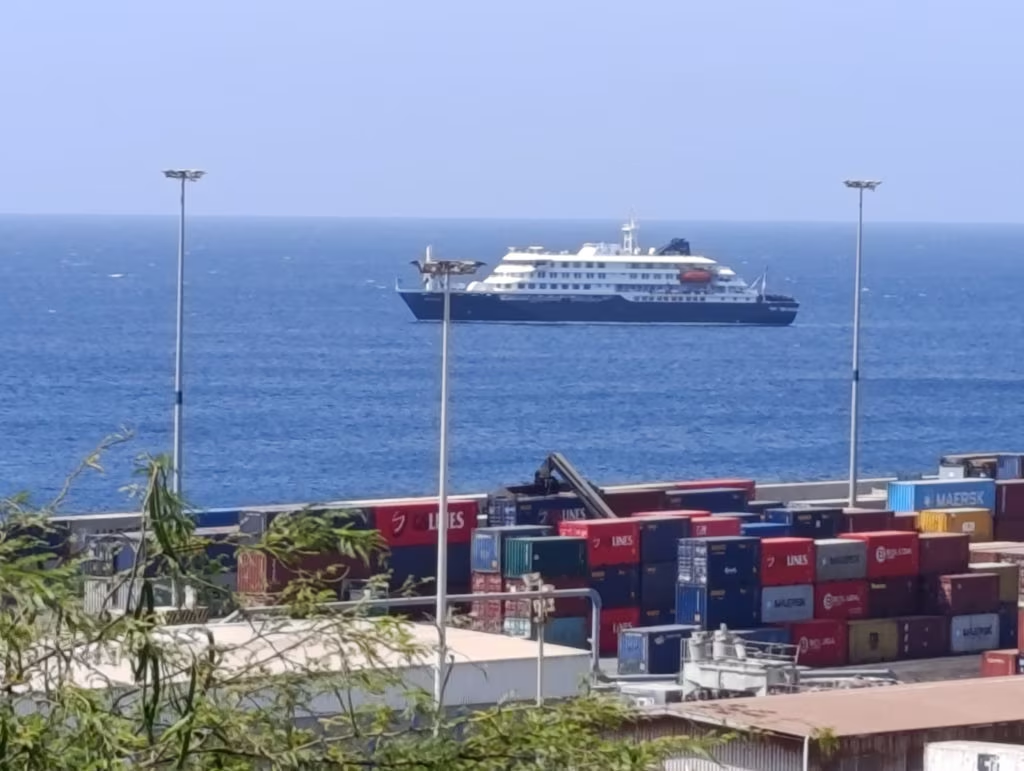
The Dutch cruise vessel Hondius remains off the coast of Cape Verde. May 4, 2026.
A Ship in a Legal Vacuum
After the WHO received a notification from the Netherlands through the European Early Warning and Response System on May 2, MV Hondius intended to dock in Tenerife and evacuate passengers there. On May 6, Canary Islands president Fernando Clavijo publicly refused. He explicitly referred to the islands’ COVID trauma and said he could not allow the vessel into the Canaries. The WHO responded by stating that Spain had a moral and legal obligation to assist, including because Spanish citizens were among the passengers. At the same time, Spanish Health Minister Mónica García said the vessel would ultimately be accepted at the port of Granadilla in Tenerife—but the regional government’s opposition remained publicly stated.
This episode almost literally reproduces situations seen in February and March 2020. Japan kept Diamond Princess quarantined in Yokohama, Cambodia alone accepted Westerdam after five countries refused it, while Chile and Argentina spent weeks refusing entry to Zaandam with COVID cases on board. The International Health Regulations of 2005—the main framework governing cross-border responses to infectious threats—do not obligate a state to accept an infected vessel. They require outbreak reporting and scientific transparency, but sanitary sovereignty over ports remains with national governments. That gap was obvious in 2020. It remains untouched.
Post-COVID political logic further hardens the response. In 2026, refusing entry to a ship carrying an infectious disease is no longer viewed as a fringe position but as an expected reaction from voters. Clavijo was not acting against public opinion—he was reflecting it. Tourist regions, especially island territories, now possess a politically advantageous line of defense against any infectious threat regardless of its actual danger. That response will likely be repeated whenever an infected vessel seeks entry into port, with the real level of risk becoming secondary.
The Virus Route—From Tierra del Fuego to Singapore
A localized South American virus became, within five weeks, a transcontinental chain requiring the coordinated work of public health authorities across at least nine countries and territories. The timeline unfolded as follows.
late November 2025—March 2026
Birdwatching tour across South America
A Dutch couple travels through Chile, Uruguay, and Argentina. Their route includes habitats of the long-tailed pygmy rice rat, the main host of Andes virus.
April 1, 2026
Departure from Ushuaia
MV Hondius departs the world’s southernmost city carrying 149 passengers and crew members from 23 countries. The Dutch couple is on board without symptoms.
April 6-11
First symptoms and death
A 70-year-old Dutch passenger develops fever, headaches, and diarrhea on board. He dies aboard the vessel on April 11.
April 24
Saint Helena
The vessel docks at the British overseas territory. The body is removed from the ship. Around 30 passengers disembark and disperse globally. Among them is the dead man’s wife, who is already symptomatic.
April 25-26
Johannesburg
During a KLM flight from Johannesburg to Amsterdam, the woman’s condition worsens and she is removed from the plane. She dies in hospital on April 26. Hantavirus is later laboratory-confirmed.
April 27
Medical evacuation from Ascension Island
A third passenger suffering pneumonia and shock is evacuated to South Africa. He remains in intensive care.
May 2-3
WHO notified
The Netherlands transmits the alert through the European early warning system. On May 3, PCR testing confirms hantavirus in the Johannesburg patient.
May 6
Tenerife refusal and Singapore quarantine
The president of the Canary Islands publicly refuses entry to the vessel. Singapore isolates two citizens in their 60s who traveled on the same flight as the deceased woman. Switzerland identifies its own case among passengers who disembarked on Saint Helena.
May 7
Course set for Granadilla
Spain’s health minister says the vessel will ultimately be accepted in Granadilla. Around 146 people remain on board, with arrival expected within days.
The structure of this chain matters. Infection occurred in Patagonia, diagnosis in Johannesburg, coordination in Stockholm (ECDC) and Geneva (WHO), contact tracing in Singapore, Bern, Amsterdam, and Manila. All of this—for five confirmed cases. The geography of infection is now defined less by the virus itself than by the architecture of international tourism, aviation, and post-COVID protocols.
Climate, Rodents, and Why This Will Not Be the Last Time
The population of Oligoryzomys longicaudatus in the southern Andes undergoes dramatic fluctuations. One documented factor is the mass flowering of Chusquea bamboo species in Chilean and Argentine forests. These plants flower synchronously across vast areas once every 60-70 years, produce enormous quantities of seeds, and trigger rodent population explosions lasting one to three years before collapsing. The connection between so-called ratadas—rodent outbreaks—and hantavirus surges in South America is well documented in regional veterinary and epidemiological literature.
Climate variability adds another layer. Wet years and ENSO-related conditions in the Southern Cone affect food availability for rodents. Regional epidemiology has long established that seasons with high Oligoryzomys density correlate with increases in hantavirus pulmonary syndrome. Predicting the exact year of an outbreak is difficult, but the broader pattern is stable: Argentina and Chile continue to experience recurring local outbreaks, and climate trends are more likely to increase than reduce their frequency.
At the same time, there is neither a vaccine nor a specific therapy. Treatment remains supportive—oxygen, mechanical ventilation, ECMO in severe cases. HPS mortality still ranges between 35-50 percent even with advanced care. Pharmaceutical companies have little incentive to invest in drugs for a rare infection with a limited stable market. An Andes vaccine has virtually no commercial future, while Argentina and Chile alone cannot finance development. This is a structural problem in the economics of rare diseases, and in the case of hantavirus it has reproduced itself for decades.
Together, these factors create a clear picture. Endemic zones will continue producing outbreaks. Cruise and eco-tourism infrastructure will continue penetrating deeper into them. Every outbreak now carries a nonzero chance of entering international transit networks. Port states have normalized refusal as a standard operating procedure. None of these conditions are likely to change anytime soon.
Russia Has Its Own Hantavirus
It is easy to view hantavirus in this story as an exotic South American phenomenon. In reality, it is the most widespread rodent-borne viral disease in Russia. Hemorrhagic fever with renal syndrome, caused primarily by Puumala virus, produces between 5,000 and 10,000 cases annually in Russia—more than in any other European country. The natural host is the bank vole, common throughout the deciduous and mixed forests of European Russia. The most active endemic regions include Bashkortostan, Udmurtia, Tatarstan, and the Ulyanovsk and Samara regions.
Puumala is significantly milder than Andes. HFRS mortality in Russia remains around 1-2 percent, compared with 35-50 percent for hantavirus pulmonary syndrome. Human-to-human transmission has never been documented. That is why Puumala does not produce international crises or cruise ships quarantined off Cape Verde. Yet it belongs to the same family, the same zoonotic mechanism, and the same absence of vaccines and targeted therapies. Among countries in the Eastern Hemisphere, Russia remains the largest chronic endemic zone for hantavirus—its local version simply does not generate headlines.