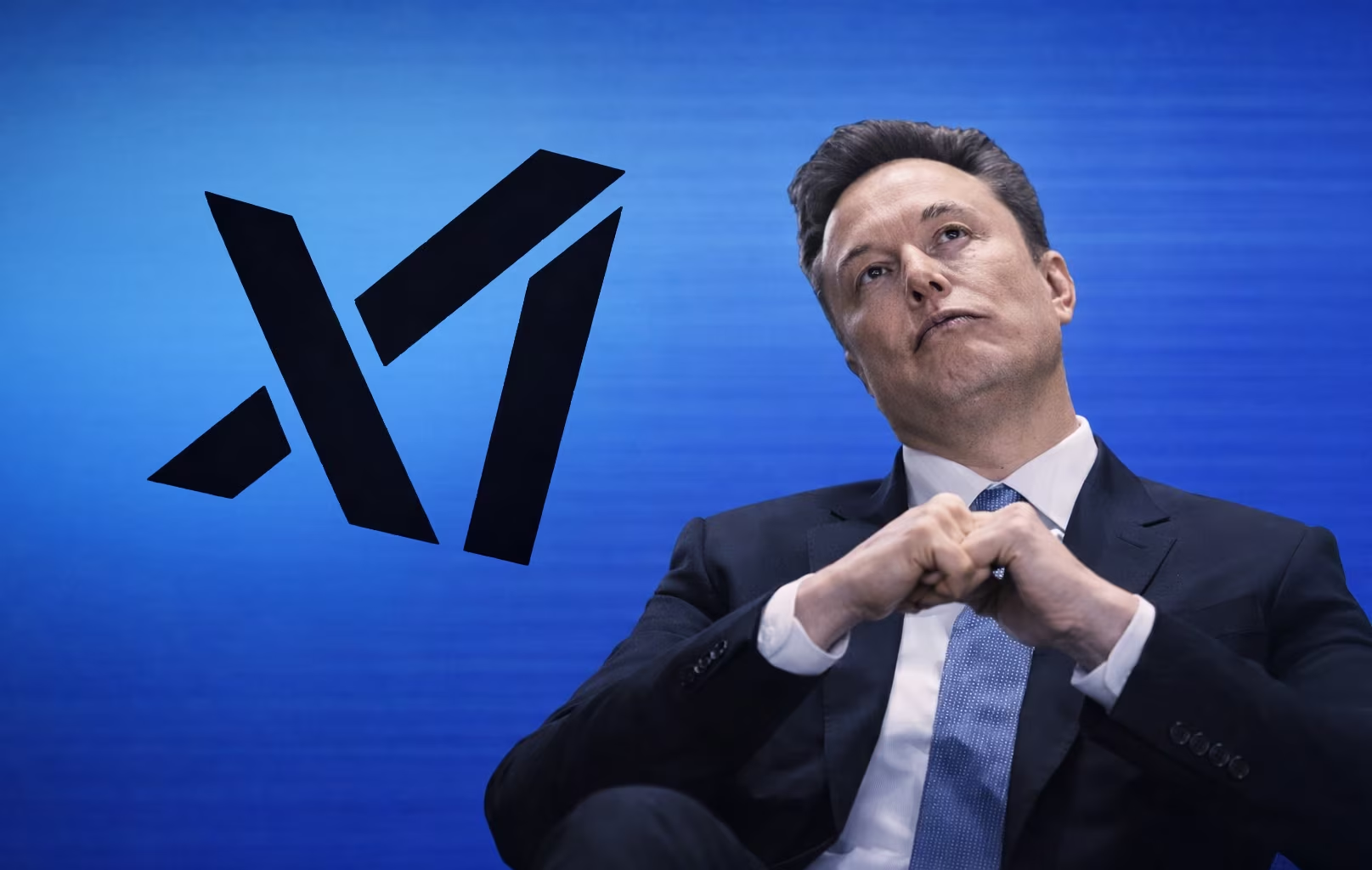
Elon Musk has ordered another round of job cuts at xAI after expressing dissatisfaction with the performance of its coding product. Several co-founders were forced out, and executives from SpaceX and Tesla have been sent in to audit the start-up and, as Musk put it, “fix the situation.”
The latest restructuring of the two-year-old start-up comes amid the success of Anthropic and OpenAI—their artificial-intelligence coding tools, according to several people familiar with the situation, have noticeably shifted the balance of power in the software development industry.
Pressure from Musk intensified after he merged SpaceX and xAI in a $1.25 billion deal. The entrepreneur is racing to meet a June deadline for what could become the largest initial public offering in history. Musk has said his longer-term ambitions include launching AI data centers into orbit, building factories on the Moon and colonizing Mars.
Even so, Musk has been pressing the loss-making start-up to catch up with rivals more quickly. So far, however, its Grok chatbot and coding product have failed to attract a substantial number of paying users—either among individual customers or corporate clients.
“xAI was built wrong from the very beginning, so we are rebuilding it literally from the foundations,” Musk wrote on X on Thursday. “The same thing once happened with Tesla.”
According to two sources directly familiar with the situation, managers from SpaceX and Tesla were sent to xAI to evaluate employees’ performance. Following the review, some specialists were dismissed—their results were deemed insufficient.
One of the key focuses of the audit was the quality of the data used to train the models. Inside the company, this is seen as one of the reasons why xAI’s coding product has fallen behind competitors—such as Claude Code from Anthropic or Codex from OpenAI.
As a result of the review, two more co-founders have left the company. One of the most senior technical figures, Zihang Dai, who had previously publicly acknowledged xAI’s lag in coding tools, departed this week.
Godun Zhang, who led the pre-training of Grok models, told colleagues he was leaving the company after being blamed for problems with the coding product and removed from his main role by Musk, according to two sources familiar with the situation. In a post on X, he confirmed that Thursday was his last day at work.
Following these departures, only two of the 11 co-founders who helped Musk launch xAI in San Francisco in March 2023 remain at the company—Manuel Kroiss, known by the pseudonym “Makro,” and Ross Nordeen.
Just a month ago, Musk publicly criticized the team developing the coding tool during an internal meeting, a recording of which later surfaced online.
At the same time, he announced a sweeping reorganization—by that point several other co-founders had already left the company, including Greg Yang, Tony Wu and Jimmy Ba.
Toby Pohlen, a former DeepMind researcher, was appointed to lead the “Macrohard” project—an initiative to build digital agents that, according to Musk, could replicate the work of entire software companies. Musk described the project as “the most important” for the company and noted that its name was a “playful” reference to Microsoft. Pohlen left the company after 16 days.
After that, Musk tasked Ashok Elluswamy, Tesla’s head of AI software development, with rebooting the Macrohard project and auditing the work already completed. According to Musk, Tesla and xAI will jointly develop a “digital Optimus”—a system intended to combine Tesla’s practical experience in real-world AI with Grok’s language models.
Employees say the constant reshuffles are undermining morale and preventing xAI from realizing its potential.
Meanwhile, Musk has built a large data center in Memphis equipped with more than 200,000 specialized AI chips. In the future it is expected to expand to 1 million GPUs. An additional source of training data comes from the social network X—which was merged with xAI last year and now actively promotes the Grok chatbot.
According to sources, employees received an internal memo on Wednesday denying preparations for mass layoffs. Nevertheless, researchers continue to leave—some because of burnout caused by Musk’s “extremely demanding” expectations at work, others after accepting more lucrative offers from competitors.
The wave of layoffs and voluntary departures has left the company with a large number of open roles. According to sources, recruiters have begun contacting candidates who were previously rejected after interviews and offering them jobs—often on more attractive financial terms.
“Over the past few years, many talented people were turned down for a job offer or even an interview at xAI. I apologize,” Musk wrote Friday morning. He added that he intends to “review the company’s interview history and reach out again to promising candidates.”
Even so, Musk remains capable of attracting leading talent from Silicon Valley. This week xAI poached two employees from the popular AI coding application Cursor—Andrew Milich and Jason Ginsberg—to strengthen development of the “Grok Code Fast” product.
Welcoming them on X on Thursday, Musk added: “Orbital space data centers and electromagnetic catapults on the Moon will be incredible.”