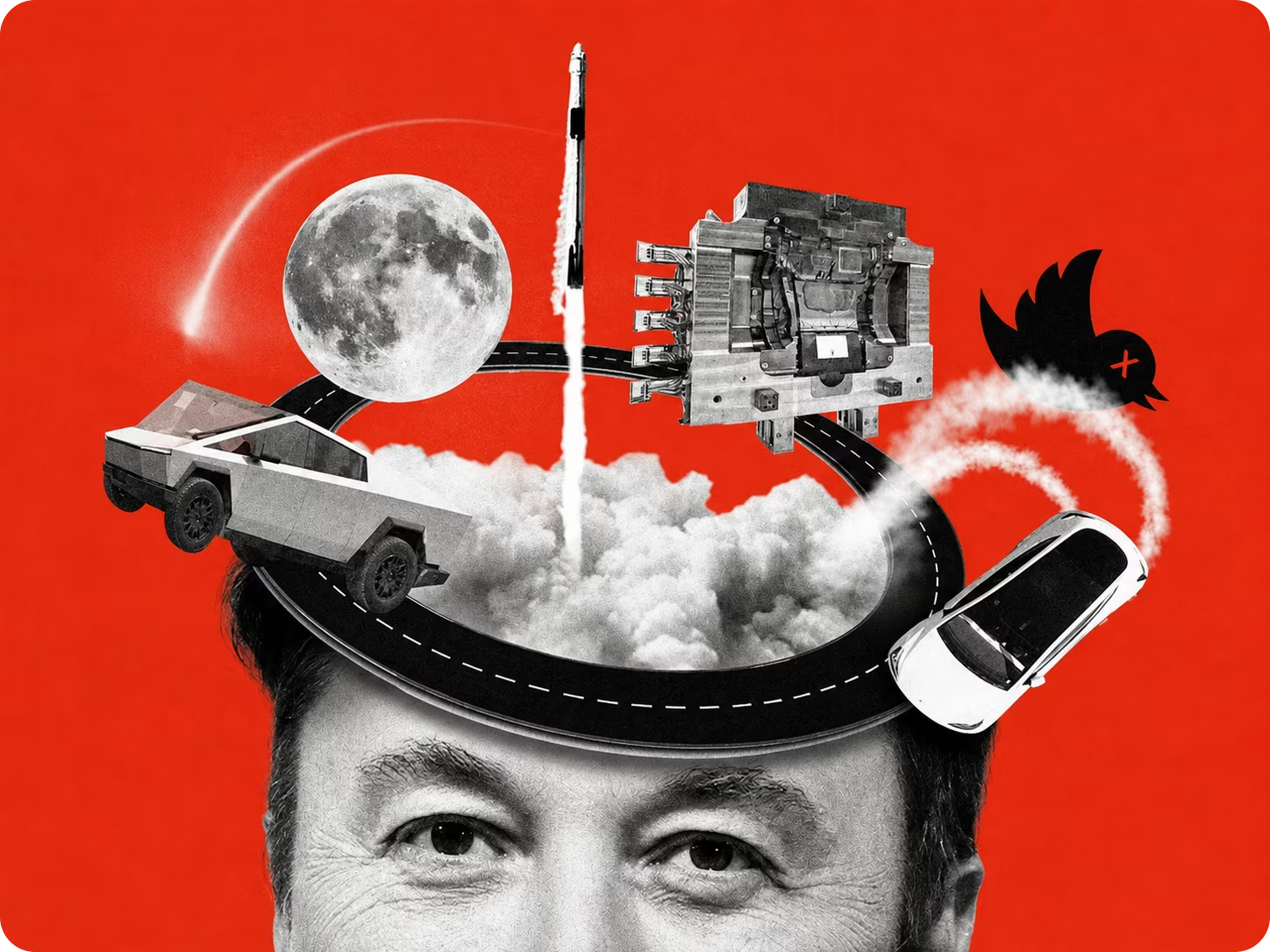
Elon Musk is approaching a level of financial influence that once seemed unattainable. The world’s richest man—and potentially its first trillionaire—has built a corporate empire without which the global economy is increasingly hard to imagine.
But on the eve of SpaceX’s massive IPO, its chief executive was focused on more than business. On his own platform, he continued to take part in culture-war battles over migration and race—and, judging by demand for the company’s shares, none of it appears to have affected investors’ attitude toward his businesses.
The combination is unusual. Over years in public life, markets have grown used to a succession of Musk scandals, any one of which would have forced most public-company executives into a boardroom crisis and an urgent effort at reputation management. In Musk’s case, there have been no visible consequences: demand for SpaceX shares at a $1.75 trillion valuation significantly exceeded supply even before the company’s historic market debut on Friday.
On Tuesday evening, anti-immigrant unrest broke out in Belfast after video of a knife attack spread on X. According to police, it was allegedly carried out by a Sudanese migrant.
Groups of masked people set fire to cars, a city bus and several homes, marched through neighborhoods chanting “foreigners out” and forced minority families to leave their homes under police protection.
Musk, who posts almost daily about violence by migrants, shared a list of protest locations published by the British far-right activist Tommy Robinson. Robinson described what happened as “another invader attack on our people.”
“Only if people protest AGAIN AND AGAIN and LOUDLY will anything change!!” Musk wrote to his 240 million followers. British politicians subsequently accused him of incitement.
His intervention in Belfast followed several weeks in which Musk had drawn attention to the case of Henry Nowak, a white British teenager killed by a British Sikh. The case prompted a wave of far-right claims about “anti-white” policing.
Musk’s activity is not confined to Britain. He has repeatedly said that elites are deliberately replacing the white populations of Western countries with migrants. Researchers of extremism note that this argument overlaps with the “Great Replacement” theory, a conspiratorial idea popular in far-right circles.
In the United States, Musk regularly returns to the issue of noncitizen voting: according to him, Democrats use the votes of illegal migrants to create a permanent one-party state. Studies of the electoral process, including work by the Brennan Center, have found that cases of noncitizen voting in the U.S. are isolated and do not affect election outcomes.
This week, Musk also joined supporters of the MAGA movement who claimed—without presenting evidence—that Democrats had carried out large-scale fraud in the Los Angeles mayoral primary.
Musk himself frames his position this way: Western civilization is being destroyed by mass migration, demographic change and “woke” institutions, and this is the overriding threat against which everything else loses meaning. When asked on Wednesday why the world’s richest man spends his days in online culture-war fights rather than enjoying his billions on a beach, he replied: “Nothing else matters if civilization falls.”
That position has repeatedly brought him into conflict with world leaders, including British Prime Minister Keir Starmer. Starmer has accused the billionaire of using his platform to “stoke division” and interfere in the democratic processes of other countries.
“People are angry that deadly migrants are beheading innocent people in their hometown, not ‘social media!’” Musk wrote on Wednesday in response to accusations of incitement.
He rejects accusations of racism and xenophobia. Such labels, he says, are used to shut down debate about migration and crime.
Investors’ calm has a rational explanation. SpaceX dominates the space-launch market, Starlink has become infrastructure on which governments and militaries depend, and contracts with NASA and the Pentagon make the company effectively indispensable. For the market, those assets outweigh any reputational risks linked to the founder’s public behavior.
There is another explanation as well: the mechanisms of corporate accountability that, even a decade ago, would have forced a board to respond to such statements by a CEO do not work in Musk’s case. His main platform is one he owns himself, while the political climate of the Trump era has shifted assumptions about what kind of rhetoric is acceptable for public figures.
If SpaceX’s valuation ultimately secures the company a place in the S&P 500 index, ordinary Americans with index funds and retirement accounts will automatically receive a stake in Musk’s empire—whether they share his views or not.