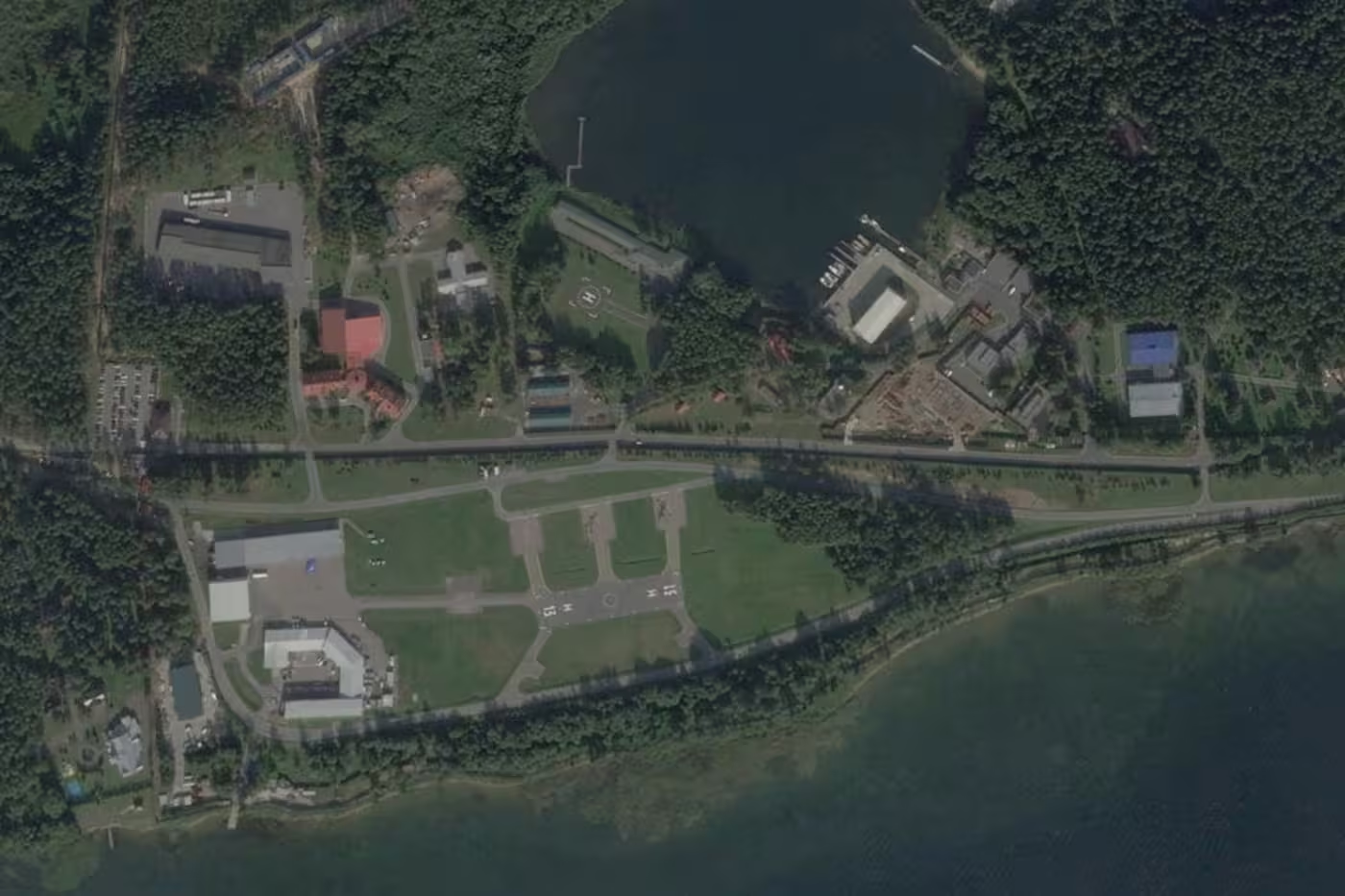
On Tuesday, December 30, Ukrainian authorities scrambled to contain the diplomatic fallout from Moscow’s claims that Ukrainian long-range drones had allegedly attacked the residence of Vladimir Putin. Kyiv dismissed the assertions as a fabrication designed to derail talks with the United States.
Russia’s foreign minister, Sergei Lavrov, said on Monday that 91 Ukrainian drones had targeted the presidential residence at Lake Valdai in Russia’s Novgorod region, but offered no evidence. Ukraine’s president, Volodymyr Zelensky, described the claim as “pure fiction.”
The situation took on added urgency after US president Donald Trump appeared to take the Russian statements at face value. He told reporters that he had heard about the alleged attack directly from Putin and that he was “very angry.”
Expressions of support for Russia also came from India’s prime minister, Narendra Modi, Pakistan’s prime minister, Shehbaz Sharif, and the foreign ministry of the United Arab Emirates, which called the incident an “outrageous attack.”
Ukraine’s foreign minister, Andrii Sybiha, said on Tuesday that Kyiv was “disappointed” by the statements from the three countries, without mentioning Trump’s remarks. “Almost a full day has passed, and Russia has still failed to present a single credible piece of evidence for its accusations of an alleged ‘attack on Putin’s residence,’” he said. “And it will not. Because they do not exist. There was no attack.”
Officials in Kyiv believe such accusations are intended to justify the continuation of Russia’s strike campaign amid ongoing peace talks, as well as to “stoke negative emotions” among Americans toward Zelensky, according to a Ukrainian official familiar with the negotiations.
The reports of an attack could not be independently verified. Russia’s defence ministry said on Monday that it had destroyed 18 drones in the region, but made no mention of any strike on the Valdai residence until Lavrov’s statement.
Ukrainian forces regularly carry out long-range drone strikes on western regions of Russia, but in recent months their attacks have been almost exclusively focused on energy infrastructure, including oil refineries and oil terminals.
The accusations came shortly after a meeting between Donald Trump and Volodymyr Zelensky in Florida, where the two sides sought to forge a common negotiating position to end the war in Ukraine.
Although the meeting produced no tangible results, both sides said meaningful progress had been made. Zelensky, in particular, said that an agreement on security guarantees between Ukraine and the United States was “100 percent ready.”
Ukrainian analysts viewed Moscow’s accusations as an attempt to derail the growing momentum of negotiations aimed at ending the conflict. The Mar-a-Lago meeting “was neither betrayal nor victory, diplomatically speaking,” wrote Ukrainian political analyst Volodymyr Fesenko. “But the Kremlin appears to have been deeply concerned that the negotiation process between Ukraine and the United States had gone too far, and decided it needed to be disrupted,” he added.
Following the allegations, Putin told Trump that Moscow would “reconsider its position” on negotiations with Ukraine, according to his foreign policy adviser Yuri Ushakov. Russian officials also said the alleged attack would “not go unanswered.”
Zelensky said he expected Russian rhetoric to be used to lay the groundwork for new strikes on government buildings in Kyiv. In September, Moscow launched a large-scale missile and drone barrage against a building in the capital that houses the cabinet of ministers.
Russia’s defence ministry said on Tuesday that the experimental “Oreshnik” missile system had entered combat duty in Belarus, publishing official images of the weapon for the first time.
European Union leaders on Tuesday reaffirmed their support for Ukraine. “We are pushing the peace process forward. Transparency and honesty are now required from everyone—including Russia,” Germany’s chancellor, Friedrich Merz, wrote on X after speaking with other European leaders, European Commission president Ursula von der Leyen, and European Council president António Costa. “We are united in our determination to step up efforts for a just and lasting peace,” Costa said.