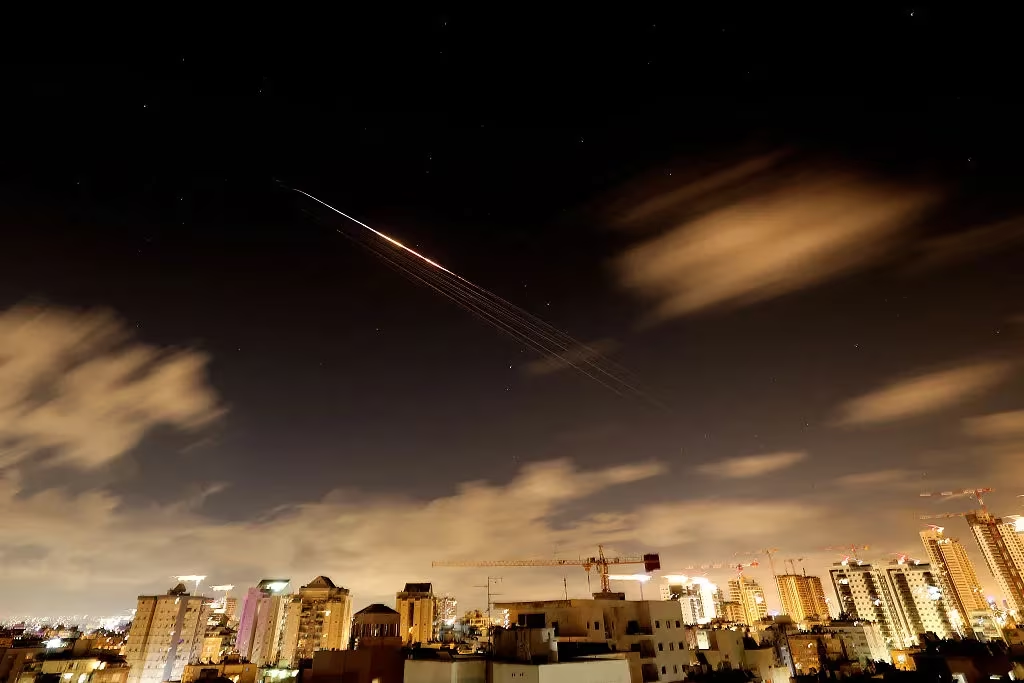
The Middle East Conflict has entered its fifth week—in Sunday strikes, Israel hit Tehran, while Saudi Arabia intercepted nearly a dozen drones, a day after Yemen’s Houthis declared they had entered the war.
The escalation comes amid the deployment of another 3,500 American troops to the region and a renewed diplomatic push—representatives of Saudi Arabia and Turkey gathered in Pakistan to discuss ways of ending a conflict that has already left thousands dead and unsettled commodity markets and global trade.
On the morning of Saturday, March 28, the Iran-backed Houthis launched ballistic missiles at Israel in response to joint American-Israeli strikes on Iranian nuclear facilities. Tehran, in turn, struck aluminum plants in Bahrain and the UAE, as well as a US base in Saudi Arabia, where about a dozen American service members were wounded.
According to The Washington Post, the Pentagon is preparing for possible ground operations in Iran that could last for several weeks. Sources cited by the newspaper say the initial objective may be to reopen the Strait of Hormuz—a critical artery through which one-fifth of the world’s seaborne oil trade passed before the war. Traffic through the strait has now all but ground to a halt, triggering what is already the largest supply disruption in the history of the global oil market.
The Strait of Hormuz has become Iran’s main instrument of pressure. Pakistan said it had reached an agreement with Tehran to allow 20 of its vessels through. Saudi Arabia has partially rerouted its exports—its East-West pipeline is operating at its full capacity of 7 million barrels a day.
The Houthis, however, could complicate even that arrangement. The Red Sea port of Yanbu, through which roughly 5 million barrels of Saudi exports now pass, lies within range of their missiles. The Houthis said they would continue operations until the United States and Israel halt their strikes on Iran and its allied groups, including Hezbollah in Lebanon.
Although they have not explicitly declared an intention to attack tankers in the southern Red Sea and the Bab el-Mandeb Strait, those routes have in practice been closed to most Western shippers since the outbreak of the Gaza war in 2023.
According to analysts at Eurasia Group, the Houthis are likely, at this stage, to avoid striking Saudi oil infrastructure—a truce reached between the sides in 2022 has broadly held.
Iran said its strikes on Gulf states and Israel were retaliation for attacks on the country’s nuclear facilities and metallurgical plants. The conflict is spilling beyond the region—French counterterrorism services are investigating a foiled bombing attempt near Bank of America’s headquarters in Paris that has been linked to the turmoil in the Middle East.
Iranian state media reported extensive damage to residential neighborhoods in Tehran and the first reports of civilian casualties. According to the Fars news agency, five people were killed in strikes on a port in Hormozgan province, and two vessels were damaged. In the Caspian coastal city of Shaft, one person was killed after an attack on a residential area.
The UAE reported fires at the Kezad industrial facility in Abu Dhabi after ballistic missiles were intercepted—with at least six people injured. In total, authorities said, the country shot down 37 drones and 20 ballistic missiles over the course of Saturday.
The strike on Prince Sultan Air Base in Saudi Arabia left at least 15 American service members wounded, five of them seriously, and also damaged aerial refueling aircraft. Among the affected equipment was an E-3 Sentry airborne early warning and control aircraft used to track missiles and drones.
Kuwait reported several drone attacks on its airport, which seriously damaged the radar system. In Oman, drones struck the port of Salalah—operations there were suspended, and one person was injured.
In Israel, one person was killed in an Iranian strike on Tel Aviv. At the same time, Israel’s operation in southern Lebanon is continuing—according to the national news agency NNA, more than 1,000 people were killed over the weekend and over a million were forced to flee their homes, including two journalists killed in strikes on Saturday.
The US military said it has struck more than 11,000 targets and destroyed more than 150 Iranian vessels since the start of the conflict.
Эскалация усиливает опасения затяжного конфликта. Несмотря на призывы Дональда Трампа к переговорам, признаков скорого начала мирного диалога между США и Ираном нет. Президент США перенес крайний срок для Тегерана до 6 апреля — к этому моменту Иран должен либо согласиться на открытие Ормузского пролива, либо столкнуться с уничтожением своих энергетических объектов.
Tehran rejected Trump’s proposed 15-point plan, which called for sanctions relief in exchange for dismantling its nuclear program, reducing its missile arsenal, and reopening the strait. In response, Iran is demanding reparations, recognition of a degree of control over Hormuz, and guarantees that the United States and Israel will not attack it again in the future.
The foreign ministers of Pakistan, Saudi Arabia, Turkey, and Egypt are set to meet in Islamabad on March 29-30 to discuss possible paths to de-escalation. Pakistan’s prime minister, Shehbaz Sharif, has already held more than an hour of talks with Iranian President Masoud Pezeshkian.
Pakistan is gradually emerging as a key mediator and is offering its territory as a possible venue for future talks between the United States and Iran.
As the conflict drags on, oil prices continue to climb—Brent closed on Friday above $112 a barrel, up more than 55% since the war began. Market optimism about the prospect of a near-term truce has visibly faded.
The fighting has already triggered fuel shortages and deepened fears of stagflation—a mix of slowing economic growth and accelerating inflation across the global economy.
According to governments and international organizations, the death toll has surpassed 4,500. Roughly three-quarters of the victims are in Iran, nearly 1,100 people have been killed in Lebanon, and dozens more in Israel and the Gulf states.
Despite repeated statements about the need for negotiations, Donald Trump has also left open the prospect of further military action, saying the United States could strike more than 3,500 additional targets in Iran—and that “it will be done quite quickly.”
US Secretary of State Marco Rubio told his G7 counterparts that, in Washington’s assessment, the conflict will last for several more weeks—but not months.
At the same time, the US administration is signaling to its allies that it does not, for now, plan to launch an immediate ground invasion of Iran.