On Monday morning, June 8, explosions were heard in central Tehran. They came amid a new exchange of strikes between Israel, Iran and forces linked to it—a round of escalation that heightened the risk of a wider conflict in the Middle East.
Shortly before noon local time, Iranian media reported explosions in western, southwestern and eastern Tehran. Several hours earlier, Israel said it had struck military targets in western and central Iran.
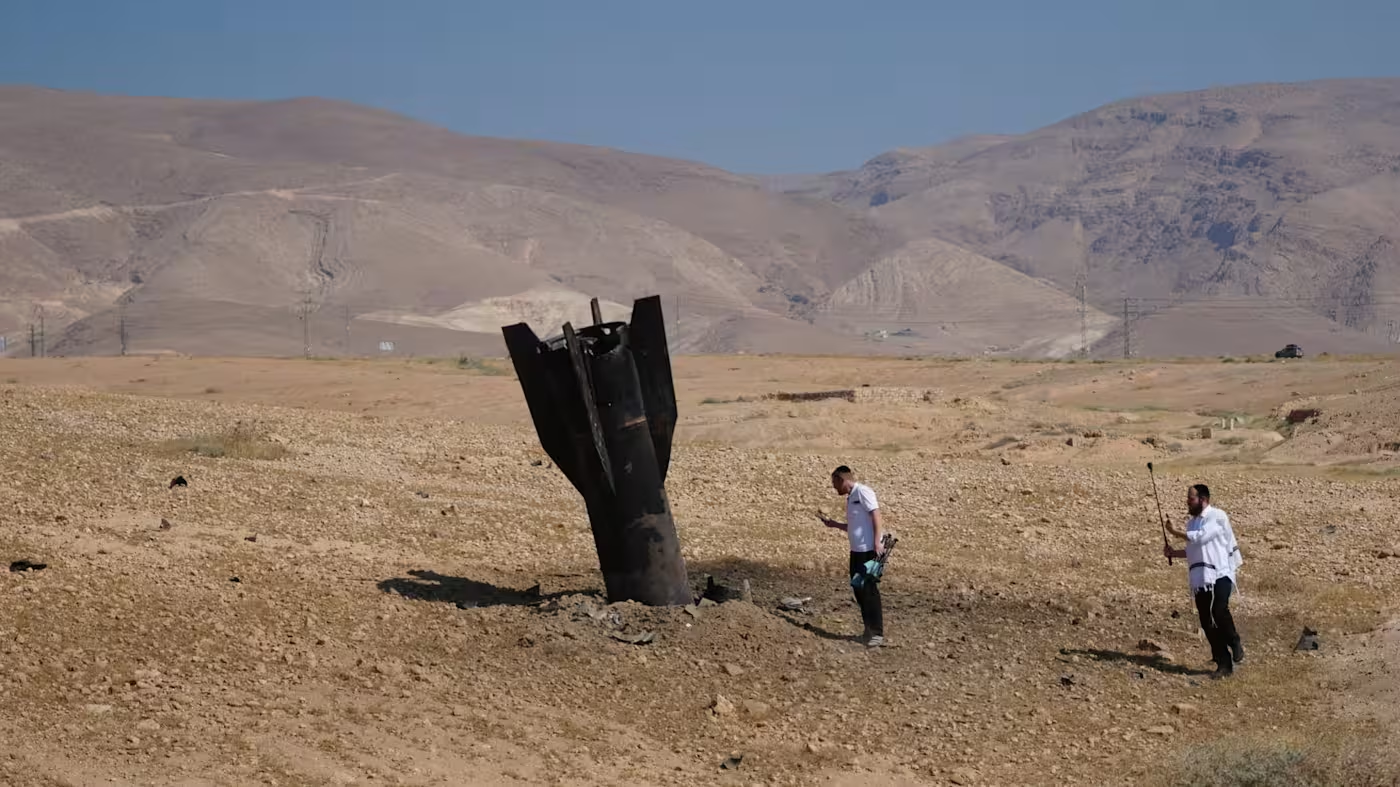
On Sunday evening, Iran launched a series of missiles at northern Israel. Tehran described the attack as a response to an earlier Israeli strike on southern Beirut that targeted Hezbollah, the Iran-backed group.
There were no casualties from the Iranian strike. But it was Tehran’s first attack on Israel since a fragile ceasefire took effect in April. Iran had insisted that the conflict between Israel and Hezbollah should be treated as part of a broader ceasefire and warned that it would respond if Israel struck Beirut.
A person familiar with the course of events said Israeli officials believe the new round of fighting could last “several days.” At the same time, he warned that “no one knows how this could escalate.”
According to the source, Israel does not currently expect the United States to take part in offensive operations. Washington, however, is likely to use its forces in the region to help Israel intercept incoming missiles.
U.S. President Donald Trump is trying to secure an agreement with Iran to extend the ceasefire and reopen the Strait of Hormuz—a key route for global energy supplies. The strait has been closed since February, when the United States and Israel first attacked Iran.
After the new escalation, oil prices rose sharply at the opening of trading, pointing to a deterioration in the prospects for a broader agreement. Brent rose by more than 4.8% to $97.58 a barrel. West Texas Intermediate, the U.S. benchmark, climbed 4.6% to $94.70.
Seeking to contain the crisis, Trump said on Sunday evening that he had called Israeli Prime Minister Benjamin Netanyahu and urged him not to respond to the Iranian missile strike.
Netanyahu nevertheless authorized the strikes—amid demands from far-right members of his cabinet for a harsh response to the Iranian barrage. On Monday, the ceasefire moved closer to collapse: Iran launched new salvos of missiles, and Israel carried out further strikes inside Iran.
The Islamic Revolutionary Guard Corps said that “the Zionist enemy used air-launched ballistic missiles to attack targets on the territory of our country.” The statement provided no further details. Earlier, state television had reported explosions in Tehran, Tabriz and Isfahan, as well as in Baghdad and Beirut.
The Israeli military said it had carried out a “large-scale strike” on “strategic defense systems” in Iran, and had also attacked “several targets at a petrochemical plant in Mahshahr in southern Iran.”
The risk of further escalation was also reflected in the actions of the Iran-linked Houthis in Yemen. They launched a missile at Israel and warned that they would attack any Israeli vessels in the Red Sea.
The Houthis had largely stayed out of the U.S. and Israeli war against Iran, but had warned that they could close the Bab el-Mandeb Strait—the waterway linking the Red Sea with the Gulf of Aden and the Indian Ocean. After Hamas’s attack on Israel on October 7, 2023, the group severely disrupted shipping in the Red Sea for almost two years.
In a telephone interview with the Financial Times on Sunday, Trump insisted that the new escalation would not affect his efforts to reach an agreement with Iran on opening the Strait of Hormuz.
According to Trump, Netanyahu would have no choice but to accept any deal. “I make the decisions. I make all decisions. He doesn’t make the decisions,” he said.
However, members of Netanyahu’s government, as well as opposition leaders, called on Israel to deliver a powerful strike against Iran. National Security Minister Itamar Ben-Gvir, who represents the far-right camp, wrote on X on Sunday evening: “Tehran must burn.”
Former Prime Minister Naftali Bennett, who is expected to become one of Netanyahu’s main rivals in this year’s election, said on Monday that Israel was facing a “moment of truth”—the question of whether it is “a sovereign state capable of defending itself.”
“A weak or symbolic response will show our enemies that the blood of our citizens was shed with impunity; therefore Israel must act strongly and effectively,” he wrote on X.
Last week, Trump also tried to persuade Netanyahu to abandon an offensive on Beirut. On Sunday, however, Israel struck Dahiyeh—a Hezbollah stronghold in the southern suburbs of the Lebanese capital.
Pakistan’s army chief, as well as the foreign ministers of Qatar and Turkey, who had been involved in mediation efforts over a U.S.-Iran deal, held phone calls with Iranian Foreign Minister Abbas Araghchi in an attempt to contain the escalation.
Pakistan’s Interior Minister Mohsin Naqvi was in Iran over the weekend, where he held talks with Araghchi.