
On Sunday, December 28, a passenger train derailed in southern Mexico, killing 13 people and injuring dozens more. The incident once again gave the opposition grounds to raise allegations of corruption surrounding railway and infrastructure projects promoted under former president Andres Manuel Lopez Obrador.
The accident occurred on the state-run Interoceanic Train, which runs across the Isthmus of Tehuantepec, linking the Atlantic and Pacific oceans. The route was conceived as a tool for economic development in one of the country’s poorest regions and as an alternative rail corridor for freight transport, intended to compete with the Panama Canal.
Images released by the government show one carriage plunging into a ravine, while another was left hanging over the edge.
President Claudia Sheinbaum said that of the 250 people on board the train, 13 were killed and 98 injured, five of them in critical condition. Speaking at a morning press conference, she pledged to carry out a “thorough analysis of what happened”.
Authorities have yet to determine the cause of the derailment in the state of Oaxaca. The attorney general’s office has announced the launch of an investigation.
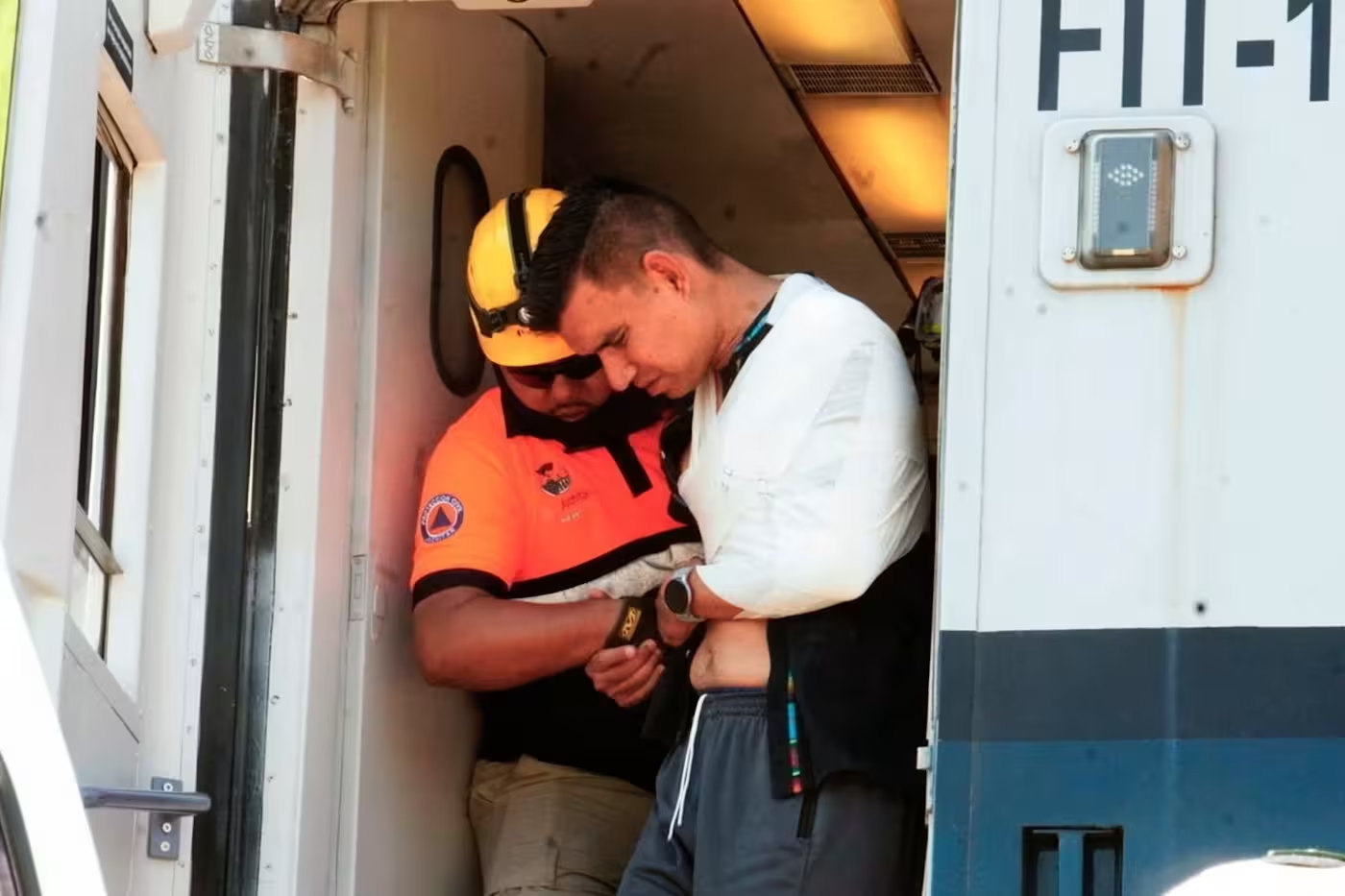
Nearly 100 people were injured in the accident in the state of Oaxaca.
The interoceanic route, which modernised a line dating back to 1907 that had been in decline for more than a century, was one of the flagship infrastructure projects of Claudia Sheinbaum’s predecessor, who left office last year.
Like a number of other state projects, including Mexico City’s new airport, it was placed under the management of the Mexican military. Last year Lopez Obrador said that one of his sons, Gonzalo “Bobby” Lopez Beltran, had overseen the interoceanic train project on a pro bono basis.
The opposition Institutional Revolutionary Party (PRI) said the tragedy demanded “immediate answers”.
PRI leader Alejandro Moreno pointed to an audio recording published last year by the investigative outlet Latinus, which referred to alleged corruption in the awarding of a contract for the construction of the Maya Train on the Yucatan peninsula.
In the recording, a nephew of Lopez Obrador is purportedly heard telling a contractor: “When the Maya Train derails, it will be yet another problem.”
“This tragedy cannot be viewed in isolation from a system of governance in which relatives, friends and those close to power benefited from state projects without proper planning or genuine oversight,” the PRI wrote on X—calling for a full audit of such initiatives.
Sheinbaum rejected Moreno’s claims, saying at her daily press conference on Monday that she “has no intention of engaging in a debate with the PRI chairman”, and stressing that the train had been operated in full compliance with all safety requirements.
Lopez Obrador and members of his family have repeatedly denied accusations of corruption and abuse of influence.
In an open letter published in 2022 and co-authored with Andres Manuel Lopez Beltran, another son of the former president, Lopez Beltran said they had become victims of political persecution, arguing that critical media coverage was based on conjecture, third-party testimony, surveillance and biased reporting.
They “categorically denied” acting on behalf of any business interests in the implementation of state projects, including the Maya Train, describing such allegations as “groundless slander”.
The derailment was the third incident on the interoceanic route since July. One occurred on December 20, when a train collided with a truck at a level crossing. Accidents have also been recorded on the Maya Train line.
The section of track where the crash occurred on Sunday had been seen as a central component of the so-called interoceanic corridor, which the authorities promoted as the backbone of efforts to turn the region into a hub for industry and economic development.
The Maya Train tourist service, which runs around the Yucatan peninsula and represents Lopez Obrador’s second major rail project, has also come under criticism. Detractors have accused it of causing environmental damage, suffering sharp cost overruns and attracting weak passenger demand.