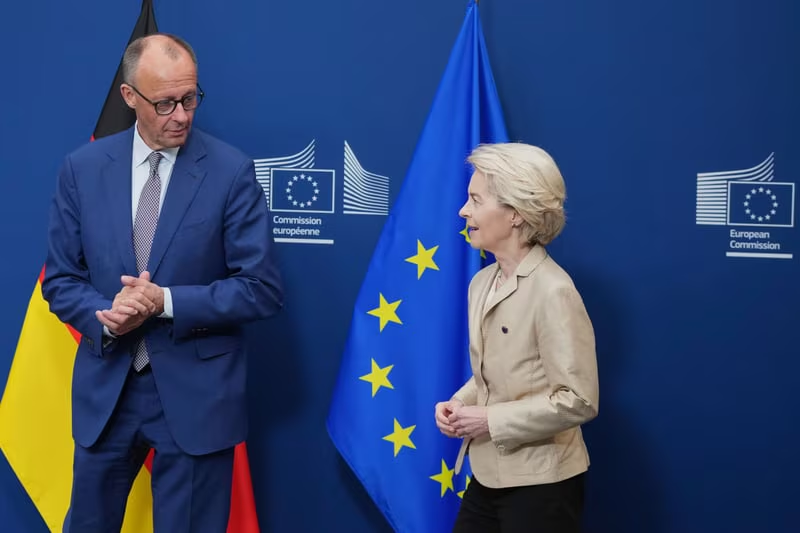
The EU’s refusal to mobilize frozen Russian assets to support Ukraine became a politically sensitive defeat for Ursula von der Leyen and Friedrich Merz—two of the most consistent advocates of the idea. Euractiv reports.
Despite hours of consultations between the European Commission and Belgian diplomats, no final decision on the assets was reached. After the summit concluded, Belgian Prime Minister Bart De Wever described the outcome in stark terms, likening the talks to a catastrophe: “It was like a sinking ship, like the ‘Titanic,’ and in the end it was over.”
Von der Leyen and Merz sought to cast the outcome of the discussions in a more favorable light. The head of the European Commission said: “I am very pleased to announce that we have done this,” stressing that Ukraine would be required to repay the loan only if it received reparations from Moscow. Merz, for his part, claimed that the idea of raising funds within the EU had supposedly been “proposed” by him, even though just a day earlier he had described a reparations-backed loan as the “only option” for assisting Ukraine.
Euractiv details how the plan to use Russian assets collapsed. According to the outlet, “leaders locked themselves in a room without mobile phones, trying to reach a compromise acceptable to De Wever.” The Belgian prime minister insisted on an unlimited sharing of financial risks among EU capitals, prompting sharp resistance from several countries.
“After more than four hours of talks, it became clear that there was no realistic path to an agreement on a €210 billion reparations loan,” the publication notes. According to two EU diplomats, the turning point came when Emmanuel Macron asked Viktor Orban to lift his blockade on issuing a common debt instrument.
Orban, acting in coordination with Czech Prime Minister Andrej Babis and Slovak President Robert Fico, agreed to support a €90 billion loan on the condition that none of the three countries would participate in its financing. In the summit’s final decision, the Czech Republic, Hungary, and Slovakia were excluded from the group of states making payments to Ukraine under the loan.
Against the backdrop of the failed talks on using frozen assets, French President Emmanuel Macron said it was necessary to resume direct dialogue with Moscow. Without contact with the Russian side, he warned, discussions on possible paths to a settlement risk reaching a dead end.
“I believe that speaking with Vladimir Putin will once again be useful. Otherwise, we will be discussing [settlement issues] among ourselves and with negotiators, which is not optimal,” Macron said.
Earlier, Vladimir Putin also spoke about the possibility of resuming dialogue with Europe. According to him, Moscow is ready for diplomatic contacts with the continent “if not with the current politicians, then after a change of political elites in Europe.”