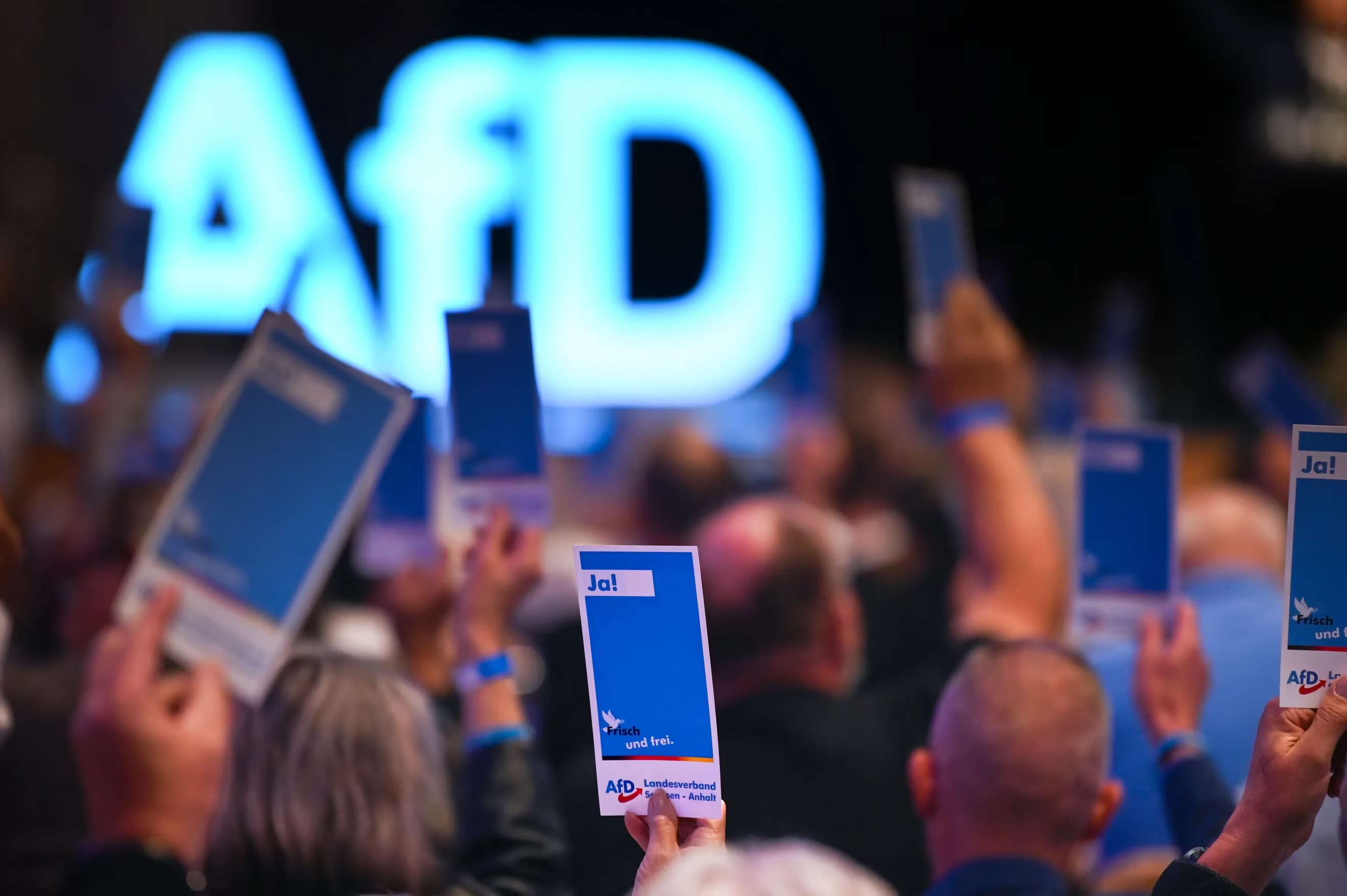
The conservative camp of Chancellor Friedrich Merz has launched a risky campaign aimed at curbing the rise of the far-right Alternative for Germany in the country’s eastern regions, where the party’s support is strongest. The effort is unfolding amid an overloaded electoral calendar—the so-called Superwahljahr, or “super election year,” as it is known in Germany—which includes five state elections and a host of local contests. These votes are widely seen as a key barometer of national sentiment, especially as AfD has pulled ahead of Merz’s governing conservatives in several polls. Two of the state races are being held in eastern Germany, where AfD is comfortably in the lead and hopes, for the first time in nearly 13 years of its existence, to secure a meaningful share of power at the regional level.
AfD’s leadership is placing particular emphasis on the small eastern state of Saxony-Anhalt, viewing the largely rural region as the most direct route to real power—polls there show the party with nearly 40 percent support.
It was here, on Tuesday, that long-serving conservative premier Reiner Haseloff announced his resignation, handing over power to fellow party member Sven Schulze—the conservatives’ lead candidate in elections scheduled for September 6. The state parliament is expected to confirm Schulze as minister-president on Wednesday. The move is intended to boost his name recognition ahead of the vote and represents an all-or-nothing tactical gamble by conservatives seeking to halt AfD’s rapid advance. If AfD secures an outright majority of seats in the Saxony-Anhalt parliament in September—a result that no longer looks out of reach for the party—it would mark the first time since the rise of the Nazis that the far right has amassed such a concentration of power in Germany. Conservative leaders describe the stakes as extraordinary. “Either Sven Schulze becomes premier, or we will have a different country,” Haseloff said in announcing his decision. It remains unclear, however, whether Schulze’s interim premiership will translate into electoral gains for the CDU, which currently sits in second place with about 26 percent. Schulze, 46, previously worked in sales at a mechanical-engineering company and presents himself as a pragmatic politician with hands-on business experience he says is needed to revive the local economy.
“The coming months should not be reduced solely to election campaigns,” Schulze said in a recent interview with the German tabloid Bild, part of the Axel Springer media group and a sister publication of Politico. “This government—under my leadership as state premier—must also deliver concrete results.”
For Merz, clear AfD victories in Saxony-Anhalt and other regions during his chancellorship would amount to a serious political humiliation. Even before his election as head of government—nearly a year ago—the conservative leader built much of his campaign on a promise to halt AfD’s rise. In an effort to win back voters who had defected to the far right, he sharply shifted the Christian Democratic Union to the right on migration. Breakthrough successes by the far right under his watch would be taken as evidence that this strategy is not working.
Electoral victories by AfD would also intensify pressure on conservatives to cooperate with the far right. For now, conservatives and other mainstream parties adhere to the so-called Brandmauer—“firewall”—around AfD, refusing to enter into coalitions with it. As a result, forming stable governments in many eastern states is becoming increasingly difficult—parties with radically different views are forced to band together simply to keep AfD out of power.
In Saxony-Anhalt, AfD has already described the CDU’s decision to hand the post of minister-president to Schulze as a desperate pre-election maneuver. The party’s lead candidate in the state, Ulrich Siegmund, said in a video address on X that the move marked “a new level of lies.” “They are playing with people’s trust in this country,” Siegmund said. “And for what? Because, apparently, they no longer have a single substantive argument against us. Especially here, in Saxony-Anhalt, there is an obvious, enormous, colossal fear that AfD will come to power.”