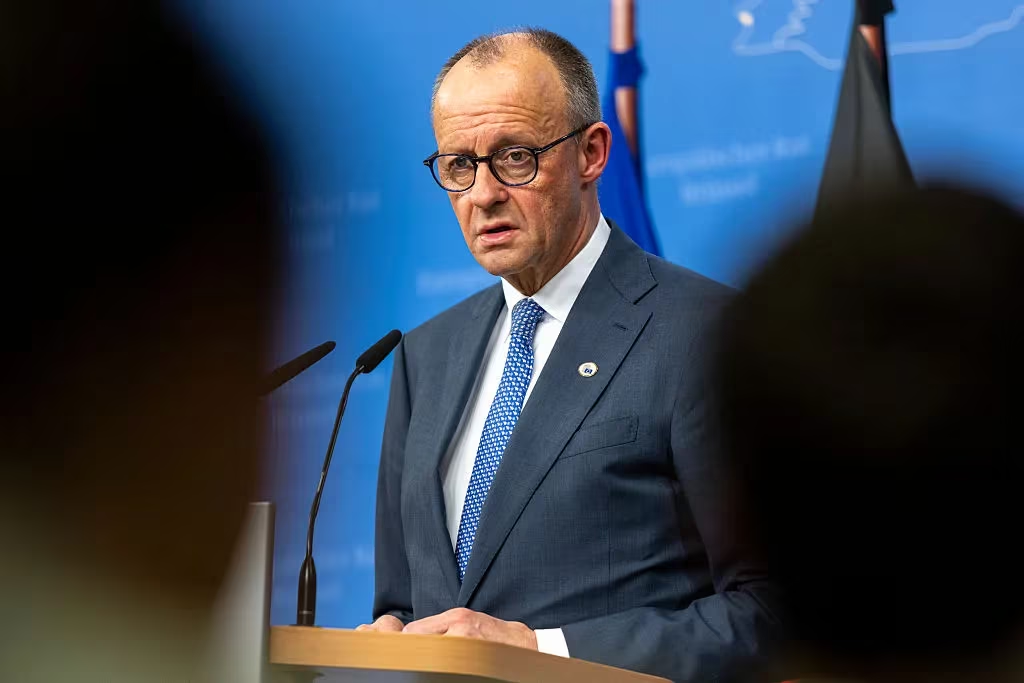
Chancellor Friedrich Merz’s attempt to restart Germany’s economy has encountered a new obstacle after his coalition partners—the Social Democrats—suffered a painful defeat in elections in one of their key regions.
The victory of the Christian Democratic Union in the southwestern state of Rhineland-Palatinate stripped the Social Democrats of power they had held there for 35 years and triggered calls for a renewal of the party’s leadership.
The political turbulence risks weakening Mr Merz’s position as he seeks to negotiate reforms to a stagnating economy, particularly as his coalition has failed to secure durable voter support in its ten months in office. Mr Merz’s CDU bloc and the SPD remain divided on core issues—from the pension system and labour-market policy to fiscal discipline.
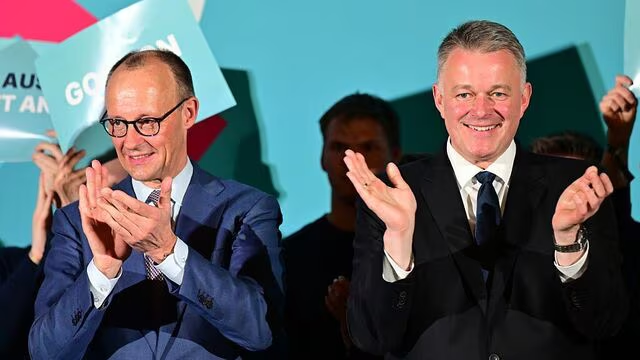
Finance Minister Lars Klingbeil, one of the SPD’s leaders, faced questions on Sunday evening about potential personnel consequences. Within the party, calls are growing to hand the vice chancellorship to Defence Minister Boris Pistorius—one of the country’s most popular politicians. Mr Pistorius himself rejected such a possibility.
“That would be irresponsible, and I am not considering such an option,” he told reporters in Berlin. “Given the global situation and the challenges Germany faces, we have other problems. We must focus on the work of the government.”
Mr Klingbeil signalled that the defeat in Rhineland-Palatinate, where the SPD had led the regional government since 1991, could have consequences at the national level, though he intends to work out next steps together with Mr Merz. He said the priority would be income-tax reform aimed at reducing the burden for part of the tax base.
“We have a number of key issues to clarify,” Mr Klingbeil said on ARD late on Sunday evening, taking responsibility for the setback and adding that the results in the region were “painful”.
According to preliminary data, the CDU secured 31% of the vote in Rhineland-Palatinate, ahead of the SPD with 25.9%.
Since taking office in May last year, Mr Merz’s alliance has operated amid weak economic growth and profound structural shifts in industry, against a backdrop of rising support for the far right.
The Alternative for Germany party, which advocates ending immigration and supports mass deportations, won 19.5% in the election—its strongest result in the western part of the country.
Merz’s victory marked a reversal after a setback two weeks earlier in Baden-Württemberg—a major industrial hub home to Mercedes-Benz AG and Porsche AG, where the CDU had long held a dominant position. In the run-up to the vote, however, the party’s comfortable lead in the polls evaporated, and the Greens ultimately edged ahead by less than one percentage point, extending their control of the region into a 15th consecutive year.
For the Social Democrats, the Baden-Württemberg election was only the latest blow. The party secured 5.5% of the vote—barely clearing the threshold to enter the state parliament—and recorded its worst result in the region since the Second World War.
The outcome in Rhineland-Palatinate merely reinforced this trajectory—SPD losses continue to accumulate across the country. On the same day, in a separate vote, Munich’s Social Democratic mayor, Dieter Reiter, lost to a Green candidate, and the party relinquished control of the Bavarian capital, which it had held almost continuously since 1948.
Three more regional votes this year—above all in the eastern states of Saxony-Anhalt and Mecklenburg—Western Pomerania—will take place against a backdrop of rapidly rising support for Alternative for Germany.
In Saxony-Anhalt, the party could secure an absolute majority, enabling it to lead a regional government for the first time since its founding in 2013.