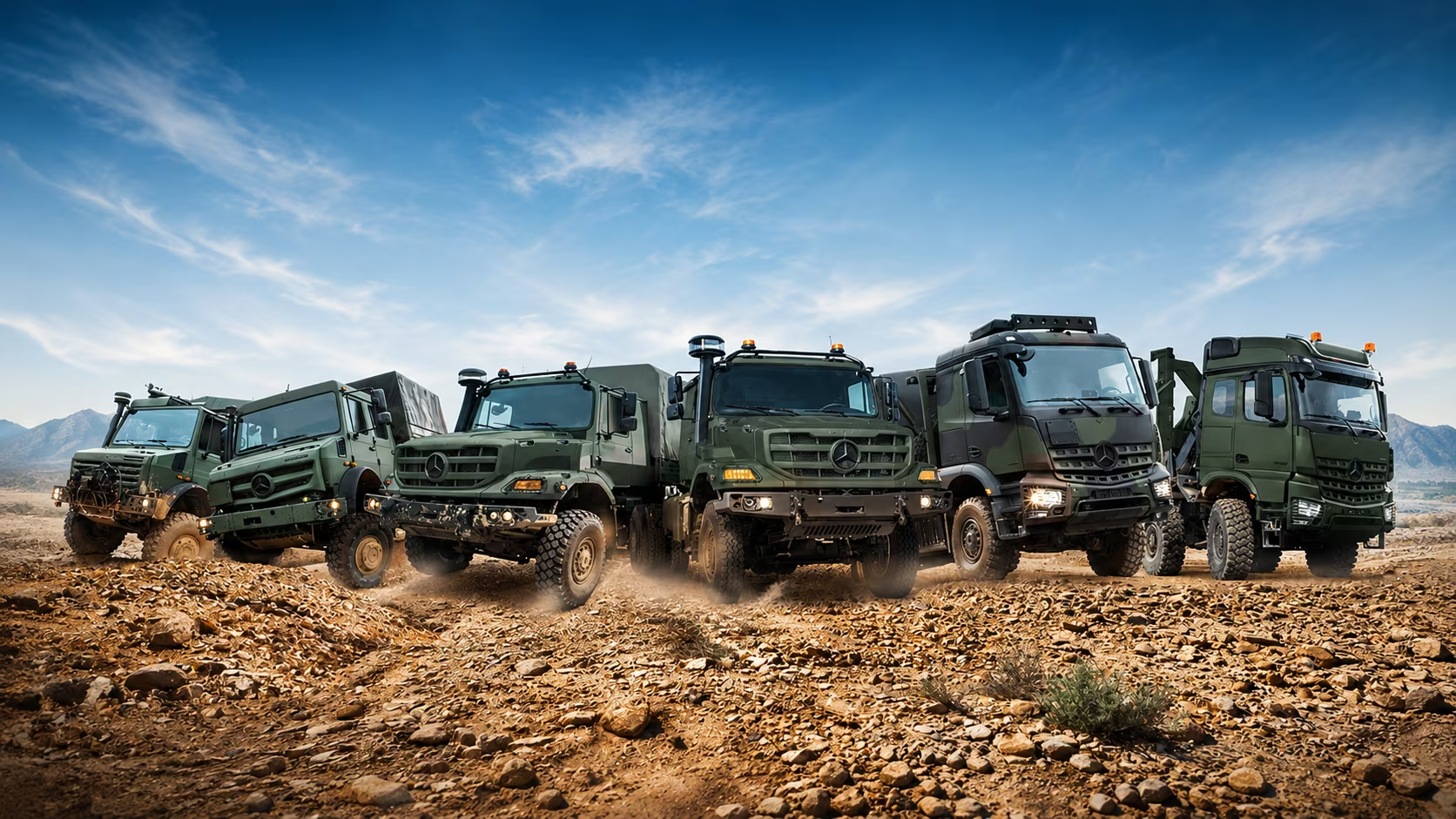
Mercedes-Benz is prepared to consider participation in defense projects if they prove economically viable, CEO Ola Källenius said in an interview with The Wall Street Journal. The remarks fit into a broader shift by Germany’s auto industry toward military contracts—a shift that, in Volkswagen’s case, has already moved from negotiations to signed agreements.
Källenius pointed to the unstable international environment and the need to strengthen Europe’s defense capabilities. “If we can play a positive role in this, we would be willing to do so,” he said. Mercedes is already tied to the defense sector through its truck division, which manufactures military vehicles, and through specialized military versions of the G-Class SUV. The key advantage of automakers, according to Källenius, is their ability to produce “high-precision machines at scale,” although he said the defense segment would likely remain a relatively small—albeit growing—part of the business.
At Volkswagen—the largest automaker in Europe—the shift looks far more concrete. In early May, Volkswagen and Israel’s state-owned Rafael Advanced Defense Systems, the developer of the Iron Dome missile-defense system, signed a memorandum of understanding under which Rafael would take control of Volkswagen’s plant in Osnabrück, Lower Saxony. Bloomberg and the German magazine WirtschaftsWoche reported last week that the parties had entered the final stage of negotiations over a joint venture expected to be formalized before the end of the year. The deal is publicly backed by the German government.
The Osnabrück plant, which employs around 2,300 people, produced the Volkswagen T-Roc Cabriolet as well as the Porsche Cayman and Boxster. Production of the T-Roc was scheduled to end by 2027, after which the facility itself was expected to close—marking the first time in Volkswagen’s history that the company would shut down a factory in Germany. The Rafael deal preserves those jobs while converting production toward Iron Dome components: launchers, generators, and heavy trucks used to transport batteries. The interceptor missiles themselves will not be manufactured in Osnabrück—Rafael plans to establish a separate facility in Germany for that purpose. According to sources cited by Reuters and the Financial Times, the production line could be launched within 12 to 18 months and would require relatively modest investment.
According to WirtschaftsWoche, discussions are already underway about expanding the partnership to include two additional Volkswagen plants in Germany, as well as converting production lines for the future Iron Beam laser-interception system. The total value of the project could eventually reach €6 billion. Iron Dome has already been purchased by Finland, while negotiations are ongoing with Greece and Romania. Germany itself has also expressed interest.
Several structural factors lie behind the deal. 2025 became Volkswagen’s worst year since the diesel-emissions scandal: operating profit plunged 53.5% to €8.9 billion amid mounting pressure from Chinese electric-vehicle manufacturers and stagnating European demand. At the same time, Berlin has steadily supported the reorientation of industrial capacity toward defense production—against the backdrop of Russia’s war against Ukraine, discussions about potential future Russian pressure on NATO’s eastern flank, and continued uncertainty surrounding American security guarantees under Donald Trump’s administration.
Volkswagen is not the only company moving in this direction. Rheinmetall has already announced joint production of cruise missiles with a Dutch partner and cooperation with Deutsche Telekom on anti-drone systems. According to WSJ, the redirection of parts of Germany’s industrial base toward defense contracts is spreading across an increasingly broad range of companies—from heavy transport platforms to electronic components.
The historical backdrop of the Rafael deal is a separate theme highlighted by both German and international media. Volkswagen was founded in 1937 by direct order of Adolf Hitler and relied on forced labor during World War II, including concentration-camp prisoners and civilians deported from occupied territories. The return of a former civilian car plant to military production—this time in the interests of an Israeli state-owned defense company—is being described in commentary as a symbolic reversal, even if the underlying logic is commercial and industrial rather than ideological.
For Mercedes-Benz, as Källenius suggested, defense remains a possibility. For Volkswagen, it is already becoming a way to keep a German factory running at a moment when the country’s automotive industry is losing confidence in its long-term trajectory for the first time in decades.
Volkswagen, founded in 1937 on the initiative of the German Labour Front, did not produce a single civilian vehicle before the war: its factory in Fallersleben—today’s Wolfsburg—was converted to manufacture the Kübelwagen military utility vehicle (around 66,000 units during the war), the Schwimmwagen amphibious vehicle, components for the V-1 flying bomb, and parts for Luftwaffe aircraft. From October 1941 onward, Volkswagen became one of the first German companies to employ Soviet prisoners of war as forced laborers.
Four concentration camps and eight labor camps operated on the factory grounds, and by the end of the war forced laborers made up around 60% of the workforce—on April 11, 1945, American troops liberated approximately 7,700 people at the site. Daimler-Benz, the direct predecessor of today’s Mercedes-Benz, was one of the Reich’s leading arms suppliers: it produced DB 600 and DB 601 aircraft engines for Messerschmitt Bf 109 fighters, military trucks, armored vehicles, barrels for Mauser Kar98k rifles, and components for the V-2 rocket. To expand aircraft-engine production, a specially camouflaged factory was built in Genshagen, south of Berlin, in 1936.
By the end of 1944, nearly half of Daimler-Benz’s more than 63,000 employees were civilian forced laborers, prisoners of war, or concentration-camp inmates. Full acknowledgment of this history came late: only in the mid-1980s did Daimler-Benz commission an independent academic study of its Nazi-era past, and in the late 1990s and early 2000s both companies became contributors to the “Remembrance, Responsibility and Future” foundation, which paid compensation to former forced laborers.